NEWS AND INSIGHTS | INSIGHTS
Fixed Income: Takeaways Amid Turbulence
octubre 27, 2026

We provide a half-dozen observations and ideas for investors to consider in the coming months.
Fixed income has been anything but a quiet asset class this year. Inflation fears tied to the Iran war, aggressive issuance by AI “hyperscalers,” higher long-term interest rates and a hawkish turn by the Federal Reserve have all contributed to volatility and made this a challenging time for investors. How could these forces influence bond markets moving forward? Where are we seeing opportunities emerge? And how should investors go about obtaining effective exposures while mitigating risk? We provide some ideas.
For several years, major central banks worked largely in lockstep, supporting economies and markets with ultralow policy rates during the COVID-19 pandemic, aggressively hiking rates in 2022, and then reducing them as inflation eased. This year, those policies diverged amid varying economic and inflationary pictures. Until September, the U.S. kept interest rates on pause, while the European Central Bank and Bank of Japan tightened. Now, energy-driven headline inflation is pushing the overall group into a tightening bias, but economic variations will continue to be relevant, with the U.S. showing relative strength—a potential factor in the interest rate landscape moving forward.
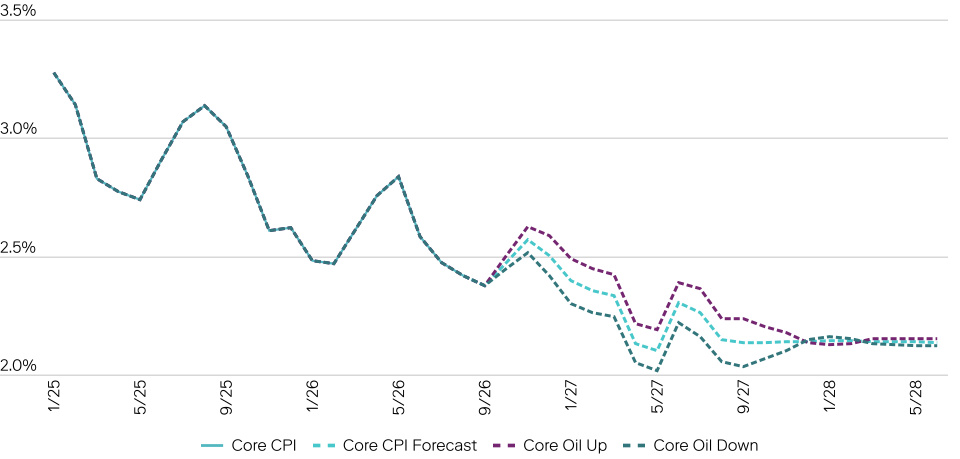
Source: Neuberger internal inflation model, as of September 2026. Base-case Core CPI incorporates oil prices that reference a combination of current spot prices and the forward market curve; the “Oil Up” scenario applies a 25% increase in spot oil prices and the “Oil Down” scenario applies a 25% decrease in spot oil prices, each propagated through a Känzig (2021) crude price-shock model. Scenario magnitudes are illustrative shock inputs calibrated to a stated peak price move, not probability-weighted forecasts.
Markets were initially skeptical of Federal Reserve Chair Kevin Warsh, who despite a hawkish reputation from his writings and past service as a Fed member, was seen as potentially bowing to President Trump’s desire for lower interest rates. Those doubts were put to rest in September with his tough speech on Jackson Hole, followed by the Fed’s unanimous choice to raise the fed funds rate by 25 basis points—its first rate hike in three years. Warsh will be able to tackle broader longer-term reforms through various task forces on its rate process, balance sheet, AI and other matters. But for now, with a stable economy and healthy labor picture, the central bank is able to refocus on the other side of its dual mandate, inflation, which has been above its 2% target for a half decade.
Despite its seeming determination, however, the Fed may not need to do all that much to rein in inflation. In contrast with many peers, we believe that the central bank is likely to raise rates one more time this year, but then return to a pause given slowing housing costs and otherwise moderating price increases. Costly energy is a wild card, but we see little impact on broader inflation, which we believe should ease further once oil starts retreating from recent highs, and then return to the 2% target by 2028. In our view, the potential for fewer rate increases triggers opportunities at the short to intermediate parts of the yield curve, which can be exploited in government bonds or a range of credit instruments. With some exceptions, we remain cautious on longer-term bonds given fiscal strains and an uncertain geopolitical picture.
Hyperscaler and AI-related bond issuance has dominated investment grade issuance for the past year. Early on, we were skeptical given the moderate yields they provided, but with market pressure and widening of their spreads (yield over Treasuries), we are seeing value emerging. These are household names with strong core businesses and ample cash flows that, importantly, in our view, are already achieving a return on capital from the issuance. All in, we believe the balance between risk and potential reward for these companies may be compelling across maturities, including at the long end of the yield curve. On the risk side, we are wary of some more speculative AI-related companies, as well as housing segments that may bear the brunt of an easing construction cycle.
We believe that extending exposure to non-U.S. fixed income can offer meaningful diversification and return potential for investors. For example, Europe tends to offer a broad mix of highly rated global manufacturing companies, and we are seeing opportunities in financial companies there and in the Middle East, across a range of senior to subordinate portions of the capital structure. Europe also tends to be light on AI-related names—an advantage when looking to mitigate exposure to the currently dominant U.S. issuance trend. More broadly, specific characteristics of countries, industries and issuers will naturally differ enough to vary risk exposures relative to a domestic-only portfolio.
We believe that moving beyond more traditional sectors can augment portfolio potential. For example, securitized credit is offering attractive all-in yields and spreads compared to other credits without requiring meaningful extension of duration exposure. Compared with corporate credit, it provides structural protections such as tranching and credit enhancement, and offers diversification away from AI-related concentration risk. Technicals are also favorable: Despite robust 2026 issuance, subdued mortgage origination and strong demand from institutional buyers have kept supply/demand in balance.
High yield bonds are another “non-core” fixed income category that we think is worth considering. Credits spreads remain narrow, but are justified, in our view, given stable economic fundamentals. On average, credit quality is up while shorter maturities versus the overall fixed income market provide more limited duration exposure; all-in yields appear generally compelling. That said, the rapidly changing business environment and geopolitical and trade turbulence contribute to the value of careful security selection.
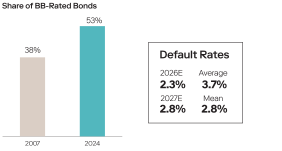
Source: Neuberger, ICE Bank of America, J.P. Morgan. Data as of September 30, 2026. Average and mean are since 1987.
With the Fed’s recent hawkish pivot, it appears that money market rates may move up somewhat over the coming months, reducing the penalty for keeping those dollars on the sidelines. However, unless held for emergencies or specific spending needs, we believe that it still makes sense to deploy excess cash to avoid losing out on opportunity. More broadly, introducing flexible fixed income exposure across geographies, sectors and duration can better capture opportunities wherever they are available, and allow for a nimble approach that can seek to anticipate market shifts to limit risk and augment return opportunity.
Despite recent noise around rising prices, we believe that the bulk of this year’s increase in the 10-year Treasury yield is not due to inflation fears, but rather to other factors that collectively equate to “real” yields. Why would they drive the increases? In part, it’s a reflection of improved economic growth expectations, but it also may be due to an AI-related supply surge and concerns about the U.S. fiscal picture.
Should investors worry about real yields? In our view, they need to reach about 3 – 4% before they start to crimp the economy, with current levels (e.g., 2.65% for the 10-year Treasury real yield)1 providing some wiggle room. Meanwhile, high real yields provide some meaningful potential benefits to income investors, reducing the likelihood of total return losses from here and, more basically, providing a sturdier bullwork to overcome the drag of inflation in maintaining and growing portfolio value.
1 Source: Neuberger, Bloomberg. Data as of September 30, 2026.
This material is provided for informational and educational purposes only and nothing herein constitutes investment, legal, accounting or tax advice. This material is general in nature and is not directed to any category of investors and should not be regarded as individualized, a recommendation, investment advice or a suggestion to engage in or refrain from any investment-related course of action. Investment decisions and the appropriateness of this material should be made based on an investor’s individual objectives and circumstances and in consultation with his or her advisors. Information is obtained from sources deemed reliable, but there is no representation or warranty as to its accuracy, completeness or reliability. All information is current as of the date of this material and is subject to change without notice. Any views or opinions expressed may not reflect those of the firm as a whole. Neuberger products and services may not be available in all jurisdictions or to all client types.
This material may include estimates, outlooks, projections and other “forward-looking statements.” Due to a variety of factors, actual events or market behavior may differ significantly from any views expressed. Investing entails risks, including possible loss of principal. Investments in hedge funds and private equity are speculative and involve a higher degree of risk than more traditional investments. Investments in hedge funds and private equity are intended for sophisticated investors only. Indexes are unmanaged and are not available for direct investment. Past performance is no guarantee of future results.
This material is being issued on a limited basis through various global subsidiaries and affiliates of Neuberger Berman Group LLC. Please visit www.nb.com/disclosure-global-communications for the specific entities and jurisdictional limitations and restrictions.
The “Neuberger” name and logo are service marks of Neuberger Berman Group LLC.