NEWS AND INSIGHTS | INSIGHTS
I Created a SLAT—Now What?
aprile 30, 2026

Even in a new tax regime, we believe the benefits of these trusts remain substantial. DOWNLOAD ARTICLE
Many clients created Spousal Lifetime Access Trusts (SLATs) in advance of the “sunset” of the federal estate and gift tax exemption, which was scheduled at the end of 2025 but was averted by subsequent legislation. If you created one of these trusts but are not clear on the details or what you should do next, we think this is a good time to “get to know” your SLAT.
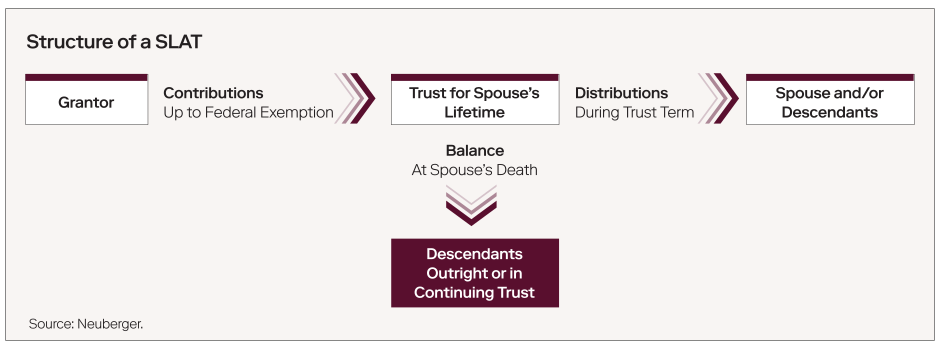
A SLAT is an irrevocable trust designed to hold assets for beneficiaries chosen by the grantor (the creator) of the trust, including the grantor’s spouse. The grantor’s contribution to the SLAT is intended to be a completed gift using the federal gift tax exemption, so that the assets held in the SLAT are removed from the taxable estate of the grantor (and, depending on the terms of the trust, from the taxable estates of the beneficiaries).
Multiple descriptors can apply to the same trust. Often a SLAT is designed to be an intentionally defective grantor trust (IDGT). This means that the trust’s income tax liability flows to the grantor. Although this may sound unpleasant, by paying income tax on assets held in the trust, the grantor is able, in effect, to make additional gifts to the beneficiaries without using up any additional gift tax exemption. The trust assets can potentially grow without being diminished by the payment of income tax.
Many grantors apply their generation-skipping transfer (GST) tax exemptions to SLAT transfers and design the trusts to last as long as allowed by applicable law. A SLAT that is long-term and GST-exempt can also be referred to as a “dynasty trust.” Various other monikers may apply to a SLAT. Some are structured as non-grantor trusts, in which case they are referred to as SLANTs (spousal lifetime access non-grantor trusts).
In 2017, the Tax Cuts and Jobs Act doubled the amount that an individual could transfer free of federal gift or estate tax up to a lifetime total of $10 million per individual, indexed for inflation each year. That provision was set to expire at the end of 2025, and the exemption amount was scheduled to be reduced to $5 million indexed for inflation from the time of the prior legislation.
Many individuals with assets over the exemption amount rushed to transfer assets to their beneficiaries using the large exemption before it was scheduled to disappear, often with transfers to SLATs. However, that doesn’t mean that the value of a SLAT is necessarily diminished. While SLATs gained popularity because of the expiring legislation, they have been used for many years and will likely continue to be employed by those who wish to use their exemptions by making gifts during their lives rather than waiting until death.
While the sunset of the exemption amount was prevented by the One Big Beautiful Bill Act of 2025, which set the exemption amount at $15 million per individual ($30 million for a married couple) indexed for inflation each year, using your exemption sooner rather than later could still be beneficial from an estate planning view.
A benefit of transferring assets to a trust and using the transfer tax exemption during lifetime rather than at death is the removal of potential growth from the grantor’s taxable estate. If the assets remained in the grantor’s estate and grew in value until the time of the grantor’s death, the estate tax bill would ultimately be higher.
The SLAT feature allows the grantor’s spouse to be a beneficiary of the trust so that if the trust assets are needed, distributions can be made to the grantor’s spouse. This concept can give comfort to grantors who may be hesitant to part with such a large amount of assets.
The answer may simply be to invest wisely and potentially watch the assets grow, with all such growth occurring outside of the grantor’s taxable estate.
One thing to avoid, in our view, is to make any distributions of trust principal to the grantor’s spouse. This would be a waste of the grantor’s limited gift exemption, which typically would have been applied in funding the trust; the exemption does not need to be used for spousal transfers because of the unlimited marital deduction (where all gifts to a spouse are nontaxable). The spouse is included as a SLAT beneficiary so that the assets can be accessed if necessary, but we believe they should be drawn upon by the spouse only if assets outside the SLAT have been exhausted and/or estate tax is no longer a concern.
The terms of every SLAT are different. Some SLATs name the spouse as the sole beneficiary during his or her lifetime and name the grantor’s children and grandchildren as beneficiaries after the grantor’s death. Some SLATs name a group of current permissible beneficiaries, including the grantor’s spouse, children and grandchildren, any of whom may receive distributions of income or principal for specific reasons or at the trustee’s discretion. Depending on the distribution provisions of the trust, the SLAT assets may be a resource to the grantor’s children as needed for any reason, or for specific reasons stated in the trust document, such as purchasing a home or starting a business.
Power of substitution: Some SLATs that are grantor trusts may give the grantor the power to replace assets currently in the trust with assets held outside of the trust. Since the grantor and the grantor trust are the same taxpayer, a grantor’s transactions with the trust are not taxed. The grantor can exchange assets—for example, swapping cash for stock—with no tax consequences.
Why would a grantor want to swap assets of an equivalent value? Assets contributed to a trust carry the grantor’s basis. If a grantor funds a SLAT with low-cost-basis stock, the grantor can later swap an equivalent amount of cash (or a note) for the stock. The purpose of this transaction would be to include the low-basis stock in the grantor’s estate so that the basis of the asset would be stepped up to fair market value as of the date of the grantor’s death. This transfer could reduce or eliminate capital gains tax when the assets are sold subsequent to the grantor’s death.
Loans: Depending on the terms of the trust, the trustees of some SLATs may be able to loan funds to the beneficiaries or to the grantor.
Additional contributions: Some SLATs may be designed to receive annual exclusion gifts (up to $19,000 per beneficiary per year1) with the inclusion of certain withdrawal rights that turn the annual exclusion gift into a gift of a present interest in property.
In addition, the gift exemption amount is set to increase with inflation each year. Depending on the terms of the trust, even a grantor who has given his or her entire $15 million exemption may be able to make additional gifts each year of the inflation-adjusted exemption increase.
Finally, a grantor who has used the entire exemption may be able to further reduce the taxable estate at death by selling assets to the trust in exchange for a note. This technique allows the grantor to freeze the value of his or her taxable estate for estate tax purposes: All of the growth on the assets takes place inside the trust rather than inside the grantor’s taxable estate.
Multiple SLATs: Both spouses can create SLATs, but care should be taken to avoid the application of the “reciprocal trust doctrine,” which says that if each spouse creates an identical trust for the other, the IRS can disregard the trusts entirely.
Divorce: Administration of SLATs can become complicated in the event of a divorce. It is important to discuss with your attorneys how a divorce could impact access to SLAT assets, and to address this contingency in the trust document.
SLATs are complex estate planning vehicles. If you have questions about your SLAT or if you are thinking about creating one, you should reach out to your estate planning attorney to help guide your decisions. Your Neuberger Wealth team is available to provide further insights and information about the resources available at our firm.
Source: Neuberger.
This material is provided for informational and educational purposes only and nothing herein constitutes investment, legal, accounting or tax advice, or a recommendation to buy, sell or hold a security. This material is general in nature and is not directed to any category of investors and should not be regarded as individualized, a recommendation, investment advice or a suggestion to engage in or refrain from any investment-related course of action. Neuberger, as well as its employees, does not provide tax or legal advice. You should consult your accountant, tax adviser and/or attorney for advice concerning your particular circumstances. Information is obtained from sources deemed reliable, but there is no representation or warranty as to its accuracy, completeness or reliability. All information is current as of the date of this material and is subject to change without notice. Any views or opinions expressed may not reflect those of the firm as a whole and Neuberger does not endorse any third-party views expressed. This material may include estimates, outlooks, projections and other “forward-looking statements.” Due to a variety of factors, actual events may differ significantly from those presented. Investing entails risks, including possible loss of principal. Past performance is no guarantee of future results.
Tax planning and trust and estate administration services are offered by Neuberger Trust Company. “Neuberger Trust Company” is a trade name used by Neuberger Berman Trust Company N.A. and Neuberger Berman Trust Company of Delaware N.A., which are affiliates of Neuberger Berman Group LLC.
Neuberger Berman Investment Advisers LLC is a registered investment adviser. The “Neuberger” name and logo are registered service marks of Neuberger Berman Group LLC.