NEWS AND INSIGHTS | MARKET COMMENTARY
Sentiment Sours on AI Substitution
3월 04, 2026

February's market broadening came with volatility, as AI disintermediation fears pressured software and services companies in both equity and credit markets—even as Q4 S&P 500 earnings delivered broadly strong results.
While the past several years have been marked by a meaningful concentration in technology and other artificial intelligence-adjacent industries and companies, February brought another month of broadening performance, but not without some hand-wringing. At the highest level, one could argue that improving earnings and momentum for sectors outside of technology should be welcomed by investors, but the rationale behind this month’s sharper moves came at a cost—and that cost was reflected in pressure on companies across sectors that face the threat of disintermediation by AI. What began with the meaningful outperformance of semiconductors versus software for much of 2025 morphed into a question of survival, not only for software companies, but for myriad service businesses that face obsolescence as AI expands its reach. This pressure was not only felt by the companies themselves in the form of stock drawdowns, but was also reflected in the credit markets, both public and private, contributing to an undercurrent of uneasiness and a pickup in volatility during the month.
This pressure came even as Q4 S&P 500 earnings were strong. With 96% of companies reporting, 73% of companies reported both positive revenue and earnings surprises, with earnings growth coming in at +14.2%—the fifth straight quarter of double-digit earnings growth. The strength was widespread as well, with 10 of 11 sectors reporting higher-than-expected earnings, but the broader revenue growth was even more notable at +9.4%—the highest since 2022. Perhaps most encouraging for broad benchmark investors was the continued strength in Magnificent 7 earnings. Despite seemingly ever-higher capex, and expectations for commensurate downward pressure in earnings, the group grew earnings at +27.2% for the fourth quarter, helping to drive the technology sector as a whole up +33.4%. Admittedly, recent concerns around the uncertain path of AI implementation and knock-on effects have pulled estimates lower for Q1, but we believe that the quality of Q4 earnings was underappreciated given the multiple crosscurrents driving investor sentiment during February.
Shifting to the U.S. economy, with the perception of pressure on the U.S. labor market growing, January’s payrolls data was encouraging. Payrolls surprised to the upside at +130k versus a +65k consensus, led by health care (+82k), social assistance (+42k), construction (+33k), and manufacturing (+5k), the latter two notable given widespread weather disruptions—while federal government and financial activities both fell for the month. The unemployment rate ticked down to 4.3% from 4.4% even as labor participation rose to 62.5% average hourly earnings and hours worked continued to trend positively. U.S. January inflation data came in largely in line with expectations, with core CPI rising +0.3% MoM and +2.5% YoY, while headline CPI was slightly softer at +0.2% MoM and +2.4% YoY, supported by moderating food prices, a drop in energy and a decline in used vehicles prices, though services and airfares provided upside pressure. More concerning was a hotter-than-expected PPI print, which showed an increase of +0.5% MoM and +2.9% YoY (vs. +2.6% expected, +3.0% prior). Specifically, final demand services surged +0.8% MoM, marking the largest monthly gain since July 2025. It will be challenging for the Fed over the coming months, balancing the fears of further labor market pressure with the potential for higher inflation from growth and/or geopolitical disruption.
Performance for the month reflected these trends. The S&P 500 returned -0.8% and lagged U.S. small caps, developed ex.-U.S. and emerging markets stocks in the quarter, as technology, consumer discretionary and communications services lagged even further behind the broader benchmark. Financials, too, were weak, in large part due to concerns over increasing defaults, particularly within private credit. Fixed income indexes were higher, save high yield bonds and leveraged loans, and commodities moved up in the month as well, save natural gas futures.
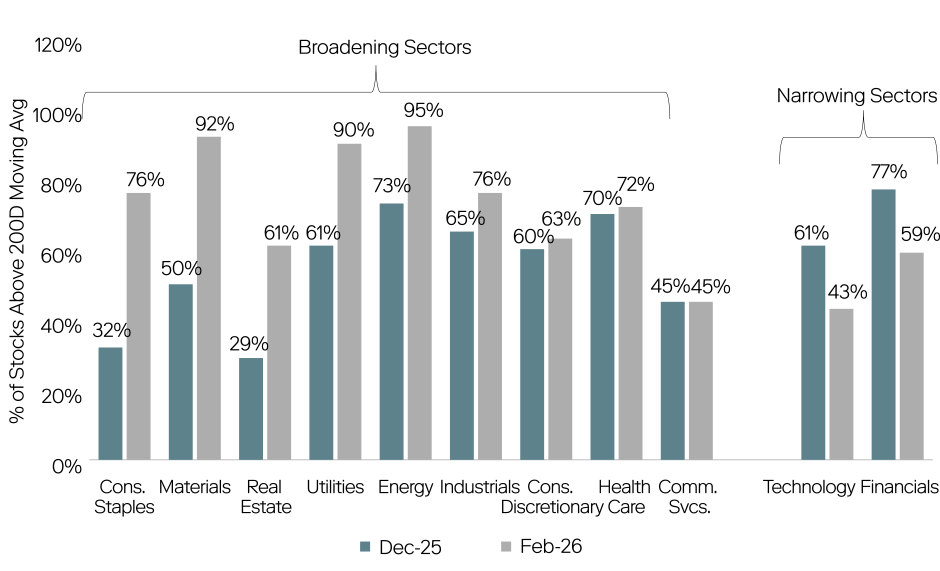
Source: Bloomberg, as of February 26, 2026.
In quieter times, the Supreme Court’s 6-3 decision to overturn the use of International Emergency Economic Powers Act of 1977 for tariffs would likely have been the most impactful market event of the month, particularly when considering the downdraft in the market following April 2025’s announcement of reciprocal tariffs. Instead, the decision and subsequent announcement of anywhere between 10% and 15% tariffs on U.S. trading partners via Section 122 of the Trade Act of 1974 proved to be just another drop in the bucket of 2026 concerns. Our view, however, is more nuanced, and one that bears worth laying out. First, we note that tariff revenue was indeed higher in 2025 than in 2024, and that those additional revenues have helped offset increased spending (or lowered revenues from tax collection, whichever way one wants to consider it) resulting from the One Big Beautiful Bill Act. The potential for tariff revenue to act as a long-term, meaningful offset to spending quieted some critics of the long-term costs of the OBBBA. Second, while the broad-brush initial approach taken by the Trump administration created meaningful disruption and confusion, the push to execute trade deals as well as a meaningful number of granted exemptions had already served to bring the tariffs down from the worst-case scenario predictions that were bandied about in April 2025. Should these trade deals fail to go into effect, that could result in higher tariffs on certain industries and companies. Finally, there is the question of already collected tariff revenue. The refund of these revenues may be a boost to certain companies, but the process might prove complex, complicating the Treasury’s budgeting efforts.
As such, there is potential for upward pressure on Treasury yields as a result of the ruling. Had the ruling occurred last year, there likely would have been such pressure, and yet we have seen little evidence that investors are shedding Treasuries in the face of these lower revenues. One could argue that there is an expectation that a large majority of the tariffs can be replicated through other means, but we would counter that there has been a shift in the demand environment for Treasuries to start the year. U.S. credit markets, which traded at or near historical tight spreads through much of 2025, have now come under modest pressure as a result of shifting AI concerns. While there were notable pockets of weakness stemming from rising debt burdens and the prospect of oversupply, the potential for massive disruption of both software and broader services business leading to an accelerated pace of obsolescence has prompted skepticism in both the public and private credit markets. As such, the pull of high-quality sovereign debt, including U.S. and non-U.S. debt, has keep yields from moving higher (save Japan) to start 2026. Admittedly, the increase in yields in high yield bonds and leveraged loans has been modest, but it is a trend that could persist as both equity and bond investors attempt to parse the near- to mid-term risks to existing loans.
This idea of obsolescence due to AI substitution may also be dampening some investors’ growth expectations. Notable layoff announcements, while at this juncture more of an outlier than the norm, have spurred questions about Federal Reserve action in light of the further threat to its mandate of maximum employment, and the potential for broad disinflationary pressure on the back of AI implementation. Finally, with U.S. military action in Venezuela and further escalation in the Middle East, the formerly solid foundation for risk assets is showing some cracks, and with yield curves broadly steeper, investment grade bonds appear poised to take center stage once again in their role as diversifier—particularly if inflation worries prove overblown.
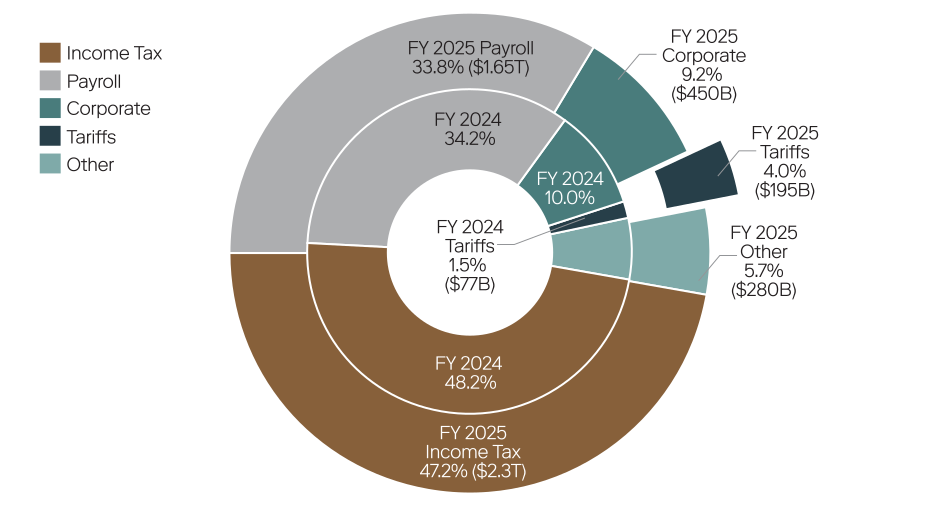
Source: US Treasury, Monthly Treasury Statement.
Equities. In our view, prospects for global equities remain broadly positive despite increased volatility and dispersion to begin 2026. We continue to favor U.S. small and midcaps, and, in fact, have become more optimistic as rate cuts, deregulation and pro-business policies more than offset short-term fluctuations in business confidence, and we are pleased by the strength in quality small-cap stocks this quarter. We see emerging markets—led by India and Brazil—as an overweight but have reduced non-U.S. developed markets to an “at target” view. While yen volatility and a recent move higher in valuations may translate into short-term pressure on Japanese equities, structural underweights in developed ex.-U.S. portfolios combined with a mid- to long-term constructive view on these companies merit a continued focus. Recent volatility has called into question the risk of both AI oversupply and obsolescence, but with the ripple effects of software weakness extending to non-technology businesses, disruption is creating opportunities even within at-target U.S. large-cap stocks.
Fixed Income. A strong 2025 and a slowing rate-cutting cycle largely underpin our downgrade of U.S. government securities, investment grade corporate credit and high yield, while municipal bonds remain at target. In contrast, we hold an overweight view of non-U.S. developed market bonds, reflecting more attractive valuations after recent volatility, as well as emerging market sovereign bonds, given their appealing yields and economic fundamentals. Multi-sector bond funds may be an appropriate vehicle to consider, given the levers a manager can opportunistically pull across sector, duration profile and region; municipals also remain attractive when compared with the broader universe of U.S. investment grade issues. We believe this is particularly important in this environment, as spreads widen and opportunities are created to invest in still fundamentally strong credits.
Private Markets. While we maintain our positioning across real and alternative assets, including overweights to commodities, private equity and private real estate, we have upgraded our view on absolute return strategies to at-target from underweight, reflecting more dynamic market conditions. Private debt remains “at target,” although rising credit risk requires vigilance and particular focus around structure and diversification within the underlying loan pools. Within private equity, liquidity and capital solutions providers will likely remain important to work through the substantial backlog of legacy investments, even as the pace of distributions accelerates against the backdrop of a revitalized M&A environment.
| Feb-26 | 3M | YTD | 2025 | |
|---|---|---|---|---|
| Equities | ||||
| Major U.S. Indices | ||||
| S&P 500 Index | -0.76% | 0.74% | 0.68% | 17.88% |
| Nasdaq Composite | -3.33% | -2.85% | -2.39% | 21.14% |
| Dow Jones | 0.31% | 3.06% | 2.12% | 14.92% |
| U.S. Size Indices | ||||
| Large Cap | -0.54% | 0.84% | 0.83% | 17.37% |
| Mid Cap | 3.82% | 6.70% | 6.99% | 10.60% |
| Small Cap | 0.80% | 5.58% | 6.20% | 12.81% |
| All Cap | -0.48% | 1.05% | 1.07% | 17.15% |
| U.S. Style Indices | ||||
| All Cap Growth | -3.34% | -5.12% | -4.57% | 18.15% |
| All Cap Value | 2.56% | 8.05% | 7.35% | 15.71% |
| Global Equity Indices | ||||
| ACWI | 1.29% | 5.38% | 4.29% | 22.34% |
| ACWI ex US | 5.02% | 14.64% | 11.30% | 32.39% |
| DM Non-U.S. Equities | 4.64% | 13.42% | 10.11% | 31.89% |
| EM Equities | 5.51% | 18.34% | 14.86% | 34.36% |
| Portfolios | ||||
| 50/50 Portfolio | 0.24% | 1.51% | 1.44% | 11.06% |
| Feb-26 | 3M | YTD | 2025 | |
|---|---|---|---|---|
| Fixed Income Currencies & Commodities | ||||
| Major U.S. Indices | ||||
| Cash | 0.27% | 0.91% | 0.56% | 4.18% |
| U.S. Aggregate | 1.64% | 1.60% | 1.75% | 7.30% |
| Munis | 1.25% | 2.29% | 2.20% | 4.25% |
| U.S. Corporates | ||||
| Investment Grade | 1.29% | 1.27% | 1.47% | 7.77% |
| High Yield | 0.28% | 1.39% | 0.79% | 8.78% |
| Short Duration (1.9 Yrs) | 0.52% | 1.12% | 0.75% | 5.39% |
| Long Duration (12.8 Yrs) | 3.21% | 1.58% | 2.98% | 6.65% |
| Global Fixed Income Indices | ||||
| Global Aggregate | 1.12% | 2.33% | 2.06% | 8.17% |
| EMD Corporates | 0.91% | 2.18% | 1.69% | 8.74% |
| Commodities | ||||
| Commodities | 1.10% | 11.22% | 11.58% | 15.77% |
| U.S. Treasury Yields | ||||
| U.S. 10-Year Yield | -0.30% | -0.08% | -0.23% | -0.40% |
| U.S. 2-Year Yield | -0.15% | -0.11% | -0.10% | -0.77% |
| FX | ||||
| U.S. Dollar | 0.64% | -1.86% | -0.73% | -9.37% |
Source: Bloomberg, Total returns as of February 27th, 2026. S&P 500 Index is represented by S&P 500 Total Return Index. Nasdaq Composite NASDAQ-Composite Total Return Index. Dow Jones is represented by Dow Jones Industrial Average TR. Large Cap is represented by Russell 1000 Total Return Index. Mid Cap is represented by Russell Midcap Index Total Return. Small Cap is represented by Russell 2000 Total Return Index. All Cap is represented by Russell 3000 Total Return Index. Large Cap Growth is represented by Russell 1000 Growth Total Return. Large Cap Value is represented by Russell 1000 Value Index Total Return. Small Cap Growth is represented by Russell 2000 Growth Total Return. Small Cap Value is represented by Russell 2000 Value Total Return. ACWI is represented by MSCI ACWI Net Total Return USD Index. ACWI ex US is represented by MSCI ACWI ex USA Net Total Return USD Index. DM Non-U.S. Equities is represented by MSCI Daily TR Gross EAFE USD. EM Equities is represented by MSCI Daily TR Gross EM USD. Cash is represented by ICE BofA US 3-Month Treasury Bill Index. U.S. Aggregate is represented by Bloomberg US Agg Total Return Value Unhedged USD. Munis is represented by Bloomberg Municipal Bond Index Total Return Index Value Unhedged USD. Munis Short Duration is represented by Bloomberg Municipal Bond: Muni Short (1-5) Total Return Unhedged USD. Munis Intermediate Duration is represented by Bloomberg Municipal Bond: Muni Intermediate (5-10) TR Unhedged USD. Investment Grade is represented by Bloomberg US Corporate Total Return Value Unhedged USD. High Yield is represented by Bloomberg US High Yield BB/B 2% Issuer Cap Total Return Index Value Unhedged USD. Short Duration is represented by Bloomberg US Agg 1-3 Year Total Return Value Unhedged USD. Long Duration is represented by Bloomberg US Agg 10+ Year Total Return Value Unhedged USD. Global Aggregate is represented by Bloomberg Global-Aggregate Total Return Index Value Unhedged USD. EMD Corporates is represented by J.P. Morgan Corporate EMBI Diversified Composite Index Level. EMD Sovereigns – USD is represented by J.P. Morgan EMBI Global Diversified Composite. Commodities is represented by Bloomberg Commodity Index Total Return. Commodities ex Energy is represented by Bloomberg Ex-Energy Subindex Total Return. U.S. 10-Year Yield is represented by US Generic Govt 10 Yr.
1The Magnificent 7 companies are Nvidia, Apple, Microsoft, Amazon, Alphabet, Broadcom and Meta, as of November 30, 2025.
IMPORTANT INFORMATION:
This material is provided for informational and educational purposes only and nothing herein constitutes investment, legal, accounting or tax advice, or a recommendation to buy, sell or hold a security. This material is general in nature and is not directed to any category of investors and should not be regarded as individualized, a recommendation, investment advice or a suggestion to engage in or refrain from any investment-related course of action. Neither Neuberger Berman nor its employees provide tax or legal advice. All information is current as of the date of this material and is subject to change without notice. The firm, its employees and advisory accounts may hold positions of any companies discussed. Any views or opinions expressed may not reflect those of the firm as a whole. Neuberger Berman products and services may not be available in all jurisdictions or to all client types. Diversification does not guarantee profit or protect against loss in declining markets. Investments in private equity are speculative and involve a higher degree of risk than more traditional investments. Investments in private equity are intended for sophisticated investors only. Unless otherwise indicated, returns shown reflect reinvestment of dividends and distributions. Indexes are unmanaged and are not available for direct investment. Investing entails risks, including possible loss of principal. Past performance is no guarantee of future results.
Portfolio positioning views expressed herein are those of Neuberger Berman’s Private Wealth Investment Group which may include those of the Neuberger Berman’s Asset Allocation Committee. Asset allocation and positioning views are based on a hypothetical reference portfolio. The Private Wealth Investment Group analyzes market and economic indicators to develop asset allocation strategies. The Private Wealth Investment Group works in partnership with the Office of the CIO. The Private Wealth Investment Group also consults regularly with portfolio managers and investment officers across the firm. The Asset Allocation Committee is comprised of professionals across multiple disciplines, including equity and fixed income strategists and portfolio managers. The Asset Allocation Committee reviews and sets long-term asset allocation models, establishes preferred near-term tactical asset class allocations and, upon request, reviews asset allocations for large, diversified mandates. Asset Allocation Committee members are polled on asset classes and the positional views are representative of an Asset Allocation Committee consensus. The views of the Asset Allocation Committee and the Private Wealth Investment Group may not reflect the views of the firm as a whole and Neuberger Berman advisers and portfolio managers may take contrary positions to the views of the Asset Allocation Committee or the Private Wealth Investment Group. The Asset Allocation Committee and the Private Wealth Investment Group views do not constitute a prediction or projection of future events or future market behavior. Defensive positioning generally means an underweight bias on allocations to risk assets such as equities and alternatives. Positioning views may change over time without notice and actual client positioning may vary significantly. Discussion of yield characteristics or total returns of different asset classes are for illustrative purposes only. Such asset classes, such as equities and fixed income, may have significantly different overall risk-return characteristics which should be consider before investing.
The information in this material may contain projections, market outlooks or other forward-looking statements regarding future events, including economic, asset class and market outlooks or expectations, and is only current as of the date indicated. There is no assurance that such events, outlook and expectations will be achieved, and actual results may be significantly different than that shown here. The duration and characteristics of past market/economic cycles and market behavior, including any bull/bear markets, is no indication of the duration and characteristics of any current or future be market/economic cycles or behavior. Information on historical observations about asset or sub-asset classes is not intended to represent or predict future events. Historical trends do not imply, forecast or guarantee future results. Information is based on current views and market conditions, which will fluctuate and may be superseded by subsequent market events or for other reasons.
Discussions of any specific sectors and companies are for informational purposes only. This material is not intended as a formal research report and should not be relied upon as a basis for making an investment decision. The firm, its employees and advisory accounts may hold positions of any companies discussed. Nothing herein constitutes a recommendation to buy, sell or hold a security. It should not be assumed that any investments in securities, companies, sectors or markets identified and described were or will be profitable. Investment decisions and the appropriateness of this content should be made based on an investor's individual objectives and circumstances and in consultation with his or her advisors.
Neuberger Berman Investment Advisers LLC is a registered investment adviser.
The “Neuberger Berman” name and logo are registered service marks of Neuberger Berman Group LLC.
© 2026 Neuberger Berman Group LLC. All rights reserved.