NEWS AND INSIGHTS | INSIGHTS
Women and Philanthropy: Asserting Leadership in a New Era
四月 30, 2026

Women will soon oversee trillions of dollars in philanthropic capital, through divorce, inheritance and their own investments. We consider ways to maximize that impact. DOWNLOAD ARTICLE
As the so-called Great Wealth Transfer moves trillions into new hands, women’s longer life expectancy, growing financial decision-making power and dual inheritances as spouses and daughters position them to direct a significant share of philanthropic capital.
In this article, we explore five key trends shaping the charitable landscape, and lay out opportunities for women to lead with clarity and confidence.
Many researchers have cited the current “Great Wealth Transfer” from Baby Boomers to successive generations.1 But what’s not often noted is that women, given their (on average) five years of additional life expectancy,2 will often have more time to spend their inherited dollars than men.
What’s more, women stand to inherit twice in that wealth transfer over the next decade—both from their parents and spouses. This transfer will occur in addition to the money women may have earned and invested themselves.
The receipt of assets in divorce settlements could also represent a transfer of wealth that empowers women’s independent philanthropy. MacKenzie Scott and Melinda French Gates (divorced from Jeff Bezos and Bill Gates, respectively) provide two high-profile examples.
As a result, by 2030, American women are expected to control a substantial portion of the financial assets held by Baby Boomers—with $18 trillion of that passing to charities, by one estimate.3
It stands to reason, then, that women will have an increasing role in the oversight and disposition of the assets that pass for the benefit of charity, as they inherit this responsibility for private foundations, donor-advised funds and other charitable vehicles.
For many wealthy families, philanthropy often emerges as the first arena in which women begin to exert authority. Doing so requires an expanded awareness of the family’s larger goals, as well as a strategy to optimize impact with the assets earmarked for charity.
Opportunity: Women can empower themselves as part of this transition by drawing on their core values to clarify their philanthropic philosophy, identifying common areas of interest among family members to guide their charitable planning, and understanding the investment strategy in place for the family’s charitable assets and checking for alignment with their purpose.
Compared to men, women more often express their philanthropic spirit in various ways beyond traditional check-writing. Common examples include:
Volunteering
Historically, more women have volunteered than men in the U.S. While American men tend to volunteer through risky acts of rescuing and protective behaviors, such as safeguarding and firefighting, women favor activities that encourage “group-orientation, group facilitation and reciprocal relationships,” and tend to remain in volunteer positions for longer if they feel a sense of intimacy and belonging within the organization.4
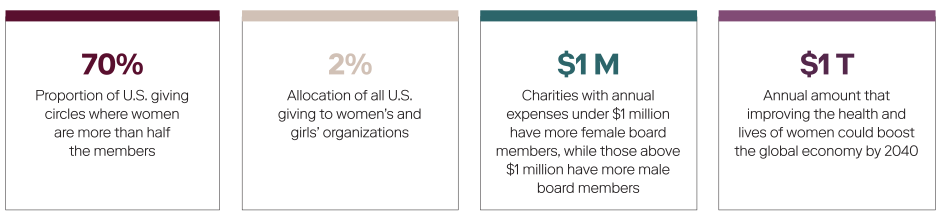
Volunteering spans a wide range of activities, from informal, ad hoc assistance, to formal nonprofit board service. While women represent the majority of board members for charities with up to $1 million in expenses, the opposite is true for organizations with more than $1 million in annual expenses, of which the majority of board members are men.
Opportunity: Women have a chance to make a significant impact by joining nonprofit boards, contributing their strategic thinking and fiduciary leadership as well as their dollars.
Values-Aligned Investing
Investing in companies with positive sustainability, as well as “impact investing” beyond just a financial return often accompanies philanthropy as a means of deploying capital toward positive change. Women exhibit a greater inclination5 toward sustainable or impact investing than men. However, they express lower levels of familiarity with these areas, with only 23% indicating they are at all familiar, compared to 33% of men surveyed.6
Opportunity: While the degree of actual knowledge varies among individuals, women can empower themselves by learning more about investing to align with their values, in the context of an overall asset allocation.
Civic Participation
Interest in civic engagement also arises more for women as a means of effecting positive change. One study found that women are more likely than men to leverage in-person networks by participating in a public event, discussing political views, volunteering for a candidate, and/or talking to a child or teen about civic engagement.7 In addition, as of 2020, “in every U.S. presidential election dating back to 1984, women reported having turned out to vote at slightly higher rates than men.”8
Opportunity: As voters, women can encourage positive change beyond just donating money by casting their ballots in elections at all levels, and serving as a family role model in demonstrating the importance of voting.
Supporting common causes alongside other donors aggregates valuable intelligence and action in addition to dollars. Giving circles have emerged as a way for donors to align their philanthropy by pooling their research and capital in distributing grants in a specific area.9 In the U.S., 70% of giving circles report that women make up more than half of their members.10
Opportunity: Women can explore the potential of bonding and giving with others through resources hosted by Charity Navigator.11
Compared to traditional donations limited to specific projects and detailed prerequisites, trust-based philanthropy has emerged as an approach rooted in open and transparent relationships between funders and grantees.
Under this approach, unrestricted general operating support allows leaders to respond quickly to changing circumstances and community needs, especially in times of crisis.
Women show a greater inclination to donate based on trust and transparency than men.12 MacKenzie Scott has exemplified this approach by giving more than $19 billion in unrestricted support to more than 2,000 organizations, with research confirming that Scott’s donations have transformed and strengthened the recipients.13
Opportunity: Women can experiment with trust-based philanthropy by identifying their most gratifying giving experiences, meeting with the receiving charity’s leadership, understanding the charity’s overall challenges, and considering unrestricted donations to further advance its work.
Research indicates that women globally spend longer in poor health than men. But it also suggests that the return in investment in their well-being could have a multiplier effect on their families and communities. Specifically, improving the health and lives of millions of women could boost the global economy by at least $1 trillion annually by 2040.14
Despite the outsized benefit of supporting the health and well-being of women and girls, who represent at least half the population, the allocation of all giving in the U.S. to women’s and girls’ organizations hovers at roughly 2%.15
Opportunity: Women can address this relative underinvestment by exploring organizations specifically focused on supporting the health, education and well-being of women and girls.
As women face an unprecedented wave of opportunity for charitable capital, they can maximize their impact both financially and personally within their families and communities by strategically partnering with nonprofit organizations and allying with others. In doing so, we believe they can take part in a pivotal era of philanthropic leadership.
Your Wealth team can provide an array of materials to help guide your philanthropic journey. Here is a sampling of resources from Neuberger and elsewhere to get started.
Elevate Your Well-Being Through Philanthropy (Neuberger)
The act of giving has been linked with increased happiness and long-term health—consider ways to build it into your family life.
Constructing Your Philanthropic Portfolio (Neuberger)
A framework for deploying capital to nonprofits can help maximize your impact.
In Family Philanthropy, Embracing Differences Can Pay Off (Kiplinger)
Different approaches to charitable giving among generations and individuals can enhance family giving.
Grapevine.org is an online platform dedicated to “giving circles,” a charitable model where people come together, pool their donations and amplify their impact.
1E.g., Girvin, Rohan, “The Great Wealth Transfer and its Implications for the American Economy,” Michigan Journal of Economics, April 3, 2025.
2Source: Shmerling, Robert, “Why men often die earlier than women,” Harvard Health Publishing, June 22, 2020.
3Source: “Cerulli Anticipates $124 Trillion in Wealth Will Transfer Through 2048,” Cerulli Associates, December 5, 2024.
4Source: “Women and Philanthropy: A Literature Review,” Women’s Philanthropy Institute, September 2025.
5Source: “Does gender affect the investment strategy of private equity firms? Evidence from impact investing,” Michael J. Brennan, Irish Finance Working Paper Series, Research Paper No. 24-3, September 6, 2025.
6Source: Mottola, Gary, et. al, “Investors say they can change the world, if they only knew how: Six things to know about ESG and retail investor,” FINRA Education Foundation, NORC at the University of Chicago, March 2022.
7Source: Infographic: Gender Differences in Civic Engagement, Wellesley Centers for Women, 2020.
8Source: Igielnik, Ruth, “Men and women in the U.S. continue to differ in voter turnout rate, party identification,” Pew Research Center, August 18, 2020.
9Source: “In Abundance: An Analysis of the Thriving Landscape of Collective Giving in the U.S.,” Philanthropy Together, 2023.
10Source: “Women and Philanthropy: A Literature Review,” Women’s Philanthropy Institute, September 2025.
11Visit www.charitynavigator.org for further information.
12Source: “Women and Philanthropy: A Literature Review,” Women’s Philanthropy Institute, September 2025.
13Source: Smith Arrillaga, Elisha, et. al., “Breaking the Mold: The Transformative Effect of MacKenzie Scott’s Big Gifts,” The Center for Effective Philanthropy, February 2025.
14Source: Ellingrud, Kweilin, “Closing the women’s health gap: A $1 trillion opportunity to improve lives and economies,” McKinsey Health Institute, January 17, 2024.
15Source: Ackerman, Jacqueline, Bergdoll, Jon, “The Women & Girls Index 2025: Measuring and Giving to Women’s and Girls’ Organizations,” Women’s Philanthropy Institute, October 2025.
This material is provided for informational and educational purposes only and nothing herein constitutes investment, legal, accounting or tax advice, or a recommendation to buy, sell or hold a security. This material is general in nature and is not directed to any category of investors and should not be regarded as individualized, a recommendation, investment advice or a suggestion to engage in or refrain from any investment-related course of action Neuberger, as well as its employees, does not provide tax or legal advice. You should consult your accountant, tax adviser and/or attorney for advice concerning your particular circumstances. Information is obtained from sources deemed reliable, but there is no representation or warranty as to its accuracy, completeness or reliability. All information is current as of the date of this material and is subject to change without notice. Any views or opinions expressed may not reflect those of the firm as a whole and Neuberger does not endorse any third-party views expressed. This material may include estimates, outlooks, projections and other “forward-looking statements.” Due to a variety of factors, actual events may differ significantly from those presented. Investing entails risks, including possible loss of principal. Past performance is no guarantee of future results.
Tax planning and trust and estate administration services are offered by Neuberger Berman Trust Company. “Neuberger Berman Trust Company” is a trade name used by Neuberger Berman Trust Company N.A. and Neuberger Berman Trust Company of Delaware N.A., which are affiliates of Neuberger Berman Group LLC.
Philanthropic & Family Governance Advisory Services and related materials are provided as a courtesy and are for informational and discussion purposes only. Neuberger is not acting in a fiduciary capacity or recommending any specific governance structures or philanthropic or charitable activities. Recipients of Philanthropic & Family Governance Advisory Services should consult their own tax or legal advisors before implementing any governance structure or philanthropic or charitable activities.
Neuberger Berman Investment Advisers LLC is a registered investment adviser. The “Neuberger” name and logo are registered service marks of Neuberger Berman Group LLC.