NEWS AND INSIGHTS | INSIGHTS
Trump 2.0: Middle Innings of an Uncertain Game
一月 29, 2026
Is the president winning his battle to transform U.S. government, business and foreign policy? It depends where you look.
Just over a year into his second term, Donald Trump is dominating the political and policy landscape with actions on immigration, foreign policy, taxes, deregulation and tariffs. Opponents appear galvanized, as reflected in the November election results, but core supporters remain loyal to their man. What could be in store next from a policy perspective? We asked political analyst Frank Kelly for insights on the current environment.
What are your thoughts on the November 2025 state and local elections? Are they a bad sign for Republicans in next year’s midterms?
It’s too early to tell. New York is unique, and it'll be interesting to see how the new mayor, Zohran Mamdani, does. I know there's a lot of concern in some quarters, but mayors there have limited authority; much is decided at the state level.
As for the New Jersey and Virginia governors’ races, the Democrats won in both cases, but they had the wind at their backs. New Jersey is a Democratic state; the last Republican governor there was Chris Christie. Glenn Youngkin, the outgoing governor of Virginia, has a great reputation, but barely won four years ago because the state is becoming “bluer” every day with the growth of the technology sector in the north. The government shutdown may have had an impact this time, but the focus was more on pocketbook issues of energy costs, food and tariffs. Democrats Mikie Sherrill in New Jersey and Abigail Spanberger in Virginia both ran against Trump, which also appears to have been effective.
Will there be a wave of Democratic victories this year? Let’s see how the economy is doing by mid-2026. If we are rip-roaring, it's going to be hard to see a blue wave. Stagnation or other major problems could move voters to seek a change.
Moving onto monetary policy, the Federal Reserve is in focus these days with Jerome Powell stepping down as chair this year. Beyond that appointment and others, how much influence can the president have on Fed policy?
In the past, presidential influence in this area was generally limited to jawboning, and several presidents, including Richard Nixon, used that tactic. But President Trump has been more aggressive in criticizing Powell and pressuring board members, most notably with the case against Fed board Governor Lisa Cook.
Could the president fire Powell? I think the Supreme Court would not allow that, and it’s why he hasn’t done it. Could we wind up with somebody who is a “how low do you want rates to go” guy? Nominee designate Kevin Warsh may be more friendly to Trump’s point of view, but I don’t think that kind of utter fealty is going to happen.1 Anyone who is appointed to the board will know that they are protected and likely to exert independence.
Shifting to industrial policy, the CHIPS Act and related initiatives have been helping drive investment in artificial intelligence. How do you see that playing out?
The CHIPS Act was a bipartisan effort to use federal dollars to attract semiconductor manufacturing back to the heartland, boosting economic development and employment. But it’s gone way beyond initial parameters, with the U.S. government now taking ownership stakes in companies, to both gain the upper hand in the global tech race and safeguard our national security. A key issue remains critical minerals, which are largely controlled by China and inform many of our strategic moves overseas. The race is on, and I think it is going to accelerate.
What does the AI boom mean for U.S. energy production?
The growth of AI will tax our natural resources, and people are already upset about energy prices. What, in my view, is the government going to do about it? It will likely seek to develop as much as possible, whether oil, natural gas, renewables or nuclear. The Defense department may be a key player in all this, along with Energy and Interior, because we need to make sure that our industrial base is prepared for conflict. So, national security becomes economic security.
Tariffs have been a pillar of the Trump 2.0 presidency. What happens if the Supreme Court overturns them?
The oral arguments back in November did not seem to go well for the president. Although it’s hard to draw conclusions, a majority appeared skeptical of his authority under the International Emergency Economic Protection Act to launch the Liberation Day tariffs, as the administration claims. We shall see.
A key question is how that would affect the tariffs that have already been collected—close to $200 billion at this point. Unless forced by a court, I don’t think the government would provide refunds to companies; rather, they would likely receive credits for those payments. The president would also look to other rationales for the tariffs, of which there are many. It would be a patchwork, but I don’t think the tariffs would go away completely; they would likely come back in different forms.
How about immigration? Could we see policy changes there?
We have a shortage of highly skilled labor in the United States, particularly in tech. I’ll give you an example. One Taiwanese company I know is building six semiconductor facilities in Arizona, but couldn’t get 50% of the people needed for the first plant, let alone the other five. The company had to get a special waiver to bring in semiconductor engineers from Taiwan. We need H-1B visas, but there is resistance. And Trump’s policy of having companies pay for the visas is backfiring, as Europeans take in workers for nothing. As for immigration in general, you are hearing from companies in agriculture and other sectors that, “You’ve got to stop deporting everybody; we can’t find people to do this work.” There’s going to be a big debate over the next few years; we have to figure this out.
How about the talk of a U.S. sovereign wealth fund? Is that real and how might it be structured?
A small group is working on this at the White House, but it would take an act of Congress to move forward. The thought is that the Secretary of Treasury would run the fund, with other cabinet members serving on the board. The assets would come from multiple sources: The Treasury is sitting on $400 billion seized from criminal activity (the U.S. is one of the largest owners of golf courses due to criminal seizures); there's a $250 billion exchange stabilization fund at Treasury; and if Freddie Mac and Fannie Mae are taken public again, those assets (or proceeds from a sale) could be added. Then you have the foreign investment pledges that Trump has secured. Even if not the $20 trillion claimed, you are still talking serious money. The potential earnings from the assets could go toward paying down the deficit and building infrastructure to keep the country competitive.
Let's turn to geopolitics. After recent economic and trade dealings with China, do you think relations are finally heading toward stabilization?
The two sides have stopped yelling at each other, but I think the situation is very fragile. The Chinese have agreed, in principle, to things like soybean purchases, but they are not buying as much as we thought. They’ve agreed to crack down on fentanyl production, but they’ve done that in writing two or three times before and haven’t yet delivered.
What about Russia and Ukraine?
We all have to get along. I think the Ukrainians have recently been able to “bring” the war to Russia with long-range drone attacks on oil and gas refineries. This has led to a massive spike in fuel prices, and long lines at gas stations, putting further pressure on Putin. I don’t know how he gets out of this, because he’s got the far-right wing pressing him to go even harder. If he does move to the negotiation table, and there is a peace deal or even a ceasefire, how does he then explain the cost of the war to the Russian people?
Keep in mind that the Ukraine situation ties into negotiations with China. President Trump signed a critical minerals deal with Ukraine, but to make it work, we would have to smelt those minerals—a process that is almost entirely controlled by China. So, we need them, but they also need the U.S. market.
How does Latin America fit in?
Latin America has almost all the critical minerals and natural resources that we might need. Currently, the U.S. has a more intense focus on the region than at any time since the Reagan administration. We recently provided $40 billion in financial assistance to Argentina to help President Javier Milei keep reforms moving forward, and he, in turn, has been a reliable ally, for example in limiting China’s influence there. The new conservative government in Chile is also friendly to the U.S., and despite her status as a socialist, Mexican President Claudia Sheinbaum has been working effectively with Trump in limiting migration and seeking a trade deal and reduced fentanyl trafficking.
In retrospect, the U.S. raid on Venezuela should not be so surprising given the regime’s involvement in drug trafficking and alignment with our geopolitical adversaries. Although Trump’s actions have been controversial, objections from our allies relate more to method than to the underlying reasons for displacing former President Maduro. There’s a lot of uncertainty now, of course, particularly around the political direction of the country, but there remains a chance for the restoration of democracy—along with more access to the largest oil reserves in the world.
The Middle East is changing quickly; what can we expect there?
Pockets of conflict remain, along with longer-term dangers, but there is great momentum for economic development. The Gulf states are linking up with the U.S. in terms of foreign direct investment. They want to invest in our data centers and real estate as part of trade deals with Trump. In return, the United States is building greater relationships with them. The end of sanctions on Syria is a key sign of this; and watch out for development in Lebanon, as regional powers seek to restore it to its former glory. All told, we could be on the cusp of a real renaissance of trade and investment in the Middle East.
Thanks for your insights, Frank.
You are very welcome.
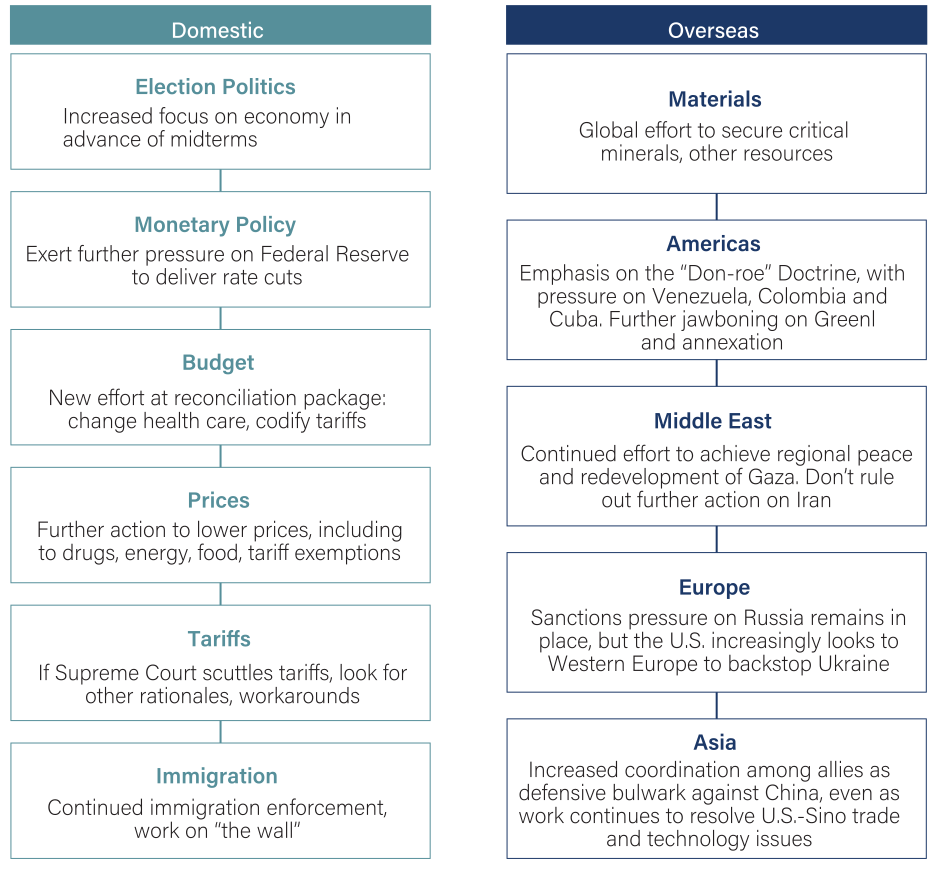
Source: Fulcrum Macro Advisors.
1Warsh, who served as a Fed governor from 2006 to 2011, has a hawkish reputation on inflation, but has also been an active critic of the central bank, recently favoring more rapid rate cuts in light of AI impacts, and supporting Trump’s tariff policies.
This material is provided for informational and educational purposes only and nothing herein constitutes investment, legal, accounting or tax advice. This material is general in nature and is not directed to any category of investors and should not be regarded as individualized, a recommendation, investment advice or a suggestion to engage in or refrain from any investment-related course of action. Investment decisions and the appropriateness of this material should be made based on an investor’s individual objectives and circumstances and in consultation with his or her advisors. Information is obtained from sources deemed reliable, but there is no representation or warranty as to its accuracy, completeness or reliability. All information is current as of the date of this material and is subject to change without notice. The firm, its employees and advisory accounts may hold positions of any companies discussed. Any views or opinions expressed may not reflect those of the firm as a whole. Neuberger Berman products and services may not be available in all jurisdictions or to all client types. Past performance is no guarantee of future results.
This material may include estimates, outlooks, projections and other “forward-looking statements.” Due to a variety of factors, actual events or market behavior may differ significantly from any views expressed.
Neuberger Berman Investment Advisers LLC is a registered investment adviser.
The “Neuberger Berman” name and logo are registered service marks of Neuberger Berman Group LLC.