NEWS AND INSIGHTS | INSIGHTS
Preparing Your Children for Wealth: A Life-Stage Roadmap
一月 29, 2026

Adapting your efforts to your children’s development can prepare them to prosper from family wealth.
As many parents know, wealth can amplify opportunities for children, but also introduce meaningful challenges, both practical and psychological. Financial literacy classes may prove useful, but address only some issues. In our view, true wealth preparation is a long-term process that builds on financial awareness as well as responsibility and self-sufficiency. Structuring your efforts by life stage can help maximize effectiveness by introducing strategies when they are most appropriate for your child. In this article, we present some ideas to help you support your pre-teens, teens, college students and/or post-college-age children as they travel on this important journey.
Your children may sense your relative level of wealth, but not understand the effort that was involved in creating it (and that it isn’t guaranteed to last), or the responsibilities that may come with wealth. In their pre-teen years, you can take concrete steps to build their appreciation and habits of altruism.
Share your family journey. When you recount your family narrative, you engage their interest in prior generations and inspire pride in your family’s achievements. Children naturally gravitate to stories, especially when enhanced with family photos and other visual media. Exploring your family’s places of origin with your children and grandchildren can create positive, lasting memories that deepen their understanding of your collective past.
Demonstrate your values through action. Whether or not children acknowledge it, you may exert more influence on them than anyone outside the family. Small gestures can have a powerful educational impact, and displaying persistence, fair play or other character attributes you value can have a cumulative effect in shaping your child’s character. When you show gratitude or kindness to others, even in the face of an unpleasant day, you foster a valuable perspective that they may apply in their own lives.
Cultivate a tradition of giving. Nurturing their philanthropic interests can be valuable, especially if you begin early. Philanthropy can increase your child’s awareness of others and their circumstances. With this awareness may come a greater appreciation of the resources available to your child. You can volunteer together and/or give together as a family. The latter can start with a discussion of the causes that interest them and build into the selection of family gifts, whether through a family donor advised fund or donation of charitable gift certificates available at select financial institutions.
At a time of rapid personal development, your children may draw broader cues from peers, media and educators about values, lifestyle and work ethic. While avoiding a domineering tone, you can help influence their direction through communication about what matters to you, reinforcing sound monetary habits and encouraging independence and resilience.
Clarify your financial philosophy. During this period of peer pressure and greater awareness, teenagers may become cognizant of social hierarchy, with visible wealth often influencing their self-perception. This, in turn, typically leads to more requests for purchases to keep up with others. In navigating such requests, it can be useful to reflect on and then communicate your priorities and philosophy regarding family spending, consistent with the values that may have helped support the growth of family wealth. This can help you decide the extent of spending you may wish to allow while clarifying what you think is most important to your children.
Foster resource management. No matter how large your family wealth, its growth and sustainability may depend on the judicious management of finite capital. With your assistance, children can begin acquiring this skill at a young age through moderate spending and a habit of monitoring their resources. Budgeting and, eventually, cash flow management, can prepare them to steward resources later on, and increase your confidence in their ability to take on more responsibility.
Providing an allowance can help them understand that spending decisions have consequences, and enables them to set priorities and accept the need for delayed gratification to make larger purchases. This, in our view, should not be an automatic entitlement or compensation for chores that they should be doing anyway. While we do not prescribe a specific allowance amount across all families, what matters more is adhering to the amount that is set for the corresponding time period. You can even bring investment lessons into the mix by showing how their money, if set aside, could potentially grow over time.
Build resilience. Overcoming and learning from setbacks can be a key part of developing confidence, independence and self-sufficiency. When teenagers face hardship, whether at school or in an extracurricular activity, quitting may be a tempting option. However, completion of a difficult undertaking can instill the discipline and drive needed to overcome future challenges. Encourage them to engage in activities where daily practice can lead to gradual improvement; and if they do choose to end an activity, if constructive to do so, have them wait until the appropriate interval (e.g., the end of a season or semester) rather than just after one bad day. Candidly sharing your own past challenges, how you coped, and what you gained from the experience can help them take away the right lessons.
The beginning of college often represents the first time a child lives outside the household for an extended period. This means that lessons around managing resources and financial habits accelerate, accompanied by important decisions about careers and the degree to which family wealth may play a part in their future.
Set expectations for spending. At the outset, consider explaining your ground rules for family support in the upcoming years, what you will pay for and what you will not—leaving it up to the child to make up the balance through savings and/or earnings. This should be informed by your underlying reasons for the arrangement and how it ties into your philosophy about wealth. This transparency can serve as a foundation for future conversations about money.
Clarify the extent of family support to help inform career decisions. College can provide an opportunity for a child to explore their identity, gain autonomy and think about the longer term. In developing their talents and choosing an academic concentration, children may need guidance in considering the earnings potential within a given field and its ramifications for their future living standards. In particular, you may wish to convey your intent around future support (conditions, amounts, etc.) so they understand to what extent they will need to provide for themselves. In this way, you may free your children to pursue their talents and commitments, with a general understanding of baseline resources that you intend to provide. (Many parents wish they had made this more explicit earlier given their children’s movement toward lucrative but sometimes unhappy careers.)
Foster independence in reaching key milestones. Professional experiences like summer jobs and internships can reinforce the critical connection between wealth and hard work and speed the path to maturity; in contrast, those who are completely underwritten by parents may lack the opportunity to learn valuable life lessons. Going a step further, the process of securing employment for post-college years can be important for personal growth and development. To further cultivate this self-sufficiency, it helps to resist the urge to secure employment on the child’s behalf, with the understanding that their success on this front can help foster confidence needed to deal with experiences that lie ahead.
New college graduates often look ahead to a life with multiple goals, such as business success, a home and family. Providing a more developed framework around family support can help them effectively plan for the future.
Communicate overarching principles. As adult children build their careers, and potentially marry, become parents and commence their own estate planning, they will likely value increased visibility around family resources available for their future. However, you may understandably worry that revealing too much information could diminish your children’s motivation.
As a middle ground, you can begin to communicate your framework in ways that do not entail immediate disclosure. For example, if you value education, entrepreneurship and family continuity, you may explain that your resources primarily exist to advance the educational and professional growth of the family, assist in your child’s business venture or encourage philanthropic activity.
Capturing such principles in writing can help anchor family discussions. Note that the emphasis of communication should generally be the purpose of family resources, rather than dollar amounts; this will allow you to set expectations without worrying about oversharing.
Delineate key milestones. Beyond broad philosophy on lifestyle, you can set expectations regarding events or goals, such as attaining home ownership or starting a new business. Here, defining the motivation for your support can foster more effective dialogue.
For example, safety and security may emerge as a key reason to assist with their housing; or your desire for their self-sufficiency may lead you to assist with a down payment, as long as they assume maintenance costs. While dollar amounts may vary for each child, the general principles can remain consistent. With a business venture, you may wish to carefully define the terms (including, for example, an extensively researched business plan or repayment enforcement) to ensure financial accountability and responsibility.
As you consider the messaging and support structure for your children, keep in mind that there is a fine line between guidance and intrusion. Encouraging them to pursue their own interests can help them develop their own identity and avoid living in your shadow.
Importantly, we think it is almost never too late to cultivate independence and financial responsibility, and that you always have the option of adjusting your level of support if you decide it is not beneficial. Indeed, parenting remains a lifelong process of learning and adjustment, and your task may be to empower them without excess accommodation or severity. No one would say that this process will be easy, but we believe that, more likely than not, it could prove worthwhile.
FFI Practitioner. Provides a treasure trove of practical articles on family wealth. Visit https://ffipractitioner.org/topics/research/.
Character Lab. Legacy website for this now-sunset organization offers guides to “cultivate strengths of heart, mind and will” among young people. Visit https://characterlab.org/playbooks/.
Family Wealth: Keeping It in the Family. James E. Hughes Jr.’s groundbreaking book explores “how family members and their advisors can preserve human, intellectual and financial assets for generations” (Gildan Media, 2004).
Mapping Wealth Communication to Your Children. Julia Chu’s article explains how well-considered, gradual process can help convey knowledge and values. (NB Private Wealth, 2023)
We maintain an extensive internal library of articles and other materials on family wealth topics. Talk to your Wealth team for details.
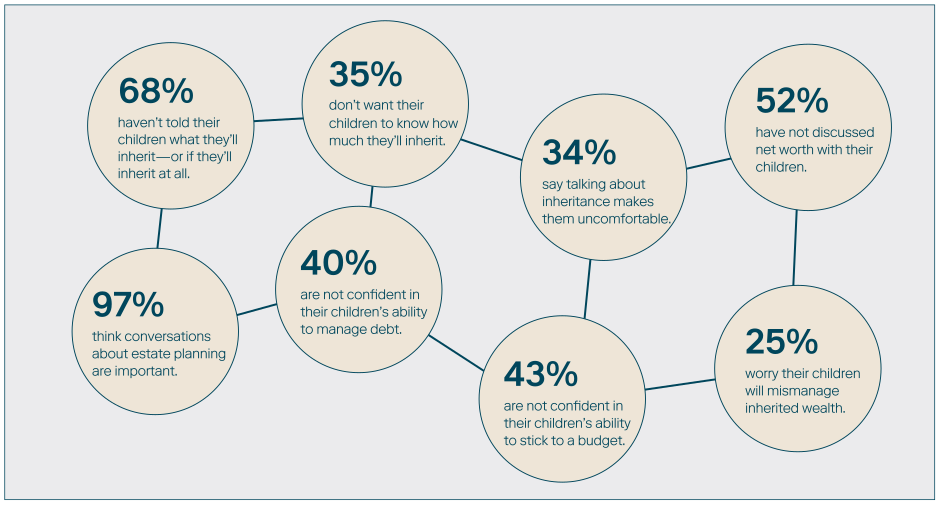
Source: Fidelity, 2025 Family and Finance Study.
This material is provided for informational and educational purposes only and nothing herein constitutes investment, legal, accounting or tax advice, or a recommendation to buy, sell or hold a security. This material is general in nature and is not directed to any category of investors and should not be regarded as individualized, a recommendation, investment advice or a suggestion to engage in or refrain from any investment-related course of action Neuberger Berman, as well as its employees, does not provide tax or legal advice. You should consult your accountant, tax adviser and/or attorney for advice concerning your particular circumstances. Information is obtained from sources deemed reliable, but there is no representation or warranty as to its accuracy, completeness or reliability. All information is current as of the date of this material and is subject to change without notice. Any views or opinions expressed may not reflect those of the firm as a whole and Neuberger Berman does not endorse any third-party views expressed. This material may include estimates, outlooks, projections and other “forward-looking statements.” Due to a variety of factors, actual events may differ significantly from those presented. Investing entails risks, including possible loss of principal. Past performance is no guarantee of future results.
Tax planning and trust and estate administration services are offered by Neuberger Berman Trust Company. “Neuberger Berman Trust Company” is a trade name used by Neuberger Berman Trust Company N.A. and Neuberger Berman Trust Company of Delaware N.A., which are affiliates of Neuberger Berman Group LLC.
Philanthropic & Family Governance Advisory Services and related materials are provided as a courtesy and are for informational and discussion purposes only. Neuberger Berman is not acting in a fiduciary capacity or recommending any specific governance structures or philanthropic or charitable activities. Recipients of Philanthropic & Family Governance Advisory Services should consult their own tax or legal advisors before implementing any governance structure or philanthropic or charitable activities.
Neuberger Berman Investment Advisers LLC is a registered investment adviser. The “Neuberger Berman” name and logo are registered service marks of Neuberger Berman Group LLC.