NEWS AND INSIGHTS | MUNICIPAL BASIS POINTS
Quality Opportunities on Sale
四月 24, 2026

Recent shifts in the municipal fixed income market have created new potential avenues to pick up yield. DOWNLOAD REPORT
The Middle East conflict has triggered volatility, but, in our view, also opportunity, in the municipal bond market.
We entered this year optimistic about the muni market’s prospects. Despite nonstop news flow both domestically and internationally, the market got off to a solid start from a total return standpoint in January and February. All of that changed in March, when the military conflict with Iran began. Usually, when a war or geopolitical crisis starts, you see a flight-to-quality trade, and assets like U.S. Treasuries and high-quality municipal bonds perform well—but not this time. Given the location of the conflict and closure of the Strait of Hormuz, the impact on energy markets was profound.
Initially, the market developed a view that, with a sharp increase in oil prices, inflation would be front and center, and central banks would potentially have to tighten monetary policy. Before the war started, the market had expected the Federal Reserve to deliver 2.5 rate cuts in 2026. Shortly after, the market started pricing in the possibility of a rate hike. As a result, Treasuries sold off and munis, which were already trading at fuller valuations, underperformed in March. For the quarter, the investment grade municipals posted a slightly negative total return.
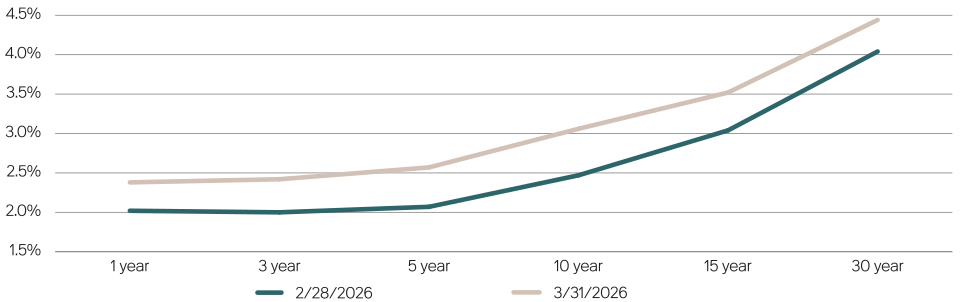
The bright side of a fixed income sell-off, however, is often higher yields and the potential for more income going forward. The yields on high-grade 10-year municipals increased by over 50 basis points in March,1 and they are higher than where they started the year. Municipal valuations relative to Treasuries have also improved. In addition, despite its smooth absorption by the market, supply has been heavy so far in 2026, and we expect that trend to continue. In our view, this combination of higher yields, better valuations and plentiful supply should represent a compelling entry point for the market.
From a positioning perspective, generally, we shifted to a more cautious duration view in the latter part of February, given lower absolute yields and fuller municipal valuations. More recently, we have favored extending portfolios and shifting duration positioning back to neutral. With yields moving higher and supply abundant, we think this is a good time to bring duration a little “closer to home.” All things equal, we see significant opportunities to buy quality, given the current level of yields and general tighter spreads (yields over Treasuries) for lower-rated investment grade bonds. Finally, rates volatility may provide opportunities to execute tax-loss swaps; we will look to be proactive on that front when it makes economic sense.
Issuance and oil remain in focus.
Yield volatility: Strong demand pushed municipal valuations to stretched levels early in the year, particularly in the five-year part of the curve. Anticipating seasonal headwinds of heavier supply and potential tax-time outflows, we favored shortening duration relative to benchmarks. That view proved timely, as higher oil prices stoked inflation concerns, pushing up bond yields—with the 10-year AAA muni yield up 60 basis points—its largest monthly move since September 2022. Moving forward, above-average issuance and potential fund outflows could pressure the muni market at times in the coming weeks.
Source: Bloomberg. Data as of March 31, 2026.
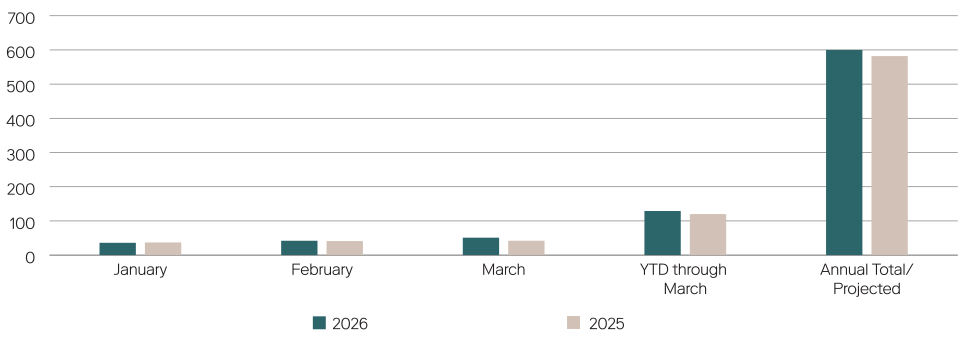
Historic level of issuance: 2026 issuance is running slightly ahead of last year’s elevated pace, with year-to-date volume of $120 billion, and full-year supply expected to exceed $600 billion. That would be a new record, driven largely by infrastructure needs and elevated construction costs. March offered an early preview, with tax-exempt new issuance hitting a monthly record of $49 billion. Increased second-quarter supply may pressure the market, particularly if rates continue to rise.
Source: BofA. Data as of March 31, 2026.
Policy backdrop: The Federal Reserve remains on hold as above-target inflation and higher oil prices have pushed market yields higher. Still, the Fed appears open to rate cuts in the second half of 2026 given potential for growth deceleration tied to oil and/or softening employment data. We favor reducing cash-equivalent holdings to take advantage of what we consider attractive entry points across the yield curve—both relative to current cash rates and, on a taxable-equivalent basis, versus comparable U.S. Treasuries.
Artificial intelligence could have meaningful implications for municipal bonds.
Artificial intelligence is moving from concept to reality faster than many investors expected, and its effects are beginning to show up across the economy. For municipal bond investors, the key question is not whether AI will matter, but how it will influence credit quality across different sectors over time. At Neuberger, we are actively monitoring these developments across the municipal market. While the utility sector is currently receiving the most attention, we view AI as a broad, evolving theme with implications that will differ meaningfully by issuer and sector.
Utilities Are the First Area of Impact
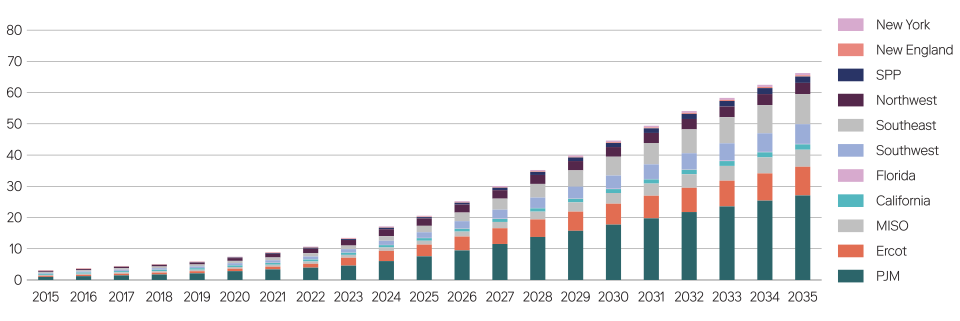
The clearest near‑term effects of AI are showing up in the electric utility sector. After many years of relatively flat electricity demand, usage has accelerated sharply. This shift reflects the rapid expansion of data centers that support AI computing, which require large, reliable amounts of power. The U.S. set an electricity generation record of approximately 4,430 TWh in 2025,¹ with projected growth of 1.9% in 2026 and 2.5% in 2027, concluding its strongest four-year stretch since 2000.2
Forecasts now point to sustained growth in electricity demand over the next decade, a notable change from the past and one that has important implications for municipal utilities. For many public power and municipal utility issuers, this demand growth represents a potential credit positive. Utilities that can secure long‑term contracts with large data center customers can benefit from more stable revenues and a broader customer base. In some cases, these arrangements can support infrastructure investment while strengthening overall credit quality. That said, the risks are real and require careful evaluation. Utilities must balance the costs of building new generation and transmission capacity with the allocation of those costs among customers. If demand projections fall short, utilities could be left with stranded assets. If costs are pushed too heavily onto residential customers, rate pressure and political resistance may follow. Our focus is on utilities that demonstrate thoughtful planning, conservative assumptions and regulatory frameworks.
Source: BloombergNEF, DC Byte. Data as of December 1, 2025. “Power demand” refers to the total electricity used by the entire data center facility. SPP is Southwest Power Pool, Ercot is Electric Reliability Council of Texas, MISO is Midcontinent Independent System Operator, PJM is PJM Interconnection.
Beyond utilities, an important long‑term question about AI is how it could affect employment and, in turn, the tax revenues that support many municipal issuers. To date, the data does not show widespread job losses tied directly to AI. In fact, AI‑related hiring has continued to grow, and unemployment trends in the occupations most exposed to AI remain relatively stable. History suggests that technological change can unfold gradually in public finance data, with new job categories often offsetting displacement. Still, we are closely watching for signs that AI could begin to affect middle‑skill and professional employment in a more sustained way. For states and local governments that rely heavily on income and sales taxes, prolonged disruption could eventually pressure revenue growth and budget flexibility. Another area we are monitoring is the growing use of tax incentives to attract data centers. While these incentives can reduce near‑term revenues, successful projects also bring construction activity, property tax base expansion, and longer‑term economic growth. The structure and scale of these programs matter, and we believe jurisdictions that approach them carefully are more likely to preserve credit stability.
We view artificial intelligence as a theme that cuts across municipal sectors rather than as a single‑issue story. Utilities are currently at the forefront, but over time, we expect impacts to emerge in state and local government finances, transportation and other areas tied to economic growth and labor markets. Our work focuses on issuer‑level analysis: evaluating how utilities manage load growth and cost allocation, tracking revenue trends for income‑tax‑dependent issuers, and assessing how local governments balance incentives with long‑term fiscal health. As this story develops, we believe disciplined credit analysis will be essential. By monitoring these trends early and grounding our views in issuer fundamentals, we aim to identify where AI‑related changes may strengthen credit profiles—and where they warrant caution.
1U.S. Energy Information Administration, Today in Energy, 2025.
2U.S. Energy Information Administration, Short-Term Energy Outlook, 2025.
This material is provided for informational purposes only and nothing herein constitutes investment legal accounting or tax advice or a recommendation to buy sell or hold a security. This material is general in nature and is not directed to any category of investors and should not be regarded as an individualized recommendation, investment advice or a suggestion to engage in or refrain from any investment-related course of action. Neuberger is not providing this material in a fiduciary capacity, and has a financial interest in the sale of its products and services. Neuberger as well as its employees does not provide tax or legal advice. You should consult your accountant tax adviser and/or attorney for advice concerning your particular circumstances. Information is obtained from sources deemed reliable, but there is no representation or warranty as to its accuracy completeness or reliability. All information is current as of the date of this material and is subject to change without notice. Any views or opinions expressed may not reflect those of the firm as a whole. Neuberger products and services may not be available in all jurisdictions or to all client types. Investing entails risks including possible loss of principal. Investments in hedge funds and private equity are speculative and involve a higher degree of risk than more traditional investments. Investments in hedge funds and private equity are intended for sophisticated investors only. Indexes are unmanaged and are not available for direct investment. Past performance is no guarantee of future results.
Unless otherwise indicated, portfolio characteristics, including attribution, yield data, relative returns and risk statistics are shown gross of fees. The views expressed herein do not constitute a prediction or projection of future events or future market behavior. This material may include estimates, outlooks, projections and other “forward-looking statements.” Due to a variety of factors, actual events or market behavior may differ significantly from any views expressed.
Neuberger Berman Investment Advisers LLC is a registered investment adviser. The “Neuberger” name and logo are service marks of Neuberger Berman Group LLC.