NEWS AND INSIGHTS | INSIGHTS
Looking Through the Storm
四月 30, 2026

We believe resilient fundamentals should survive market turbulence, setting up potential opportunities driven by careful security selection and an eye toward risk. DOWNLOAD ARTICLE
Events over the past few months have unfolded in dramatic fashion, and the distance covered from where markets began the year and where they stand today is evidence of a rapidly changing environment. January delivered on the promise of a broadening market, with equities rallying, small caps leading, and bond markets reflecting the opportunities outside of the U.S. February complicated that narrative, as the accelerating reach of “agentic” artificial intelligence cast a long shadow over companies—technology and otherwise—whose valuations had not yet reflected the threat of disintermediation. And then March arrived, bringing with it a geopolitical shock that rapidly repriced inflation expectations, pushed yields sharply higher across the globe, and cast doubt on the path for global monetary policy.
Breaking it down further, performance dynamics reflected the crosscurrents we have been navigating. Commodities were the standout, up 24.4% for the first quarter, a direct reflection of the energy price spike in March—and an area that we favored coming into the year. Equities, by contrast, were down across the board: The S&P 500 fell 4.3% for the quarter and non-U.S. developed market stocks were off 1.2%, while emerging markets equities held up somewhat better at -0.2%. All three remain meaningfully positive on a one-year basis at 17.8%, 21.3% and 29.6%, respectively, through quarter-end. Fixed income returns were positive coming into March, but the subsequent crisis-related jump in yields hurt investors who were positioned for stable to lower yields, particularly at the short end of the curve.
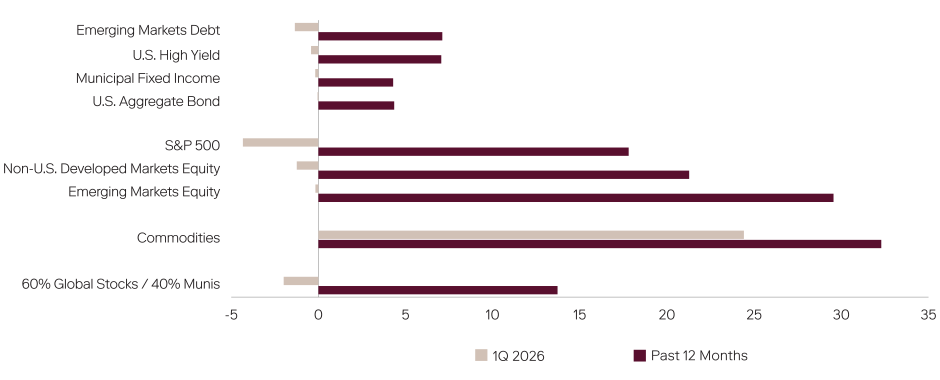
Source: Bloomberg. Data as of March 31, 2026. Indexes are as follows: S&P 500, MSCI ACWI (global stocks), Bloomberg Municipal Bond Index, Bloomberg U.S. High Yield 2% Issuer Cap, Bloomberg EM USD Aggregate, Bloomberg U.S. Aggregate, MSCI Emerging Markets, MSCI ACWI ex-U.S. (non-U.S. large and midcap stocks), Bloomberg Commodity. Nothing herein constitutes a prediction or projection of future events or future market behavior. Historical trends do not imply, forecast or guarantee future results. Due to a variety of factors, actual events or market behavior may differ significantly from any views expressed. Investing entails risks, including possible loss of principal. Past performance is not indicative of future results.
Coming into 2026, our views on the potential transformation of the economic and market landscape were constructive. In our Solving for 2026 outlook, we cited the opportunities in the accelerating AI capex cycle and the probability that spending would migrate from mega-cap tech to other parts of the economy. We acknowledged the potential threat of lofty valuations, suggesting that investors could become less willing to accept the massive spending that increasingly cannibalized cash flows.
This concern proved valid, as the “hyperscalers” felt pressure on both sides of their balance sheets. The demand for greater accountability and a clearer timeline toward monetization was apparent in the investor response to the spending guidance of these large tech names. With $411 billion spent in 2025 (and an estimated $653 billion in 2026) by Amazon, Microsoft, Google, Meta and Oracle,1 investors are likely to continue to push for evidence of broad AI adoption to justify these outlays.
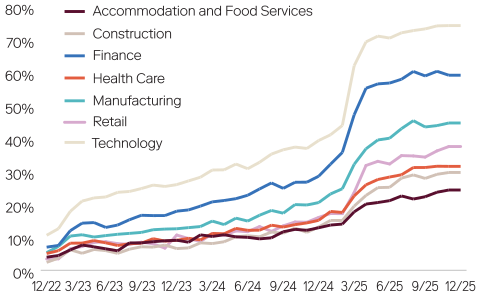
Source: FactSet, Ramp AI Index and the Visual Capitalist, as of December 2025.
Another undercurrent of the AI theme, however, has proven even more impactful for markets so far this year. The outperformance of semiconductors over software in 2025 was a well-telegraphed market narrative; and a potential reversal (or at least compression) of the return difference between the two industries ties in nicely with our view that AI integration for both tech and non-tech companies could help drive markets in 2026. However, with the release of several new agentic AI tools by Anthropic, the landscape changed seemingly overnight. In what was dubbed the “SaaSpocalypse,” software stocks moved sharply lower as investors questioned the sustainability of the software-as-a-service (SaaS) model, and in particular, the safety of the recurring cash flows generated by subscription and per-seat revenue models.
Extending its impact, the dark cloud of disintermediation pressured equity prices for everything from enterprise software to trucking and logistics providers. In addition, the emergence of private credit concerns that began in 2025 quickly accelerated as investors adopted a “shoot first, ask questions later” approach to software and services exposure. This resulted in a sharp increase in investor redemption requests from those Business Development Companies that are heavily weighted to the sector, and pressured publicly listed asset managers offering these products.
In theory, should agentic AI prove to be as disruptive as some fear, continued capital expenditures to support implementation across the economy could once again be welcomed by investors. However, the reality may sit somewhere in the murky middle: The hyperscalers could face pressure to turn their free spending into cash flows, while companies facing disintermediation will need to better articulate how they can remain competitive—likely through integration of AI solutions of their own.
While AI-related volatility was unpleasant for investors, the pain was generally concentrated in the technology, communication services and financial sectors in the first two months of the year. With the February 28 launch of Operation Epic Fury, however, the market narrative immediately changed. U.S. and Israeli airstrikes to command centers, nuclear sites, missile infrastructure and industrial facilities prompted the Iranians to launch attacks on U.S. bases and economically important sites in the Gulf region; they also effectively closed the Strait of Hormuz.
While some initially thought the conflict would only last for a few days, it has continued for close to two months, with a fragile ceasefire in place at the time of this writing. The immediate impact of the conflict has been an increase in energy prices, which is consistent with past crisis periods. However, the rapid repricing of inflation expectations this time has been notable and most evident in bond markets.
Heading into 2026, bond markets had largely anticipated a stable to modestly easier policy path across the major central banks (excluding Japan), but that consensus unraveled as energy prices surged. Central banks have historically looked through geopolitically driven energy shocks in setting policy, but the combination of slow progress toward long-term inflation targets and acute energy insecurity across Europe, China and Japan gave markets reason to reprice aggressively, driving yields meaningfully higher before pulling back in hopes of peaceful resolution.
Even the U.S. rate picture changed, despite better access to energy supplies. As of publication, the market no longer expects the two to three cuts that were broadly anticipated at the end of February. Unlike the European Central Bank, which has adopted a more hawkish tone in recent weeks, the Federal Reserve has the dual mandate of low inflation and maximum employment, and the labor market, while still technically resilient, has exhibited signs of weakness in recent months. Job openings have narrowed and hiring rates have moderated, even as initial jobless claims have yet to exhibit a firmly higher trend. This has weighed on consumer confidence, and history tells us that when workers begin to worry about employment stability, they pull back on discretionary spending well before any actual deterioration in payrolls. Higher energy prices compound that behavior. As such, the Fed is watching this dynamic carefully, as a simultaneous hit to consumer sentiment from energy prices and labor market anxiety could increase the probability of a growth undershoot, and could push the Fed back to a more accommodative posture faster than markets currently anticipate.
Importantly, the threat of a central bank policy mistake notwithstanding, we believe that the probability of a sustained inflationary spike and a meaningful deceleration in economic growth is low. First, we believe that a more permanent agreement to renew access to the Strait of Hormuz is likely. The waterway is crucial to many nations, including China, which accesses much of its energy there. Therefore, the Chinese government could become more active in seeking a diplomatic solution to Strait oversight. Second, the backdrop for supply prior to March was favorable as global oil and product inventory levels were largely healthy, enabling refiners to pull from these inventories to source crude. As such, we think oil prices could remain in the $100 per barrel range during this period without prompting a meaningful increase in general inflation levels.
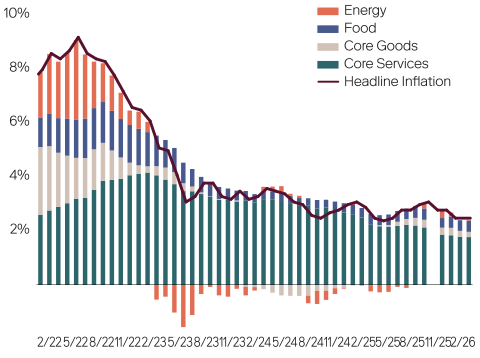
Source: Bloomberg. Data as of February 2026. Nothing herein constitutes a prediction or projection of future events or future market behavior. Historical trends do not imply, forecast or guarantee future results. Due to a variety of factors, actual events or market behavior may differ significantly from any views expressed. Past performance is not indicative of future results.
Even if the crisis proves more durable than expected, it’s worth noting that AI could act as a deflationary offset to higher energy prices, while slowing wage growth due to low hiring could also prove a counterbalance. As such, we think global bond markets have overshot the fundamentals, especially at the short end of the yield curve, and see potential opportunity in that disconnect. In our view, the path to lower yields could take two possible paths from here: Either the conflict de-escalates and energy prices retrace their steps or sustained price pressure erodes demand and does the Fed’s work for it. In either scenario, the case for lower yields appears more compelling than the market is giving it credit for.
While no one has a crystal ball, we believe that our expectations for stronger nominal growth, slower inflation and improved earnings across a range of companies remain appropriate, although selectivity within equities could be paramount. The broad-based selling we observed in March created indiscriminate pressure across sectors and geographies, and, in our view, that kind of volatility often produces opportunity for disciplined investors. Companies with strong pricing power, low energy input costs and domestically anchored revenue streams are better insulated from the current macro headwinds and, we believe, represent a more compelling risk/reward balance than they did coming into the year—even in sectors such as technology, which had enjoyed strong year-over-year gains.
In addition, we believe the dynamics of the fixed income market have changed quickly and dramatically, affording us the opportunity to lean into areas that we previously viewed as fairly to overly valued. While admittedly not positioned for a sharp deterioration in the economic outlook, we will continue to adjust our expectations as the Middle East conflict evolves. Should energy prices remain elevated through the summer, we would likely look to reposition portfolios for a less accommodative monetary policy environment. That said, our long-term strategic asset allocations take into account periods of volatility like the one we are experiencing now, and we encourage continued discipline in maintaining those allocations even as markets fluctuate.
1Source: FactSet, Ramp AI Index, and the Visual Capitalist, as of December 31, 2025.
This material is provided for informational and educational purposes only and nothing herein constitutes investment, legal, accounting or tax advice, or a recommendation to buy, sell or hold a security. This material is general in nature and is not directed to any category of investors and should not be regarded as individualized, a recommendation, investment advice or a suggestion to engage in or refrain from any investment-related course of action. Investment decisions and the appropriateness of this material should be made based on an investor’s individual objectives and circumstances and in consultation with his or her advisors. This material is not intended as a formal research report and should not be relied upon as a basis for making an investment decision. The firm, its employees and advisory clients may hold positions within sectors discussed, including any companies specifically identified. Specific securities identified and described do not represent all of the securities purchased, sold or recommended for advisory clients. It should not be assumed that any investments in securities, companies, sectors or markets identified and described were or will be profitable. Neuberger, as well as its employees, does not provide tax or legal advice. You should consult your accountant, tax adviser and/or attorney for advice concerning your particular circumstances. Information is obtained from sources deemed reliable, but there is no representation or warranty as to its accuracy, completeness or reliability. All information is current as of the date of this material and is subject to change without notice. Any views or opinions expressed may not reflect those of the firm as a whole and Neuberger does not endorse any third-party views expressed. Third-party economic or market estimates discussed herein may or may not be realized and no opinion or representation is being given regarding such estimates. Neuberger products and services may not be available in all jurisdictions or to all client types. The use of tools cannot guarantee performance. Diversification does not guarantee profit or protect against loss in declining markets. As with any investment, there is the possibility of profit as well as the risk of loss. Investing entails risks, including possible loss of principal. Investments in hedge funds and private equity are speculative and involve a higher degree of risk than more traditional investments. Investments in hedge funds and private equity are intended for sophisticated investors only. Unless otherwise indicated, returns reflect reinvestment of dividends and distributions. Indexes are unmanaged and are not available for direct investment. This material may include estimates, outlooks, projections and other “forward-looking statements.” Due to a variety of factors, actual events may differ significantly from those presented. Investing entails risks, including possible loss of principal. Past performance is no guarantee of future results.
The views expressed herein may include those of the Neuberger Multi-Asset Class (MAC) team, Neuberger’s Asset Allocation Committee and Neuberger’s Wealth Investment Group. The Asset Allocation Committee is comprised of professionals across multiple disciplines, including equity and fixed income strategists and portfolio managers. The Asset Allocation Committee reviews and sets long-term asset allocation models, establishes preferred near-term tactical asset class allocations and, upon request, reviews asset allocations for large, diversified mandates. Tactical asset allocation views are based on a hypothetical reference portfolio. The Neuberger Wealth Investment Group analyzes market and economic indicators to develop asset allocation strategies. The Neuberger Wealth Investment Group consists of five investment professionals and works in partnership with the Office of the CIO. The Neuberger Wealth Investment Group also consults regularly with portfolio managers and investment officers across the firm. The views of the MAC team, the Asset Allocation Committee and the Neuberger Wealth Investment Group may not reflect the views of the firm as a whole, and Neuberger advisers and portfolio managers may take contrary positions to the views of the MAC team, the Asset Allocation Committee and the Neuberger Wealth Investment Group. The MAC team, the Asset Allocation Committee and Neuberger Wealth Investment Group views do not constitute a prediction or projection of future events or future market behavior. This material may include estimates, outlooks, projections and other “forward-looking statements.” Due to a variety of factors, actual events or market behavior may differ significantly from any views expressed or any historical results. Nothing herein constitutes a prediction or projection of future events or future market or economic behavior. The duration and characteristics of past market/economic cycles and market behavior, including length and recovery time of past recessions and market downturns, is no indication of the duration and characteristics of any current or future market/ economic cycles or behavior.
Neuberger Berman Investment Advisers LLC is a registered investment adviser. The “Neuberger” name and logo are service marks of Neuberger Berman Group LLC.