NEWS AND INSIGHTS | MARKET COMMENTARY
A Rocky Rotation
February 06, 2026

Our outlook remains constructive for risk assets; within equities, we recommended overweight positions in emerging markets and favor U.S. small/midcaps; downgrade U.S. investment grade fixed modestly; and remain overweight to commodities and private equity.
Pessimism was in short supply as the calendar turned to 2026, with many bears in full hibernation ahead of what was expected to be a strong start to the year. With expectations for accelerating global growth and the transmission of lower policy rates to companies in the U.S. and Europe, many investors started the year positioned for risk assets to continue their outperformance from 2025. In addition, while artificial intelligence is expected to remain a driver of growth this year, the necessity of the shift in spending from companies supplying the capabilities to those ostensibly demanding those capabilities cannot be understated; the strength of the broader rally likely hinges on the handoff over the next 12 – 18 months.
A flurry of events upset hopes for a quiet start to the year. A surprise raid led to the capture of Venezuelan President Nicolas Maduro in Caracas by American forces, after which he was moved to New York to face criminal charges. President Donald Trump announced his desire to purchase Greenland, in turn threatening the European Union with tariffs should he face pushback; he also threatened to raise tariffs on Korea. In addition, the Trump administration set its sights on defense companies, calling for a potential curb on buybacks and dividends for these companies should they fail to continue to invest in innovative technologies, and banks, for which he floated a 10% cap on credit card interest rates.
With this as a backdrop, economic data released during the month was mixed. In the U.S., core CPI was a touch cooler than expected while headline CPI matched forecasts. Food was a key driver (both at-home and away-from-home prices rose 0.7% month-over-month), energy was modest (up 0.3% with gasoline down), and within core inflation, shelter reaccelerated—all potentially troublesome trends as affordability concerns continue to weigh on the economy. Labor market momentum remains muted as well, as December U.S. payrolls rose just 50,000 versus the expected 70,000, with prior months revised downward, leaving weaker momentum (three‑month average down 22,000) and only 584,000 payroll growth in 2025. Sector gains were concentrated in health care, social assistance and leisure/hospitality, while retail, construction and manufacturing declined; the unemployment rate fell to 4.4% even as participation dipped. Outside of the U.S., euro area CPI decelerated to 1.9%, Japan inflation also came in a touch light at 2.1%, while U.K. CPI remains sticky, posting 3.6% for the month of December. Ex.-U.S. growth showed signs of easing in the fourth quarter, with the euro area growing at 1.4%, South Korea posting GDP of 1.5%, and growth in China coming in at only 4.5%—this despite an overall 2025 increase of 5.5% for the year, which lifted its trade surplus to a record of nearly $1.2 trillion.
Corporate earnings complicated the narrative this past month. Through the end of January, about a third of U.S. S&P 500 companies had reported for the fourth quarter, with 75% besting earnings estimates, and 65% beating on revenues. While both measures are below longer-term averages, the earnings growth rate has remained strong, with average standing at 11.9% as of the end of the month. However, despite solid earnings growth, market reactions have been muted, with companies that beat earnings estimates facing lackluster enthusiasm, and those that have missed or issued lowered guidance facing pressure. Idiosyncratic announcements around upgraded AI capabilities from certain private companies and lower-than-anticipated government reimbursement rates for Medicare Advantage also weighed on certain industries such as software and managed care, further compounding the index volatility.
In short, the foundation for a stronger environment for risk appears to be the relative strength of the global economy, but geopolitical, policy and industry specific crosscurrents yielded a rocky start to the year. Even with the volatility, the S&P 500 closed the month up 1.5%, with small-cap, non-U.S. developed and emerging markets equities all meaningfully outperforming as the rotation from technology continued. The dollar continued to weaken, commodities were higher, and fixed income was also positive in the month, further amplifying the need for diversification across asset classes and geographies.
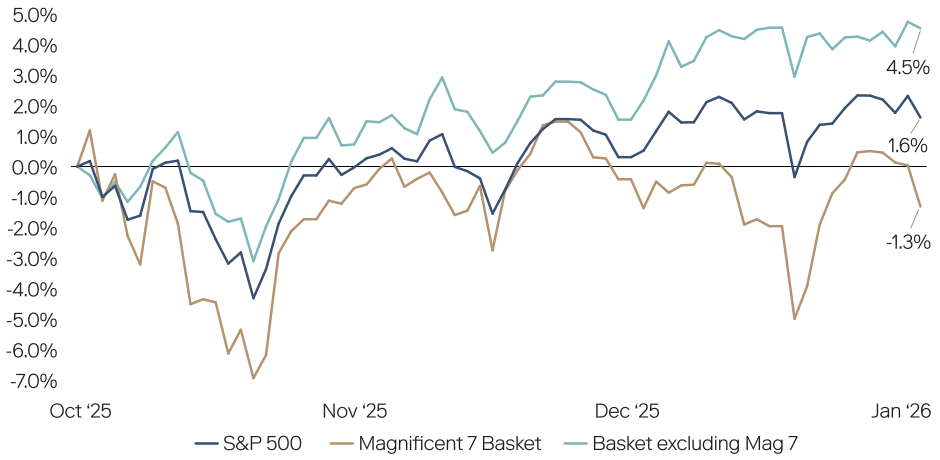
Source: Bloomberg, January 30th. “Magnificent 7 Basket” is constructed by Bloomberg LP, the “Basket excluding Mag 7” leverages Bloomberg 500 Index excluding the Magnificent 7.
The specter of potential political influence hung ominously over the Federal Reserve throughout much of 2025. Treasury Secretary Scott Bessent, in the early days of his tenure, prioritized lowering the 10-year Treasury yield as a way to facilitate borrowing for U.S. businesses and consumers; and President Trump’s tone suggested that the administration thought the Fed was responsible for delivering on that promise. Speculation was rampant that Fed Chair Jerome Powell would be replaced prior to the end of his term with a more dovish outsider, and the recently released Department of Justice subpoenas concerning the renovation of Fed’s Washington, D.C. offices only served to turn up the heat. Prediction betting markets swung wildly in recent weeks around the Fed pick, as frequent frontrunner Kevin Hassett (currently director of the National Economic Council) lost momentum, while Kevin Warsh, Christopher Waller and Rick Rieder all enjoyed time in the spotlight in their quest for the nomination.
Despite much hand-wringing, President Trump appears to be following a relatively traditional script, announcing on January 30 his selection of Kevin Warsh as his nominee for Fed chair. Warsh served as a Fed governor from 2006 to 2011, and helped engineer the monetary policy response to global financial crisis. He has since been critical of Fed actions, calling for a more disciplined approach to managing its balance sheet, and warning that long-term downward pressure on interest rates could create inflationary distortions in the economy. This, at first blush, might appear inconsistent with Trump’s desire to deliver lower borrowing costs; but the administration remains clear in prioritizing this mandate, and it is reasonable to assume that Warsh thinks more accommodation is not only possible, but appropriate.
We see two clear takeaways. First, downward pressure on gold and silver continued as the threat of the loss of Fed independence faded. While this move was likely exacerbated by the recent rise in speculative positioning, and a subsequent unwind of that positioning in the metals, we think it would be naïve to believe that the lowered risk of a politically malleable Fed chair did not play a role in the price action. Second, we have likely seen the end of Powell’s actions at the Fed. While one could argue that there is a lot of data to be digested between now and May, the dual mandate of price stability and maximum employment currently appears in balance. The labor market is admittedly sluggish, but there is little evidence that layoffs are accelerating. In addition, with U.S. GDP expected to grow at 2.5%, or perhaps more, in 2026, there is little justification to move quickly toward that next step down in rates, particularly as last year’s moves have yet to transmit fully into the U.S. economy.
In short, Warsh’s nomination does little to change our expectations for the Fed this year—without significant further weakening of the labor market, the Fed is likely to deliver two interest rate cuts. Question around quantitative easing will likely arise after May, particularly if the Trump administration pushes for further intervention akin to the purchase of mortgage-backed securities by Freddie Mac and Fannie Mae last month, and efforts to remake the Fed and reframe its response mechanism—both in policy and rhetoric—could change the dynamics as well.
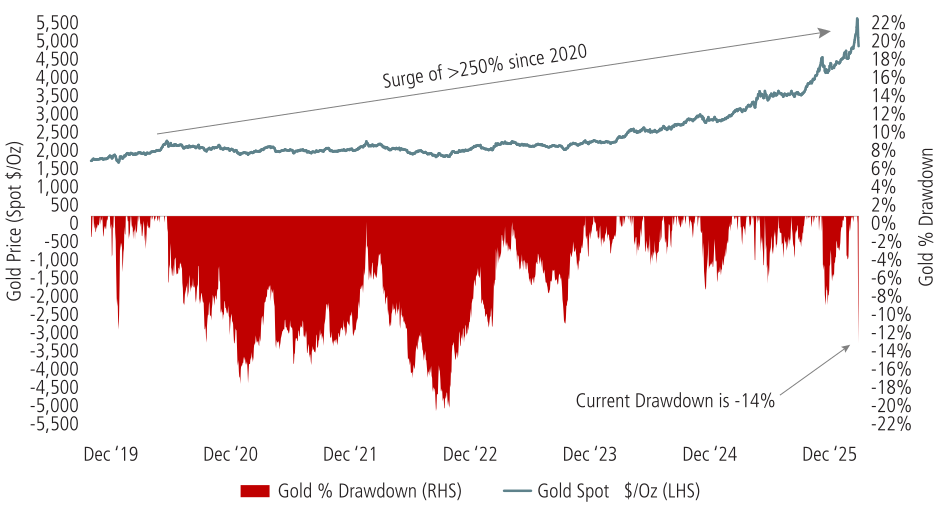
Source: Bloomberg, as of Jan 2nd, 2026.
Equities. In our view, prospects for global equities remain broadly positive. We now see emerging markets—led by India and Brazil—as an overweight but have reduced non-U.S. developed markets to an “at target” view. While yen volatility and a recent move higher in valuations may translate into short-term pressure on Japanese equities, structural underweights in developed ex.-U.S. portfolios combined with a mid- to long-term constructive view on these companies merit a continued focus. We continue to favor U.S. small and midcaps, and, in fact, have become more optimistic as rate cuts, deregulation and pro-business policies more than offset short-term fluctuations in business confidence. Recent volatility has called into question the risk of overexposure to technology and AI-adjacent companies, and, as such, we reiterate our recommendation of geographic and sector diversification.
Fixed Income. A strong 2025 and a slowing rate-cutting cycle largely underpin our downgrade of U.S. government securities, investment grade corporate credit and high yield, while municipal bonds remain at target. In contrast, we hold an overweight view of non-U.S. developed market bonds, reflecting more attractive valuations after recent volatility, as well as emerging market sovereign bonds, given their appealing yields and economic fundamentals. Multi-sector bond funds may be an appropriate vehicle to consider, given the levers a manager can opportunistically pull across sector, duration profile and region; municipals also remain attractive when compared with the broader universe of U.S. investment grade issues.
Private Markets. While we maintain our positioning across real and alternative assets, including overweights to commodities, private equity and private real estate, we have upgraded our view on absolute return strategies to at-target from underweight, reflecting more dynamic market conditions. Private debt remains “at target,” although rising credit risk requires vigilance. Within private equity, liquidity and capital solutions providers will likely remain important to work through the substantial backlog of legacy investments, even as the pace of distributions accelerates against the backdrop of a revitalized M&A environment.
| Jan-26 | 3M | YTD | 2025 | |
|---|---|---|---|---|
| Equities | ||||
| Major U.S. Indices | ||||
| S&P 500 Index | 1.45% | 1.76% | 1.45% | 17.88% |
| Nasdaq Composite | 0.97% | -0.96% | 0.97% | 21.14% |
| Dow Jones | 1.80% | 3.23% | 1.80% | 14.92% |
| U.S. Size Indices | ||||
| Large Cap | 1.38% | 1.63% | 1.38% | 17.37% |
| Mid Cap | 3.06% | 4.08% | 3.06% | 10.60% |
| Small Cap | 5.35% | 5.75% | 5.35% | 12.81% |
| All Cap | 1.55% | 1.81% | 1.55% | 17.15% |
| U.S. Style Indices | ||||
| All Cap Growth | -1.27% | -3.48% | -1.27% | 18.15% |
| All Cap Value | 4.66% | 8.16% | 4.66% | 15.71% |
| Global Equity Indices | ||||
| ACWI | 2.96% | 4.03% | 2.96% | 22.34% |
| ACWI ex US | 5.98% | 9.13% | 5.98% | 32.39% |
| DM Non-U.S. Equities | 5.22% | 9.09% | 5.22% | 31.89% |
| EM Equities | 8.86% | 9.48% | 8.86% | 34.36% |
| Portfolios | ||||
| 50/50 Portfolio | 1.19% | 1.51% | 1.19% | 11.06% |
| Jan-26 | 3M | YTD | 2025 | |
|---|---|---|---|---|
| Fixed Income Currencies & Commodities | ||||
| Major U.S. Indices | ||||
| Cash | 0.29% | 0.92% | 0.29% | 4.18% |
| U.S. Aggregate | 0.11% | 0.58% | 0.11% | 7.30% |
| Munis | 0.94% | 1.26% | 0.94% | 4.25% |
| U.S. Corporates | ||||
| Investment Grade | 0.18% | 0.63% | 0.18% | 7.77% |
| High Yield | 0.51% | 1.80% | 0.51% | 8.78% |
| Short Duration (1.9 Yrs) | 0.23% | 1.07% | 0.23% | 5.39% |
| Long Duration (12.8 Yrs) | -0.22% | -1.14% | -0.22% | 6.65% |
| Global Fixed Income Indices | ||||
| Global Aggregate | 0.94% | 1.43% | 0.94% | 8.17% |
| EMD Corporates | 0.77% | 1.51% | 0.77% | 8.74% |
| Commodities | ||||
| Commodities | 10.36% | 13.53% | 10.36% | 15.77% |
| U.S. Treasury Yields | ||||
| U.S. 10-Year Yield | 0.07% | 0.16% | 0.07% | -0.40% |
| U.S. 2-Year Yield | 0.05% | -0.05% | 0.05% | -0.77% |
| FX | ||||
| U.S. Dollar | -1.35% | -2.82% | -1.35% | -9.37% |
Source: Bloomberg, Total returns as of January 30th, 2026. S&P 500 Index is represented by S&P 500 Total Return Index. Nasdaq Composite NASDAQ-Composite Total Return Index. Dow Jones is represented by Dow Jones Industrial Average TR. Large Cap is represented by Russell 1000 Total Return Index. Mid Cap is represented by Russell Midcap Index Total Return. Small Cap is represented by Russell 2000 Total Return Index. All Cap is represented by Russell 3000 Total Return Index. Large Cap Growth is represented by Russell 1000 Growth Total Return. Large Cap Value is represented by Russell 1000 Value Index Total Return. Small Cap Growth is represented by Russell 2000 Growth Total Return. Small Cap Value is represented by Russell 2000 Value Total Return. ACWI is represented by MSCI ACWI Net Total Return USD Index. ACWI ex US is represented by MSCI ACWI ex USA Net Total Return USD Index. DM Non-U.S. Equities is represented by MSCI Daily TR Gross EAFE USD. EM Equities is represented by MSCI Daily TR Gross EM USD. Cash is represented by ICE BofA US 3-Month Treasury Bill Index. U.S. Aggregate is represented by Bloomberg US Agg Total Return Value Unhedged USD. Munis is represented by Bloomberg Municipal Bond Index Total Return Index Value Unhedged USD. Munis Short Duration is represented by Bloomberg Municipal Bond: Muni Short (1-5) Total Return Unhedged USD. Munis Intermediate Duration is represented by Bloomberg Municipal Bond: Muni Intermediate (5-10) TR Unhedged USD. Investment Grade is represented by Bloomberg US Corporate Total Return Value Unhedged USD. High Yield is represented by Bloomberg US High Yield BB/B 2% Issuer Cap Total Return Index Value Unhedged USD. Short Duration is represented by Bloomberg US Agg 1-3 Year Total Return Value Unhedged USD. Long Duration is represented by Bloomberg US Agg 10+ Year Total Return Value Unhedged USD. Global Aggregate is represented by Bloomberg Global-Aggregate Total Return Index Value Unhedged USD. EMD Corporates is represented by J.P. Morgan Corporate EMBI Diversified Composite Index Level. EMD Sovereigns – USD is represented by J.P. Morgan EMBI Global Diversified Composite. Commodities is represented by Bloomberg Commodity Index Total Return. Commodities ex Energy is represented by Bloomberg Ex-Energy Subindex Total Return. U.S. 10-Year Yield is represented by US Generic Govt 10 Yr.
1The Magnificent 7 companies are Nvidia, Apple, Microsoft, Amazon, Alphabet, Broadcom and Meta, as of November 30, 2025.
IMPORTANT INFORMATION:
This material is provided for informational and educational purposes only and nothing herein constitutes investment, legal, accounting or tax advice, or a recommendation to buy, sell or hold a security. This material is general in nature and is not directed to any category of investors and should not be regarded as individualized, a recommendation, investment advice or a suggestion to engage in or refrain from any investment-related course of action. Neither Neuberger Berman nor its employees provide tax or legal advice. All information is current as of the date of this material and is subject to change without notice. The firm, its employees and advisory accounts may hold positions of any companies discussed. Any views or opinions expressed may not reflect those of the firm as a whole. Neuberger Berman products and services may not be available in all jurisdictions or to all client types. Diversification does not guarantee profit or protect against loss in declining markets. Investments in private equity are speculative and involve a higher degree of risk than more traditional investments. Investments in private equity are intended for sophisticated investors only. Unless otherwise indicated, returns shown reflect reinvestment of dividends and distributions. Indexes are unmanaged and are not available for direct investment. Investing entails risks, including possible loss of principal. Past performance is no guarantee of future results.
Portfolio positioning views expressed herein are those of Neuberger Berman’s Private Wealth Investment Group which may include those of the Neuberger Berman’s Asset Allocation Committee. Asset allocation and positioning views are based on a hypothetical reference portfolio. The Private Wealth Investment Group analyzes market and economic indicators to develop asset allocation strategies. The Private Wealth Investment Group works in partnership with the Office of the CIO. The Private Wealth Investment Group also consults regularly with portfolio managers and investment officers across the firm. The Asset Allocation Committee is comprised of professionals across multiple disciplines, including equity and fixed income strategists and portfolio managers. The Asset Allocation Committee reviews and sets long-term asset allocation models, establishes preferred near-term tactical asset class allocations and, upon request, reviews asset allocations for large, diversified mandates. Asset Allocation Committee members are polled on asset classes and the positional views are representative of an Asset Allocation Committee consensus. The views of the Asset Allocation Committee and the Private Wealth Investment Group may not reflect the views of the firm as a whole and Neuberger Berman advisers and portfolio managers may take contrary positions to the views of the Asset Allocation Committee or the Private Wealth Investment Group. The Asset Allocation Committee and the Private Wealth Investment Group views do not constitute a prediction or projection of future events or future market behavior. Defensive positioning generally means an underweight bias on allocations to risk assets such as equities and alternatives. Positioning views may change over time without notice and actual client positioning may vary significantly. Discussion of yield characteristics or total returns of different asset classes are for illustrative purposes only. Such asset classes, such as equities and fixed income, may have significantly different overall risk-return characteristics which should be consider before investing.
The information in this material may contain projections, market outlooks or other forward-looking statements regarding future events, including economic, asset class and market outlooks or expectations, and is only current as of the date indicated. There is no assurance that such events, outlook and expectations will be achieved, and actual results may be significantly different than that shown here. The duration and characteristics of past market/economic cycles and market behavior, including any bull/bear markets, is no indication of the duration and characteristics of any current or future be market/economic cycles or behavior. Information on historical observations about asset or sub-asset classes is not intended to represent or predict future events. Historical trends do not imply, forecast or guarantee future results. Information is based on current views and market conditions, which will fluctuate and may be superseded by subsequent market events or for other reasons.
Discussions of any specific sectors and companies are for informational purposes only. This material is not intended as a formal research report and should not be relied upon as a basis for making an investment decision. The firm, its employees and advisory accounts may hold positions of any companies discussed. Nothing herein constitutes a recommendation to buy, sell or hold a security. It should not be assumed that any investments in securities, companies, sectors or markets identified and described were or will be profitable. Investment decisions and the appropriateness of this content should be made based on an investor's individual objectives and circumstances and in consultation with his or her advisors.
Neuberger Berman Investment Advisers LLC is a registered investment adviser.
The “Neuberger Berman” name and logo are registered service marks of Neuberger Berman Group LLC.