NEWS AND INSIGHTS | INSIGHTS
Mapping the Evergreens: Finding Direction in Private Markets Innovation
April 30, 2026

Evergreen fund structures are opening private markets to a broader range of investors. In our view, understanding how to match the right vehicle to the right asset class and strategy could be the key to building a truly effective private markets portfolio. DOWNLOAD ARTICLE
As individual investors increasingly gain access to private markets strategies through product and vehicle innovation, we believe it’s important to consider the nuances of recently developed fund structures: What are their benefits and tradeoffs? How do they align with the unique characteristics of various asset classes and strategies? And how do we think about using these fund structures in a total portfolio context? Here, we explore the various “evergreen” fund types, and how they fit into diversified private markets portfolios.
Once the domain of institutional investors and ultra-high-net worth families, private markets have gradually opened up to a broader range of clients as product and vehicle innovation has progressed.
We have long believed that, where appropriate, private markets can deliver diversified sources of returns to enhance outcomes for investors’ portfolios. The challenge historically was not the value of the asset class, but rather the limitations of the traditional limited partnership fund structure: stringent investor qualifications, high minimums, long lockups (sometimes lasting a decade or more), complex cash-flow planning and onerous tax reporting.
Over the last several years, however, we’ve experienced a significant rise in evergreen fund structures that seek to mitigate some of these burdens. Specifically, evergreen funds accept ongoing investments (rather than just in an offering at the opening of a fund) and provide potential for periodic withdrawals, though often not guaranteed, in contrast to the more severe lockups of traditional funds. Many have lower minimums and less onerous investor requirements. The changes have drawn a generally positive response from investors, leading to meaningful growth for evergreen funds as the market continues to refine and adapt these structures (see “Advantages and Trade-Offs” below).
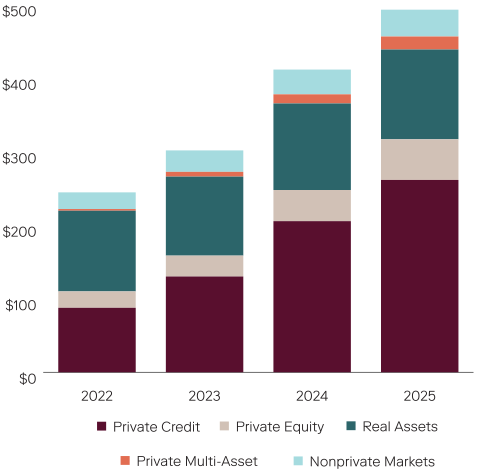
Source: Pitchbook, 4Q2025 U.S. Evergreen Fund Landscape Summary.
Advantages
Operational simplicity. Evergreen funds generally involve a single subscription and one capital call, with the flexibility to increase the subscription amount over time if desired. Tax reporting is generally simpler than for traditional funds.
Capital efficiency. Investor commitments can be deployed immediately into a diversified portfolio of private investments, enhancing potential for compounding returns from day one. Cash inflows from company realizations are often reinvested efficiently.
Lower investor requirements and minimums. Evergreens are open to a larger cohort of investors, and lower investment minimums enable more effective diversification across asset classes and strategies.
Potential for periodic withdrawals. It’s easier to withdraw capital during periods of relative calm, although there may be “gating” mechanisms that limit redemptions during bouts of market stress and increased demand for liquidity from investors. Gating helps to alleviate liquidity mismatches, where pressure for withdrawals might otherwise force managers to sell at inopportune prices (see “liquidity mismatch” below).
Transparency. More frequent reporting makes it easier to evaluate manager track records and underlying exposures.
Trade-Offs
Liquidity mismatch. Even with their advantages, it’s important to understand what evergreen structures cannot do: transform inherently illiquid private assets into liquid investments simply by wrapping them in a more accessible vehicle. This distinction proved consequential during the 2022 real estate sell-off and, more recently, amid this year’s private credit dislocation, where there have been mismatches between redemption requests and the liquidity that funds were able to provide. While some have criticized the liquidity gates employed to hold back those dollars, such mechanisms can serve as a needed protective feature to shield all investors—those seeking to exit and those staying invested—from losses that can result from forcing the sale of illiquid assets at depressed prices.
Cash drag. Evergreen funds typically hold cash and publicly traded securities to meet potential redemption requests. Holding more cash can dampen return potential, while liquid public securities generally do not benefit from the expected illiquidity premium associated with private investments. In general, the more frequently liquidity is offered, the greater the need to maintain cash and other liquid holdings.
Sourcing. As evergreen vehicles grow, managers may face the challenge of sourcing attractive investments at scale while maintaining underwriting discipline.
Despite the commonalities, it’s easy to oversimplify the evergreen landscape. Thinking about the funds too broadly tends to gloss over the nuances within the evolving category, which encompasses both newer structures such as private evergreens, tender offer funds and interval funds, and “recycled” entities including non-traded Business Development Companies (BDCs) and Real Estate Investment Trusts or REITs (see the table below for a breakdown).
Keep in mind that these are holding entities, not actual investments, so their distinctions relate to characteristics like subscription frequency (when the investor commits to the manager), available liquidity, investment minimums, investor qualification requirements and more. While these elements are part of the overall appeal of evergreens, what can matter more is how closely they fit with the various private market asset classes and strategies that are available.
| Traditional Limited Partnerships | Evergreen Funds | ||||
|---|---|---|---|---|---|
| ‘Closed-End Drawdown’ | Private Evergreen | Tender Offer | BDC / REIT (Non-traded) | Interval Fund | |
| General | Classic private markets structure, long-term orientation, liquidity lock-ups | Ongoing subscriptions and redemptions while preserving flexible format of traditional LP | Periodically invites investors to redeem at NAV; SEC-registered | Focused on private credit or real estate; periodic repurchases, wider investor eligibility, simpler taxes; SEC-registered | Most accessible evergreen, best suited to shorter-duration, income-oriented investments; SEC-registered |
| Subscription Frequency | Capital committed upfront, called over several years | Quarterly or monthly | Monthly | Monthly | Daily |
| Valuation Frequency | Quarterly | Quarterly or monthly | Monthly | Monthly | Daily |
| Redemption Terms | Long lock-ups followed by periodic distributions | Periodic, subject to gates | Quarterly, subject to a limit and board discretion | Monthly or quarterly, subject to a limit and board discretion | Required quarterly, subject to a limit |
| Typical Minimum Investment | $250,000+ | $250,000+ | $25,000+ | $2,500+ | $1,000+ |
| Investor Eligibility | Qualified purchaser | Qualified purchaser | Accredited investor or qualified client | By state | Accredited investor or below |
| Tax Reporting | K1 | K1 | 1099 | 1099 | 1099 |
| Leverage and Diversification Limits | No | No | Yes | Yes | Yes |
| Most Suitable Asset Class | Long-duration asset classes (private equity, opportunistic real estate, infrastructure) | All, with bias toward income | All | Private credit or real estate | Short duration, income-focused (private credit) |
Source: Neuberger. For illustrative and discussion purposes only. A SEC-registered fund is subject to regulatory oversight, and must comply with requirements set by the U.S. Securities and Exchange Commission. Generally speaking, a qualified purchaser has at least $5 million in investments, an accredited investor has a net worth of at least $1 million or an annual income of at least $200,000, and a qualified client has a net worth of at least $2.2 million or assets under management of over $1.1 million. Further criteria may apply; consult your Wealth team for details.
At a high level, the appropriateness of a given vehicle may depend on the characteristics of an underlying investment strategy—in particular, the consistency and timing of cash flows, the holding period and the ease with which assets can be sold or refinanced. The key for investors, then, is to make sure that asset class and fund type align effectively.
| Cash Flows | Less Liquid | More Liquid |
|---|---|---|
| Less Predictable | PE Buyout/Venture Typical vehicles:
|
Public-Private Hybrid Typical vehicles:
|
| More Predictable | Real Assets (Core Real Estate/Infrastructure) Typical vehicles:
|
Private Credit/Asset-Based Finance Typical vehicles:
|
Source: Neuberger.
Private credit. As a form of debt, private credit tends to have better-defined maturities and consistent income potential than equity strategies, allowing for increased liquidity at the fund level. As such, private credit may be well suited for inclusion in interval funds, the most liquid fund structure, which are legally required to offer periodic share repurchases and whose holdings can now be entirely devoted to the asset class.
Another choice for private credit is a non-traded BDC, which are funds that lend to middle-market companies. They must offer owners periodic opportunities to sell shares back to the fund. The industry standard is for quarterly repurchase offers of up to 5% of net asset value (NAV), although terms may vary by fund. Indeed, the timing and size of each offer is determined by the fund’s independent board—providing investors with a degree of regular liquidity while preserving the fund’s ability to hold longer-term assets.
Private equity (PE). PE strategies (including buyouts, growth equity, venture capital, co-invest and secondaries) are typically less suited to highly liquid structures due to long holding periods and irregular exit timing; longer-dated structures such as “tender-offer funds” and old fashioned “closed-end drawdown” funds may work better.
With a tender-offer fund, the board may periodically invite investors to sell back a portion of their shares at NAV, typically on a quarterly or semiannual basis, although it has no obligation to do so. Unlike interval funds, they also don’t have to maintain a minimum level of liquid assets, either. This allows for bigger allocations to private equity, but may make these vehicles a less reliable source of cash when needed. Ultimately, this reduced liquidity is better aligned with the long-term nature of the asset class.
Closed-end drawdown funds (clearly not “evergreen” but useful for comparison) are the classic structure for private equity. Here, investors commit capital upfront that is “called” over time as investments are made. Capital is returned, along with earnings, as portfolio companies are sold.
Some managers have launched hybrid strategies combining public and private equity within interval funds. However, because interval funds carry fixed repurchase obligations, most of their assets are usually in public markets. Similarly, mutual funds and ETFs can only allocate up to 15% in illiquid private assets given their need to provide daily liquidity. Although right for some investors, they may be less effective for investors looking to meaningfully bolster private equity, private credit or real asset exposure.
Real assets. Real estate and infrastructure carry their own unique attributes that can affect their fit with various fund structures. Generally speaking, real estate and infrastructure investments include large, illiquid, long-lived assets, which can make it difficult to sell them for near-term liquidity.
However, “core” real estate and infrastructure investments typically have more stable values and a cash component that can mitigate, though not eliminate, illiquidity risk. For these investments, non-traded REITs can be an appropriate vehicle, typically offering quarterly share repurchase programs similar to tender offer funds. It is worth distinguishing these from publicly traded REITs, which are exchange-listed securities with full daily liquidity and are more analogous to public equities than to private real estate vehicles.
Value-add or opportunistic real asset strategies often hold assets undergoing repositioning or development, with limited near-term cash flows. They therefore may be less suited to fund structures with fixed repurchase obligations, such as interval funds, and more appropriate for tender-offer funds and traditional drawdown structures.
Buyout: Investment in mature companies, often keyed to operational improvement.
Venture capital: Focus on early-stage, high-growth companies with future earnings prospects.
Private credit: Loans made directly to companies or assets outside of the traditional banking system, spanning corporate lending, asset-based finance, etc., with a focus on generating returns through interest income.
Real assets: Purchase/management of long-lived physical assets, including real estate and infrastructure.
Distressed: Investment in stressed companies typically involving restructuring, refinancing and/or other operational turnaround efforts.
Secondaries: Purchase of existing, more mature stakes in private funds on the secondary market.
Co-invest: A direct investment in a specific company or asset alongside general partners who manage the investment day-to-day.
Looking beyond the asset class level, not all strategies are equally suited to evergreen fund structures that require continuous deployment of capital as investors contribute to the fund. In our view, what matters is strong and consistent deal flow that allows the manager to hit deployment targets while maintaining underwriting standards. This gives an advantage to scaled private equity and private credit platforms, co-invest and some secondaries strategies.
In addition, evergreen vehicles may not work for some niche strategies that invest in a narrow market, or that hold only limited, high-conviction positions. This can be true of industry-specific venture capital or buyout strategies, for example, along with opportunistic approaches like distressed investing that focus on short-term market dislocations. “Primary fund” investments, where investors commit capital to a blind pool and contribute capital calls over a multiyear period to fund investments, followed by intermittent liquidity as investments are sold, may also be ill-suited to evergreens given their cash-flow characteristics. Illiquidity risk may increase during market stress, when redemption requests can rise just as new deal flow slows. Thus, we think these strategies are often better suited to traditional drawdown fund structures.1
What role can evergreen private marketd funds play in a total portfolio context? We observe two approaches.
1. Core-Only Exposure
Investors who aren’t willing or able to deal with the operational complexity of traditional closed-end, drawdown structures may look to evergreen funds for their sole private markets exposure. Diversification through direct co-investments and general partner-led secondaries sourced from a wide range of managers can provide fee efficiency and diversification across manager, industry, company size, geography and vintage year.
2. Core and Satellite
Using both evergreen and traditional vehicles can offer advantages. Evergreens can act as the core PE exposure, while traditional funds can provide access to niche, opportunistic and/or complementary strategies. The evergreen holdings can speed up the overall investment timeline of the portfolio, making the combination particularly suited for investors who are early in the private markets journey and want to put capital to work. (Note that a core-and-satellite approach still requires thoughtful pacing of commitments to traditional drawdown vehicles to avoid overconcentration in any single vintage.)
This approach allows investors to view their entire portfolio through a liquidity lens, segmenting capital into buckets based on time horizon and accessibility. Evergreens, which provide the potential to redeem/tender shares periodically (subject to fund terms), occupy the middle tier between fully liquid public markets holdings and locked-up private markets commitments. This structure can account for shorter-term needs while enhancing long-term compounding potential in less liquid strategies.

The proliferation of evergreen fund structures has increased accessibility to the private markets, to the benefit of a broadening segment of investors. However, while not all fund structures are the same, in our view, none is superior. Rather, the appropriate choice may depend on the interaction among the liquidity profile of the underlying investments, the characteristics of the strategy, and the objectives of the investor. Working to develop an optimal mix can take some effort, but ultimately should enhance the impact of the private markets asset class as investors seek long-term portfolio performance and risk mitigation.
1See Von Lehe, et. al., “Evergreen Private Equity Investing: Key Benefits of a Direct, Multimanager Approach,” Neuberger, January 28, 2026.
This material is provided for informational and educational purposes only and nothing herein constitutes investment, legal, accounting or tax advice. This material is general in nature and is not directed to any category of investors and should not be regarded as individualized, a recommendation, investment advice or a suggestion to engage in or refrain from any investment-related course of action. Investment decisions and the appropriateness of this material should be made based on an investor's individual objectives and circumstances and in consultation with his or her advisors. Information is obtained from sources deemed reliable, but there is no representation or warranty as to its accuracy, completeness or reliability. All information is current as of the date of this material and is subject to change without notice. The firm, its employees and advisory accounts may hold positions of any companies discussed. Any views or opinions expressed may not reflect those of the firm as a whole. Neuberger products and services may not be available in all jurisdictions or to all client types. References to third-party sites are for informational purposes only and do not imply any endorsement, approval, investigation, verification or monitoring by Neuberger of any content or information contained within or accessible from such sites.
This material may include estimates, outlooks, projections and other “forward-looking statements.” Due to a variety of factors, actual events or market behavior may differ significantly from any views expressed. Investing entails risks, including possible loss of principal. Investments in hedge funds and private equity are speculative and involve a higher degree of risk than more traditional investments. Investments in hedge funds and private equity are intended for sophisticated investors only. Indexes are unmanaged and are not available for direct investment. Past performance is no guarantee of future results.
This material is being issued on a limited basis through various global subsidiaries and affiliates of Neuberger Berman Group LLC. Please visit www.nb.com/disclosure-global-communications for the specific entities and jurisdictional limitations and restrictions.
The “Neuberger” name and logo are registered service marks of Neuberger Berman Group LLC.