NEWS AND INSIGHTS | INSIGHTS
Political Outlook: If You Feel Exhausted Now…
July 29, 2026

In an already frenetic year for policy and politics, expect more noise and uncertainty, but minimal legislative achievement.
Download the Article
President Donald Trump began his second term with a barrage of moves to unwind Biden policy measures and double down on cornerstones of his America First agenda, including immigration enforcement, government efficiency, tariffs, deregulation, low taxes and assertive foreign policy. However, despite early legislative success, the country’s still-elevated (if improved) inflation and a difficult military conflict have helped weaken his approval rating and undermined Republicans in advance of a likely difficult midterm election. We talked to political analyst Frank Kelly about recent geopolitical, policy and political developments, and what to watch for in the months ahead.
The midterm elections are now in focus. How are you handicapping the outcome?
I think the Democrats are likely to take the U.S. House of Representatives by a small margin and have a 50/50 chance of winning the Senate. Given that the opposition is typically favored in the House during a midterm election, the question is one of magnitude. At one point, it seemed like the Democrats could win a 20-seat margin. But gerrymandering will likely narrow that gap, giving them around 10-plus seats in the House.
Candidate quality is making the Senate tougher for Republicans than it had to be. Any time there’s a contested race in a “safe” state, you have to spend extra money at the expense of other locations. Nebraska, Alaska, Iowa, Ohio and Texas are all unexpectedly vulnerable “red” states, a situation made worse for Republicans in these farming states by stresses tied to the President’s tariffs. Farmers are really hurting and while most vote Republican, the risk is that they just don’t show up at the polls on election day.
How important is economic insecurity to the election?
Kitchen table issues will likely be crucial, and are a key reason for the GOP weakness I just mentioned and the more progressive nature of many Democratic candidates. These trends speak to the economic insecurity faced by many Americans, and suggest that they may be ready to vote for change—whatever that change may be.
Is political division accelerating?
It seems to be, and it goes beyond traditional party lines. Among Democrats, there’s an ugly fight between progressives and moderates over political direction. A number of House Democrats recently said they would start boycotting the Democratic Congressional Campaign Committee because of its habit of tipping the scale toward progressive candidates. Playing favorites within a party is something that Trump did in his first term, and Democrats have followed suit. Among Republicans, the MAGA movement is in charge for now, but there has been fragmentation since the start of the Iran war—a trend that could worsen during the midterms and the runup to 2028.
Does candidate quality matter anymore?
We are seeing candidates with major skeletons in the closet, but that hasn’t seemed to matter much to primary voters. In Maine, they chose unvetted Democrat Graham Platner, who later withdrew, and in Texas they picked scandal-ridden Republican Ken Paxton. It appears that these voters are more interested in defeating the other team than worrying about personal flaws; but whether that works out in the general election is an open question. Sadly, it could be that fewer potentially great leaders are willing to run at all. They would rather be in the private sector and use their connections to encourage change—whether in support of the greater good or their specific business interests. As one political analyst friend once told me, sometimes in politics, “it is better to know them than to be them.”
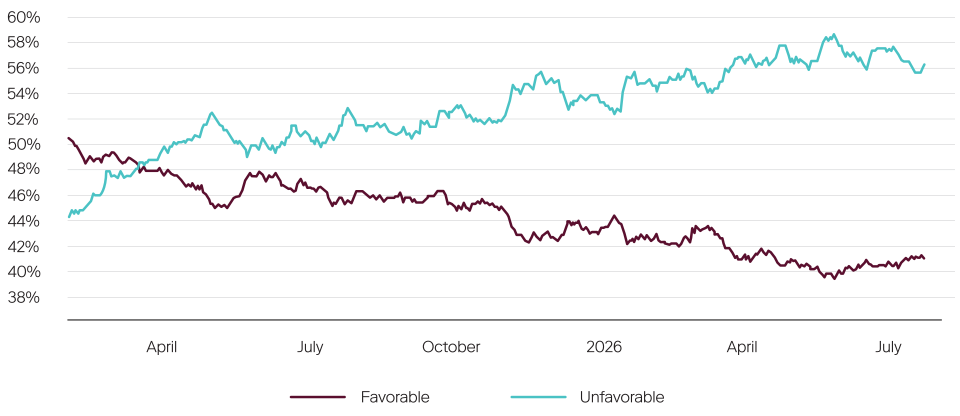
Source: Real Clear Politics polling average. Data as of July 13, 2026.
Do you anticipate any substantial policy advances for the rest of the year?
The calendar is crucial, and there simply aren’t that many legislative days left in 2026. Also, Congress will be focused on elections, and won’t want to vote for anything that could hurt politically. That said, I'm watching for legislation on cryptocurrency, which Congress has been wrestling with for years; they passed one piece of major crypto legislation last year, but more is needed to fill out a very skeletal regulatory regime. We could also see additional reconciliation bills (requiring just 51 Senate votes for passage), focusing on defense spending and voter ID, along with a number of “wish list” items that legislators will want to give constituents, including raising the deduction for state and local taxes and various business provisions. But these are big “ifs”, and whether anything more gets done this year is an open question.
How about in 2027?
Next year, you should see Congress focus on artificial intelligence and deregulation, as well as health care measures designed to facilitate the use of GLP-1 drugs across an array of diseases, and more broadly the acceleration of treatment innovation powered by AI. Legislators face a steep learning curve in cutting-edge areas, but there’s bipartisan consensus for regulatory guardrails that facilitate development while limiting risk.
Space will be on the agenda, as well as defense. Threats are growing, and Ukraine has demonstrated how much the battlefield has changed. Once the cornerstone of military strategy, tanks today seem as useful as horse cavalry; and the role of artillery and foot soldiers has been reduced in favor of drones and robots. Converting 20th century capabilities to meet 21st century needs will require a lot of money, and create heated debate over priorities.
That said, the real action may be on the regulatory front. Agencies including the FDA, SEC and Federal Reserve are where the Trump “A team” congregates. These are very competent administrators, and are moving aggressively on a variety of regulatory reforms that will likely be locked in over the second half of the presidential term.
Could we see a new wave of investigations by Democrats?
Yes, assuming Democrats reclaim one or both chambers. I think that an impeachment effort is almost a sure thing, although we would never see a conviction given the two-thirds majority required in the Senate. Beyond that, I think there will be more investigations across many areas of the administration, and we could see more corporate CEOs appear at Congressional hearings. Democrats have made it very clear that they intend to investigate any M&A deal where a company seemed to get preferential treatment—a process potentially soaked in reputational risk for those involved.
Let’s turn to foreign policy. What’s your current take on the Iran situation?
Many people look at this war as just another Middle East conflict, but I think that’s wrong. Unlike any other country in the region, Iran has endured over 50 years of hardship due to wars and heavy sanctions, mostly imposed under the direction of the U.S. But its leaders have done whatever it takes to maintain power, including killing thousands of their own citizens, and retain substantial, well-trained military forces. Despite setbacks, the country remains ideologically committed in its opposition to the U.S. and Israel.
The initial peace agreement faltered even though it involved few concessions from Iran. And while leaders there initially agreed to open the Strait of Hormuz, clearly, they have the ability to close it when they wish. Iran also understands the broader economic strains caused by the war, which could make the U.S. reluctant to sustain kinetic action. I expect a constant struggle going forward, whether militarily, in negotiations or in getting Iran to stick to an agreement.
What could be the lasting economic effects of the conflict?
I think it’s proving to be an accelerant of economic self-sufficiency—a trend that was already developing after the pandemic. Many countries are now moving at warp speed to find alternate sources for oil, fertilizer, hydrogen and other essential products and services, including the expansion of capabilities within their own borders.
We haven’t heard much lately about China and Taiwan. How has that situation evolved?
In my view, President Xi Jinping has learned the lesson that if you invade another country like Russia did to Ukraine, things can go very badly—not only from a military perspective but economically as well. Aside from oil, Russia had a very small place in the global economy, but China could be devastated by similar sanctions if it chose to invade Taiwan. Xi is probably also distracted by his current purge of military leaders and more broadly by sluggish economic growth.
All in, Xi appears to have tempered his approach to Taiwan, with softer messaging and more outreach. For example, he recently hosted the head of the KPT, the Taiwan opposition party, for the first time in 10 years. It seems that, for now, he’d rather use honey than vinegar in seeking reunification.
Conditions in Cuba continue to deteriorate. What do you expect there?
What’s happening in Cuba is extraordinarily sad. Something like 70% of the population can only afford one meal a day; they have virtually no oil or natural gas; the infrastructure has collapsed; and blackouts are chronic. The country is essentially in palliative care, and to me the question is not whether, but when there is a political change. More than likely, we’ll see an arrangement like in Venezuela, with members of the current regime serving in an interim government that theoretically moves toward holding free and fair elections. Importantly, in that case, capital would likely begin flooding in—not just to hotels and casinos, but to many other areas. There’s reportedly substantial offshore oil drilling potential, and even opportunity to mine for critical minerals. In this way, the country could be shocked back to life.
Looking across the globe, do you see any underrated risks?
In my view, Russia is a huge risk that is flying under the radar. That is, we are all locked into a mindset of what happens if Russia wins in Ukraine, but what happens if Russia loses? Its economy is getting worse every day, and internal criticism of Vladimir Putin is rising. If we wake up in six months and Putin is out of power, who will take over? The options could be much worse than we have now, including zealous nationalists who favor even more aggressive military action.
Could Putin make a deal with Ukraine?
By some estimates, about 1.4 million Russians have died in the Ukraine war. The Russian economy is in a shambles. How does Putin explain an agreement where they receive little more than what they had at the start of the war, and potentially sanctions aren’t even removed? He is between a rock and a hard place.
Pessimism is endemic these days. Does anything make you optimistic?
Yes, and it’s a combination of innovation and capital. Years ago, when faced with major political and military crises, you and I might have just said our prayers and hoped for the best. But today, we can pick up the phone and make a trade—we invest. The capital markets are now a mitigator of risk.
There’s no better example than Ukraine: It took the capital markets investing in drone technology and robotics to change the course of the war. In Latin America, despite ongoing challenges, innovation and investment are encouraging greater stability and growth. In China, worries over sanctions and investor backlash are discouraging aggression toward Taiwan. In my view, the power of capital to achieve change could become even more meaningful in the years ahead.
This material is provided for informational and educational purposes only and nothing herein constitutes investment, legal, accounting or tax advice, or a recommendation to buy, sell or hold a security. This material is general in nature and is not directed to any category of investors and should not be regarded as individualized, a recommendation, investment advice or a suggestion to engage in or refrain from any investment-related course of action. Investment decisions and the appropriateness of this material should be made based on an investor’s individual objectives and circumstances and in consultation with his or her advisors. This material is not intended as a formal research report and should not be relied upon as a basis for making an investment decision.
The firm, its employees and advisory clients may hold positions within sectors discussed, including any companies specifically identified. Specific securities identified and described do not represent all of the securities purchased, sold or recommended for advisory clients. It should not be assumed that any investments in securities, companies, sectors or markets identified and described were or will be profitable. Neuberger, as well as its employees, does not provide tax or legal advice. You should consult your accountant, tax adviser and/or attorney for advice concerning your particular circumstances. Information is obtained from sources deemed reliable, but there is no representation or warranty as to its accuracy, completeness or reliability.
All information is current as of the date of this material and is subject to change without notice. Any views or opinions expressed may not reflect those of the firm as a whole and Neuberger does not endorse any third-party views expressed. Third-party economic or market estimates discussed herein may or may not be realized and no opinion or representation is being given regarding such estimates. Neuberger products and services may not be available in all jurisdictions or to all client types. The use of tools cannot guarantee performance. Diversification does not guarantee profit or protect against loss in declining markets. As with any investment, there is the possibility of profit as well as the risk of loss. Investing entails risks, including possible loss of principal. Investments in hedge funds and private equity are speculative and involve a higher degree of risk than more traditional investments. Investments in hedge funds and private equity are intended for sophisticated investors only. Unless otherwise indicated, returns reflect reinvestment of dividends and distributions. Indexes are unmanaged and are not available for direct investment. This material may include estimates, outlooks, projections and other “forward-looking statements.” Due to a variety of factors, actual events may differ significantly from those presented. Investing entails risks, including possible loss of principal. Past performance is no guarantee of future results.
Neuberger Berman Investment Advisers LLC is a registered investment adviser. The “Neuberger” name and logo are service marks of Neuberger Berman Group LLC.