NEWS AND INSIGHTS | INSIGHTS
Private Credit: An Emerging Silver Lining
July 29, 2026

Careful deal selection and attention to risk can help investors capitalize on recent market turbulence.
Download the Article
The private credit market has recently been in the crosshairs of a skeptical public. Calls for redemptions at private Business Development Companies (BDCs), potential impacts of artificial intelligence and the general health of private borrowers in a higher interest-rate environment are all causing angst in the financial press and markets. Although we think some concerns are valid, we believe they may be overstated in the context of a diversified portfolio with a careful underwriting process. Investors should also distinguish between the largely technical issue of redemption requests and questions around fundamental performance. Overall, recent dynamics have created an environment more friendly to lenders—enhancing what we consider an already compelling case for the asset class.
To understand the dynamics, it’s important to first clarify what’s being discussed. When we refer to private credit in this article, we mean the U.S. sponsor-backed direct lending market. That is, private loans that are privately negotiated and provided to privately owned companies—typically as part of a private equity-driven leveraged buyout, but sometimes tied to refinancing or an add-on acquisition. One way to think about this is that the investment is similar to private equity, except that you are at the top of the “capital stack” in senior debt, with returns primarily driven by contractual cash coupons rather than by earnings growth or multiple expansion. You typically receive your capital back at or ahead of maturity, or earlier if the company is sold or refinanced.
In general, private equity financing comes from one of two sources: the broadly syndicated loan market or private credit firms. In the syndicated loan market, investment banks originate and pass along their loans to mutual funds and collateralized loan obligation vehicles. Private credit firms work directly with private equity funds to underwrite and then hold the debt themselves. The direct lending market has grown to be larger than the syndicated market because, in many instances, we believe private equity firms prefer the speed, certainty and flexibility of direct lending. That said, while syndicated loans are repackaged, and thus reasonably liquid, private direct loans are not easily tradable, so investors receive a premium for greater complexity and illiquidity.
The negative turn in sentiment around the broad private credit market has been driven by multiple factors, including macro uncertainty, concerns about potential disruption from artificial intelligence and worries over how investments are being monitored and valued (i.e., marked to market in the absence of public trading). Pervasive negative media coverage has only amplified that anxiety.
A more structural recent challenge is an uptick in redemption requests at various private BDCs. The problem is due to a liquidity mismatch between the assets placed in these vehicles and the expectations of many investors, who were drawn to the BDCs based on their marketing as “liquid” or “semi-liquid” vehicles. Yes, these vehicles provide opportunities for liquidity, but practically speaking, liquidity is limited, as a majority of the underlying investments themselves are illiquid, leading to the imposition of redemption gates designed to protect remaining investors.
In Knowledge…
All this said, it is important to acknowledge and deal with investor concerns. When it comes to worries about AI, much of the news coverage today recognizes that the technology is going to transform the economy in ways that we don't understand yet—a key knowledge gap, as there is considerable investment by private equity and private credit in software, tech and business services companies exposed to AI impacts.
More broadly, uncertainty is a permanent feature of investing, not an exception to it. There are important questions we would all like answered, but clarity is rarely guaranteed—which is precisely why we call this investing rather than forecasting. In our experience, investors understand this. The knowledge gap is accepted as a fact of life, and the focus shifts to navigating it thoughtfully.
…and Trust
There’s also something we call the trust gap, where investors have questions arising from these concerns and others—about investment diversification, software/technology exposure, underlying loan-by-loan financial performance, the type, use, source and purpose of leverage, loans utilizing payment-in-kind (PIK) interest in place of cash interest, loans on non-accrual and the valuation of illiquid loans, to name a few. Addressing the trust gap should be easy: It all comes down to disclosure and open communication, which can give investors confidence about their portfolio and a manager’s capabilities, performance and alignment. Investment managers should be providing this information to investors at a regular cadence, with clear transparency around the methodology used to calculate the figures.
Default and loss rates, for example, are among the most commonly reported figures, and for good reason. They speak to a manager’s track record and offer a clear picture of how a portfolio has performed over time. But they are backward-looking by nature. They tell you what happened, not what may be developing right now.
That is where metrics like loans on a watchlist, loans paying coupon on PIK and loans on non-accrual become important. These figures offer a more current view of portfolio health, and can help identify early signs of borrower stress. It is important to note that “watchlist” is a subjective term that needs to be defined by the manager clearly. Moreover, PIK can occur in two ways: by design, where loan terms anticipate that a portion of interest may be temporarily deferred, providing flexibility to the borrower, or unplanned, potentially reflecting liquidity challenges faced by the borrower. Because the reporting and calculation of the PIK percentage can vary meaningfully from manager to manager, understanding the specific methodology behind the figure is essential to interpreting it correctly.
Although the economy has not experienced a recession in a long time, inflation and higher interest rates have pressured borrowers since the pandemic. Current industry defaults of 2.7% are slightly above their historical average range of 1.5 – 2.5%—a far cry from what one might assume from media coverage—and remain meaningfully lower than the 5.5% peak during COVID-19.1 We expect industry defaults to remain at an elevated level for some time as inflation, higher interest rates and technological transformation continue to affect the U.S. economy.
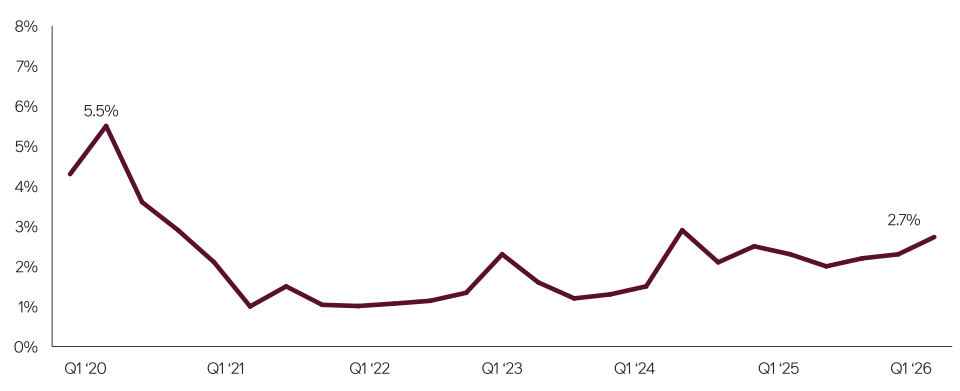
Source: Proskauer Rose. Data as of 1Q 2026. Default level is as of the end of the quarter indicated. The Private Credit Index, also known as the Proskauer Private Credit Default Index, includes 872 active senior secured and unitranche loans in the U.S., representing $152 billion in original principal amount.
In our view, default trends reinforce the importance of investing with a manager with strong deal-sourcing capabilities and a selective and disciplined investment approach. When assessing investment managers, their alignment, culture and structure are all important factors, as each shapes how a manager balances capital preservation against capital deployment. We believe that capital deployment is the enemy of selectivity: The pressure to put money to work can quietly erode the discipline that protects investors. At Neuberger, deploying capital is never a goal in itself. Capital preservation comes first—and, in our view, that discipline is precisely what drives attractive risk-adjusted returns over time.
Despite recent headlines, we believe that now is a compelling time to consider private credit. If anything, the negative attention has worked in lenders’ favor: Spreads on new loans have widened by approximately 50 basis points, accompanied by stronger documentation and tighter covenant packages. We expect these lender-friendly conditions to persist, with spreads potentially widening further.
In our view, the asset class itself is sound, but the manager matters enormously. As dispersion among managers continues to grow, investors should be deliberate about aligning themselves with those who combine strong sourcing capabilities with a genuine commitment to capital preservation.
1Source: Proskauer. Data as of 2Q 2026.
This material is provided for informational and educational purposes only and nothing herein constitutes investment, legal, accounting or tax advice. This material is general in nature and is not directed to any category of investors and should not be regarded as individualized, a recommendation, investment advice or a suggestion to engage in or refrain from any investment-related course of action. Investment decisions and the appropriateness of this material should be made based on an investor’s individual objectives and circumstances and in consultation with his or her advisors. Information is obtained from sources deemed reliable, but there is no representation or warranty as to its accuracy, completeness or reliability. All information is current as of the date of this material and is subject to change without notice. Any views or opinions expressed may not reflect those of the firm as a whole. Neuberger products and services may not be available in all jurisdictions or to all client types.
This material may include estimates, outlooks, projections and other “forward-looking statements.” Due to a variety of factors, actual events or market behavior may differ significantly from any views expressed. Investing entails risks, including possible loss of principal. Investments in hedge funds and private equity are speculative and involve a higher degree of risk than more traditional investments. Investments in hedge funds and private equity are intended for sophisticated investors only. Indexes are unmanaged and are not available for direct investment. Past performance is no guarantee of future results.
This material is being issued on a limited basis through various global subsidiaries and affiliates of Neuberger Berman Group LLC. Please visit www.nb.com/disclosure-global-communications for the specific entities and jurisdictional limitations and restrictions.
The “Neuberger” name and logo are service marks of Neuberger Berman Group LLC.