NEWS AND INSIGHTS | INSIGHTS
Market Outlook: Rallying Through Resistance
July 29, 2026

Despite uncertainty, investors appear optimistic about artificial intelligence and the economy. Why we agree—but are keeping an eye on risk and diversification opportunities.
Download the Article
Investors have recently endured questions around conflict and its consequences, but the answer from markets has proven familiar: gains tied to enthusiasm for AI and economic resilience. Despite the extended Strait of Hormuz closure, equity investors cast aside concerns about hotter inflation in the second quarter, and embraced a narrative of stronger earnings and a potential new phase of AI infrastructure development. The SpaceX initial public offering generated initial enthusiasm, whether from buyers looking for new exposure or those anticipating exit opportunities. In the Middle East, a tense ceasefire turned into an uneasy “memorandum of understanding,” which dampened the war premium in energy prices, but did not reduce expectations for higher short-term interest rates as central banks appeared poised to become more hawkish.
Market performance reflected these trends. Equities were strongly positive for the quarter, with the S&P 500 closing up 15.2% as growth reasserted itself over value. U.S. small-cap stocks were also winners, with wider AI investment helping names beyond the S&P 500. Emerging markets equities were particularly solid, up 24.2%, while European stocks lost their comparative luster as energy prices weighed on growth. Fixed income assets generally earned their coupon, with easing concerns about credit contagion supporting high yield over investment grade credit. Commodities were generally lower, largely due to lower energy prices on the back of Middle East de-escalation.
In recent months, equity markets experienced little of the broadening performance seen in January and February, with highly concentrated gains skewed to a small number of companies anointed (sometimes overnight) as the next winners in the AI race. Renewed comparisons to the 1990s fed into “fear of missing out,” as some investors may have felt compelled to bet on companies previously painted as too commoditized or niche to warrant exposure.
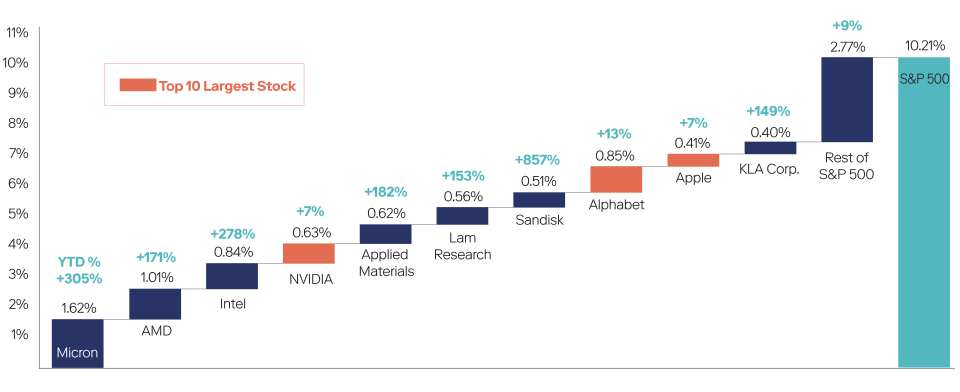
Source: FactSet. Data as of June 2026. Nothing herein constitutes a prediction or projection of future events or future market behavior. Historical trends do not imply, forecast or guarantee future results. Due to a variety of factors, actual events or market behavior may differ significantly from any views expressed. See additional disclosures at the end of this publication, which include additional information regarding the Neuberger Asset Allocation Committee and the Neuberger Wealth Investment Group and the views expressed. Investing entails risks, including possible loss of principal. Past performance is not indicative of future results.
Could the enthusiasm be justified? Investment in infrastructure to support large-scale adoption of AI points to the need for increased supply of memory and CPUs. But given practical and political limitations, companies that focus on creating more efficient data centers may see stronger revenues—even if the volume growth of these facilities disappoints. Most important, in our view, structural impediments to supply could boost pricing and profit margins for suppliers, translating into stronger earnings expectations.
That said, the “AI enablers” represent a relatively modest investment universe that may have trouble reaching the heights of more established names. While the mega-cap tech companies were able to draw on their competitive dominance and vast cash flows to build an AI foundation, the newer entrants may not have the capital and pricing power to sustain performance leadership.
All told, we believe AI should benefit more companies going forward, albeit less dramatically than during the initial round. A true transformation would require that companies (and eventually consumers) adopt the technology, but their capital burden could be meaningful and draw additional scrutiny over time. Showing returns on investment, whether through stronger topline growth or productivity enhancement, will likely be key for management teams to retain market interest. Investing broadly and actively could make sense, with selection based on a deep understanding of business fundamentals and an eye toward potential success in capitalizing on the promise of AI. To us, that may be a better approach than attempting to catch “lightning in a bottle” as occurred with the Magnificent 7.
In addition to the Middle East crisis, Federal Reserve policy was again in the spotlight amid conflicting trends and a leadership transition.
After the early stages of the Iran conflict bottled up the Strait and fostered higher energy prices, an initial peace seemed likely to set a near-term ceiling for energy prices. However, the conflict remains unresolved, and six years after the start of the pandemic, U.S. inflation has yet to return to the Fed’s 2% target, despite aggressive rate hiking in 2022 – 23.
The causes are well known—supply chain dislocations, tariffs, fiscal stimulus and geopolitical conflict—but the story going forward may be more nuanced. The global economy is experiencing an industrial inflection as capital expenditure fuels growth. The resulting drive for resources echoes China’s industrial push starting in the late 1990s, but with a difference: Today, procurement may be more difficult given strained trading relationships and unequal access to materials.
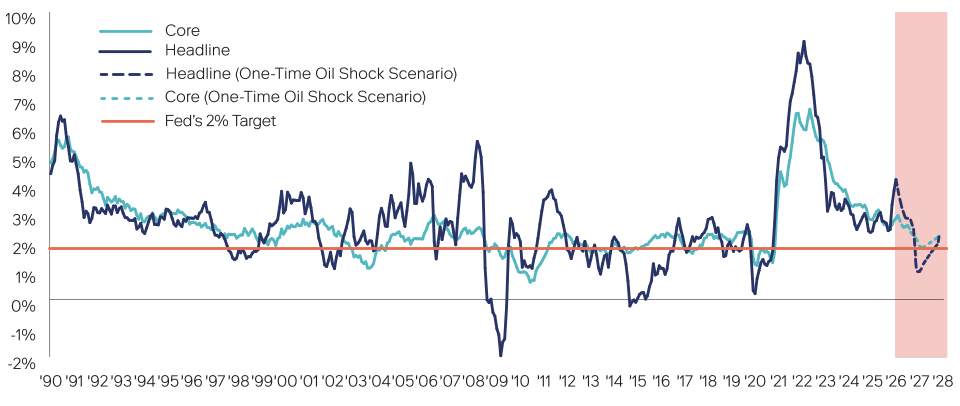
Source: Bloomberg, data as of May 2026; Neuberger estimate, data as of April 13, 2026. The “oil shock” scenario uses the current gas futures curve (RBOB) to provide a sequence of forward exogenous inputs to a small model of CPI Energy Goods; the “no oil shock” scenario combines forecasts prior to the Iran conflict with a random walk forecast for oil prices. Nothing herein constitutes a prediction or projection of future events or future market behavior. Historical trends do not imply, forecast or guarantee future results. Due to a variety of factors, actual events or market behavior may differ significantly from any views expressed. Information is obtained from sources deemed reliable, but there is no representation or warranty as to its accuracy, completeness or reliability. See additional disclosures at the end of this publication.
It is hardly surprising, then, that central banks have adopted a hawkish tilt in their most recent meetings. Increased demand translates into pockets of scarcity, and prolonged scarcity can change inflation from transitory to structural. Productivity gains and efficient use of resources may cushion the blow, but that could take some time.
Complicating the Fed’s calculus is its dual mandate. Delivering maximum employment implies encouraging stronger growth, but the “transmission mechanism” of such policy in an increasingly efficient, capital- and information-intensive economy could prove challenging. Incentivizing consumer spending and corporate fixed investment through easier borrowing has been part of the Fed’s longtime playbook. Individuals today, however, may benefit less from this tactic, and rate cuts could worsen inflation that is already pressuring their pocketbooks.
What can break the impasse apart from recession? Despite its inflationary demand for resources, AI could be the hero. From 2000 – 2010, globalization and internet adoption helped keep prices low, demonstrating the potential benefits of disruptive change. The effects continued over the decade following the Global Financial Crisis with six years of sub-2% core inflation. (Growth for that decade averaged 2.43%, slightly under the average for 1990 – 2025.)1 Similar to previous tech inflection points, a new wave of job roles could also be created, supporting the broad consumer economy and alleviating pressure on the Fed to ease rates.
The final piece of the puzzle could be where real rates (interest rates above inflation) land. Growth over the next two to three years could be somewhat stronger, or much stronger, depending on how quickly evidence of AI transformation materializes. Forward inflation expectations are currently well anchored, while the variable pushing rates higher has been growth. Should this dynamic continue, efforts by the Fed to put a cap on 10-year yields could prove mildly ineffective at best, and unnecessarily disruptive at worst, particularly given the affordability issues faced by consumers. To us, the tug of war between hawks and doves has likely just begun, and newly appointed Fed Chair Kevin Warsh will have his hands full as he navigates the initial months of his tenure.
Given the dizzying pace of the rebound from March lows, it is relatively easy to identify areas of potential froth in the equity market. AI-related companies, particularly the beneficiaries of hardware and infrastructure spending, posted significant gains in the second quarter as leadership was ceded to the next crop of tech winners. However, we think the benefits could be broadening, as earnings momentum generates enthusiasm across a number of sectors and smaller companies increasingly build out AI capabilities. Geographically, too, we are looking to diversify, upgrading our conviction on China and reaffirming our emphasis on Japan, while fading Europe and India given macro headwinds.
Although upward pressure on yields has increased, we favor leaning into global interest rate exposure selectively, given what we believe is a disconnect between expectations and likely outcomes for rate hikes. We have also raised our outlook for U.S. credit, both investment grade and high yield, given solid fundamentals and potential (if somewhat reduced) yield pickup. Within alternatives, we are maintaining our commodities overweight, despite lower energy prices, given the demand for industrial metals and El Niño’s potential impact on agricultural prices. In private equity, distributions remain below historical pacing, translating into continued opportunities in secondaries and midlife co-investments.
Overall, we are positioned for trend growth and potentially higher inflation, anticipating that further central bank accommodation may be unlikely this year. Typical summer weakness, anxiety over the midterm elections, and discomfort with the extent of recent gains in U.S. equities could produce volatility in the months ahead. Still, we would take advantage of any drawdowns to reposition portfolios to align with our high-conviction views.
1Source: Bloomberg. Data as of May 31, 2026.
This material is provided for informational and educational purposes only and nothing herein constitutes investment, legal, accounting or tax advice, or a recommendation to buy, sell or hold a security. This material is general in nature and is not directed to any category of investors and should not be regarded as individualized, a recommendation, investment advice or a suggestion to engage in or refrain from any investment-related course of action. Investment decisions and the appropriateness of this material should be made based on an investor’s individual objectives and circumstances and in consultation with his or her advisors. This material is not intended as a formal research report and should not be relied upon as a basis for making an investment decision. The firm, its employees and advisory clients may hold positions within sectors discussed, including any companies specifically identified. Specific securities identified and described do not represent all of the securities purchased, sold or recommended for advisory clients. It should not be assumed that any investments in securities, companies, sectors or markets identified and described were or will be profitable. Neuberger, as well as its employees, does not provide tax or legal advice. You should consult your accountant, tax adviser and/or attorney for advice concerning your particular circumstances. Information is obtained from sources deemed reliable, but there is no representation or warranty as to its accuracy, completeness or reliability. All information is current as of the date of this material and is subject to change without notice. Any views or opinions expressed may not reflect those of the firm as a whole and Neuberger does not endorse any third-party views expressed. Third-party economic or market estimates discussed herein may or may not be realized and no opinion or representation is being given regarding such estimates. Neuberger products and services may not be available in all jurisdictions or to all client types. The use of tools cannot guarantee performance. Diversification does not guarantee profit or protect against loss in declining markets. As with any investment, there is the possibility of profit as well as the risk of loss. Investing entails risks, including possible loss of principal. Investments in hedge funds and private equity are speculative and involve a higher degree of risk than more traditional investments. Investments in hedge funds and private equity are intended for sophisticated investors only. Unless otherwise indicated, returns reflect reinvestment of dividends and distributions. Indexes are unmanaged and are not available for direct investment. This material may include estimates, outlooks, projections and other “forward-looking statements.” Due to a variety of factors, actual events may differ significantly from those presented. Investing entails risks, including possible loss of principal. Past performance is no guarantee of future results.
The views expressed herein may include those of the Neuberger Multi-Asset Class (MAC) team, Neuberger’s Asset Allocation Committee and Neuberger’s Wealth Investment Group. The Asset Allocation Committee is comprised of professionals across multiple disciplines, including equity and fixed income strategists and portfolio managers. The Asset Allocation Committee reviews and sets long-term asset allocation models, establishes preferred near-term tactical asset class allocations and, upon request, reviews asset allocations for large, diversified mandates. Tactical asset allocation views are based on a hypothetical reference portfolio. The Neuberger Wealth Investment Group analyzes market and economic indicators to develop asset allocation strategies. The Neuberger Wealth Investment Group consists of five investment professionals and works in partnership with the Office of the CIO. The Neuberger Wealth Investment Group also consults regularly with portfolio managers and investment officers across the firm. The views of the MAC team, the Asset Allocation Committee and the Neuberger Wealth Investment Group may not reflect the views of the firm as a whole, and Neuberger advisers and portfolio managers may take contrary positions to the views of the MAC team, the Asset Allocation Committee and the Neuberger Wealth Investment Group. The MAC team, the Asset Allocation Committee and Neuberger Wealth Investment Group views do not constitute a prediction or projection of future events or future market behavior. This material may include estimates, outlooks, projections and other “forward-looking statements.” Due to a variety of factors, actual events or market behavior may differ significantly from any views expressed or any historical results. Nothing herein constitutes a prediction or projection of future events or future market or economic behavior. The duration and characteristics of past market/economic cycles and market behavior, including length and recovery time of past recessions and market downturns, is no indication of the duration and characteristics of any current or future market/ economic cycles or behavior.
Neuberger Berman Investment Advisers LLC is a registered investment adviser. The “Neuberger” name and logo are service marks of Neuberger Berman Group LLC.