NEWS AND INSIGHTS | MUNICIPAL BASIS POINTS
Buckle Up
January 22, 2026

Muni bond fundamentals look solid, but watch out for volatility. DOWNLOAD REPORT
Selectivity could be front and center in 2026.
Despite a choppy start to the year, the municipal bond market delivered decidedly positive returns in 2025.1 It was hard for the market to find its footing for much of the first half of the year as the “Liberation Day” Treasury selloff, concerns around a potential reduction of the municipal tax exemption, and heavy new issuance all weighed on investor sentiment. When it was clear that the One Big Beautiful Bill Act (OBBA) would leave the muni tax-exemption unscathed, market sentiment started to turn positive. In addition, higher absolute yields and the relative value of munis drew investors into the asset class. That improved sentiment was reflected in strong fund flows. Given that 2025 was an all-time record year for new issuance, it was impressive to us how easily the market was able to absorb all the supply.
Digging a little deeper into returns, unlike the previous two years, BBB rated bonds did not outperform higher grades last year. After rallying strongly in 2023 and 2024, spreads for BBB rated bonds began 2025 on the tighter side, which probably explains why they ran out of steam. High yield munis underperformed investment grade bonds, primarily due to weak returns in the tobacco sector and one large transportation-related issuer. Yield-curve positioning was important in 2025 as a more bulleted approach (targeting specific points on the curve) performed better in the first half of the year, only have a barbell (heavily weighted in short- and long-term bonds) do better in the final six months.
Supports, but Challenges, Too
Looking ahead, we are optimistic about the municipal market’s prospects for 2026. We have a constructive view on the economy and believe stimulus from the OBBA and deregulation should create tailwinds. In addition, the Federal Reserve starts the year in an easing cycle. However, federal policies, including potential Medicaid cuts, could affect certain parts of the market. Active credit decisions and “what you don’t own” may end up driving return outcomes.
We are expecting another record year of supply. As bond pickers, we love having more bonds to choose from and recognize that when supply is heavy, sometimes deals fall through the cracks. While we do not anticipate a market move of the magnitude of the Liberation Day selloff, there should be no shortage of events that could cause market shifts, albeit smaller ones. Changes at the Federal Reserve, midterm elections and geopolitics could all cause pockets of volatility and, in turn, present opportunities. In our view, it should be a market environment where active management will matter.
In 2025, tensions over tariffs and tax exemption gave way to relief and positive flows for municipals.
Key Market Dynamics in 2025
Federal Reserve policy: The Fed lowered rates by 25 basis points at its December meeting, bringing total cuts in 2025 to three, as it reacted to signs of a soft labor market. Over the past year, the unemployment rate has increased from 4.0% to the mid-4% range.
Solid year for municipal performance: Investment grade performance was positive for the year, led by strength in the intermediate part of the curve.2
Municipal yield movement: 2025 was a tale of two halves, the first marked by higher yields due to volatility around Liberation Day tariffs and concerns over potential changes to the municipal tax exemption, and the second driven by robust demand for bonds as investors priced in the resumption of Fed rate cuts, taking advantage of attractive absolute tax-exempt yields.
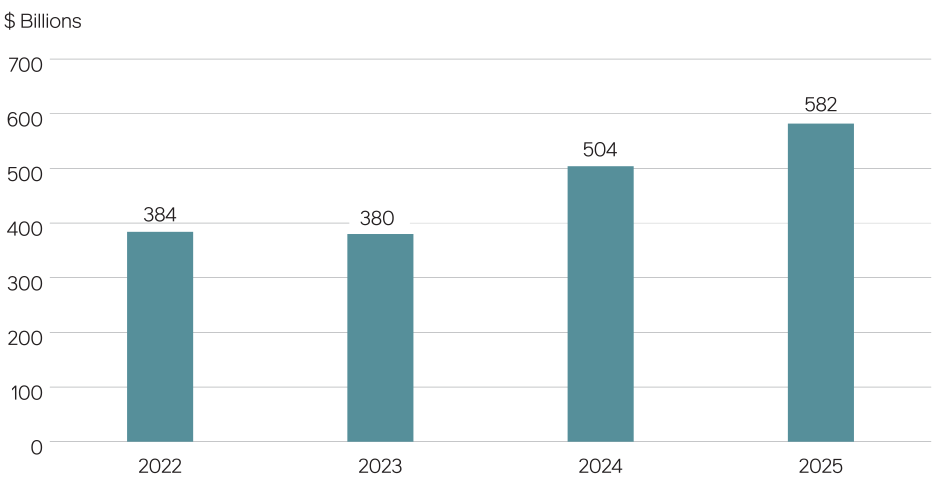
Record issuance: Municipal gross issuance reached $582 billion in 2025, the second straight record year of supply. The key drivers were higher infrastructure costs and issuers front-loading deals in advance of feared changes to the municipal tax exemption. For 2026, analysts project supply above $600 billion3 due to further infrastructure needs and potential for increased cost-saving refunding issuance.
Source: BofA, as of December 31, 2025.
Takeaways for 2026
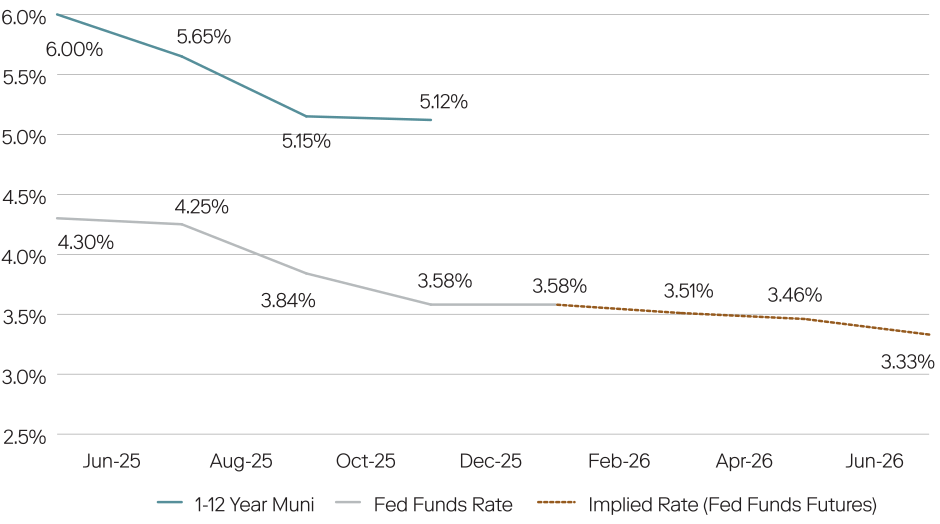
With the Fed resuming rate cuts, we favor reducing cash-equivalent holdings to limit reinvestment at potentially lower yields. In our view, municipal yields remain compelling across the curve—both relative to current cash rates and on a taxable-equivalent basis versus comparable U.S. Treasuries.
Source: Bloomberg, as of December 31, 2025. ICE BofA 1-12 Year Municipal Securities Index.
We believe the fundamentals for municipal credit generally remain solid.
During a year marked by dramatic headlines and federal policy shifts, municipal credit markets demonstrated notable resilience despite the potential vulnerability of select issuers and sectors. Looking ahead, we believe 2026 will see generally favorable credit conditions for municipal bonds. While challenges remain, particularly as governments adjust to evolving federal priorities, the foundation for credit quality appears solid.
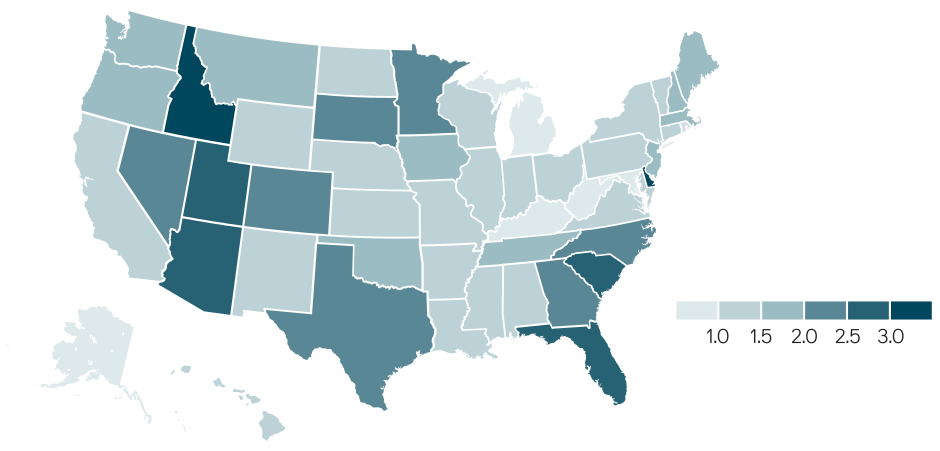
A reassuring indicator of overall municipal credit trends is the continued stability demonstrated by U.S. states. In our view, the outlook for states in 2026 appears constructive, though growth and fiscal strength will likely vary widely. Revenue growth has normalized from the elevated levels seen during the recovery from the pandemic, with median state tax revenue projected to grow at roughly 2.3% in 2026,4 closely tracking inflation and sufficient to maintain services with modest budget adjustments.
States are entering 2026 with rainy day funds that are near all-time highs, and enacted budgets project further increases this fiscal year. Those experiencing faster expansion are typically benefiting from technology investment, energy development and strong population inflows, while states with greater exposure to trade-sensitive manufacturing and agriculture may see slower trends. Broadly speaking, these differences are driven by factors including industry mix, migration patterns and local policy choices. Despite this divergence, growth across the country remains steady and supportive of our constructive assessment of municipal credit.
Source: Moody’s, as of November 2025.
Assessing Potential Credit Weaknesses
While we think the overall outlook for municipal credit remains constructive, it is important to acknowledge that not all sectors share the same degree of stability; the most notable continuing to face headwinds include health care, higher education and K – 12 schools.
In the health care sector, providers are contending with rising operating costs, reimbursement pressures and changes to federal funding, which could affect revenue stability and service delivery. Higher education institutions, particularly regional and less selective colleges, face declining enrollment, elevated capital needs and increased competition for students. Meanwhile, some large universities have been targeted by the federal government’s efforts to revisit academic policies and practices, adding further uncertainty to the sector. Another sector facing potential credit pressures is K – 12 school districts, which are managing a loss of one-time federal aid, wage pressure and, in some regions, declining student populations. The transition to new funding models and the expansion of school choice programs add further complexity for district budgets. Amid these challenges, we continue to look for well-managed issuers that have proactively addressed and planned for potential risks. Our focus remains on credits that show prudent planning, adaptability and a clear response to evolving conditions.
More broadly, we believe effective governance—including fiscal discipline, timely financial adjustments and transparency—remains central to credit stability. As federal policy changes continue to shape the operating environment for state and local governments, our team is committed to identifying credits that offer value and stability, even in an environment where select headwinds persist.
1 Source: Bloomberg, as of December 31, 2025. Bloomberg Municipal Bond Index.
2 Source: Bloomberg, as of December 31, 2025.
3 Source: BofA, as of December 31, 2025.
4 Source: Moody’s, as of November 2025.
This material is provided for informational purposes only and nothing herein constitutes investment legal accounting or tax advice or a recommendation to buy sell or hold a security. This material is general in nature and is not directed to any category of investors and should not be regarded as individualized recommendation investment advice or a suggestion to engage in or refrain from any investment-related course of action. Neuberger Berman is not providing this material in a fiduciary capacity and has a financial interest in the sale of its products and services. Neuberger Berman as well as its employees does not provide tax or legal advice. You should consult your accountant tax adviser and/or attorney for advice concerning your particular circumstances. Information is obtained from sources deemed reliable, but there is no representation or warranty as to its accuracy completeness or reliability. All information is current as of the date of this material and is subject to change without notice. Any views or opinions expressed may not reflect those of the firm as a whole. Neuberger Berman products and services may not be available in all jurisdictions or to all client types. Investing entails risks including possible loss of principal. Investments in hedge funds and private equity are speculative and involve a higher degree of risk than more traditional investments. Investments in hedge funds and private equity are intended for sophisticated investors only. Indexes are unmanaged and are not available for direct investment. Past performance is no guarantee of future results.
Unless otherwise indicated, portfolio characteristics, including attribution, yield data, relative returns and risk statistics are shown gross of fees. The views expressed herein do not constitute a prediction or projection of future events or future market behavior. This material may include estimates, outlooks, projections and other “forward-looking statements.” Due to a variety of factors, actual events or market behavior may differ significantly from any views expressed.
Neuberger Berman Investment Advisers LLC is a registered investment adviser. The “Neuberger Berman” name and logo are registered service marks of Neuberger Berman Group LLC.