NEWS AND INSIGHTS | MARKET COMMENTARY
Earnings, Inflation and a Fed in Transition
May 06, 2026

We maintain an overweight to global equities, and see compelling opportunities in front-end rates and investment grade credit, while private equity and credit sit at target amid AI disruption risks and refinancing pressures.
The malaise under which the markets were operating in February and March stemming from AI disintermediation and the war in the Middle East seemingly lifted as the calendar turned to April, with risk assets shooting higher across the board. This sharp snapback, quite similar to the one experienced last year following the announcement of several key trade deals, comes even as there is no clear plan to renew traffic through the Strait of Hormuz and, in turn, lower energy prices. In addition, software stocks have been unable to mount a strong recovery, an indication that short-term concerns are likely to translate into longer-term dispersion in the industry. Technology stocks broadly, however, have delivered in this most recent rally, as investors acknowledge the continued earnings strength of these companies.
In addition, there is little evidence that a downshift in consumer spending is threatening the overall strength of the U.S. economy. While, admittedly, consumer confidence remains subdued—University of Michigan consumer sentiment posted its lowest reading ever—retail sales were strong, with the control group besting expectations and growing +0.7% month-over-month in April. Spending has been supported by a stable labor market, as March nonfarm payrolls came in well above expectations at +178,000, driven largely by a rebound in health care, along with solid gains in leisure and hospitality, construction and manufacturing—pushing the three-month average to +68,000 and anchoring the unemployment rate at 4.3% on lower participation. In addition, U.S. manufacturing expanded for the fourth straight month in April, with the ISM PMI holding steady at 52.7—the highest since August 2022—as strong new orders and production offset a weaker employment reading.
What we are watching most closely, then, is inflation. March headline CPI surged to +3.4% year-over-year, driven almost entirely by a historic spike in energy prices—gasoline alone jumped +21%—as Middle East supply disruptions pushed overall energy costs up nearly +11% in a single month. The good news is that core CPI came in cooler than expected at +2.6% year-over-year, with continued progress in medical care, used cars and household furnishings suggesting that, outside of energy, underlying inflation remains on a constructive path. April PCE was a bit hotter than CPI, given the lower contribution of shelter (which is experiencing continued disinflation) to this measure; headline PCE rose by +3.5% year-over-year with core climbing to approximately +3.2%.
With higher energy prices and better-than-expected payrolls, it was not surprising to see the Federal Reserve hold rates steady at 3.50 – 3.75% in their April meeting—likely Jerome Powell’s last as Fed chair. More surprising were the four dissents to the decision—the most since 1992—revealing a committee far more fractured than the market had anticipated, and Powell's decision to stay on as a governor after his chair term ends on May 15. While Powell was candid that higher energy prices will continue to weigh on the global economy, he was also clear that labor market softness is acting as a buffer against a repeat of the 2022 inflation regime—and that, combined with his neutral rate estimate in the 3 – 4% range, it could keep the door open for further easing. The combination of dissents and Powell’s decision to stay in his seat potentially complicates the transition to Kevin Warsh, who is on a clear path to Senate confirmation ahead of May 15. Our view is that the Fed is likely to remain in the spotlight, as investors will be watching for how Warsh will grapple with the emergence of a hawkish cohort, and how he will balance his desire for a more nuanced approach to both balance sheet reduction and inflation, viewing gradual shrinkage and front-end rate cuts as complementary—all while responding to calls for lower rates from the White House.
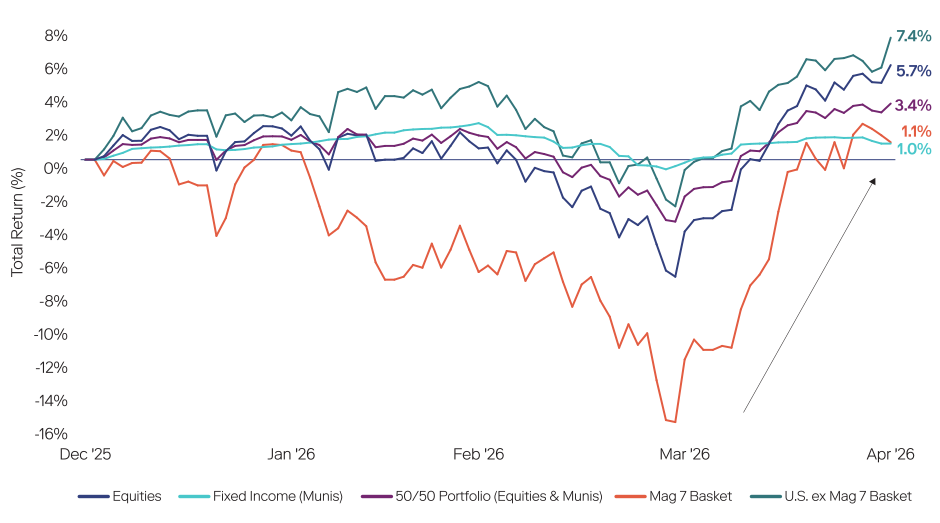
Source: Bloomberg, as of April 30, 2026. Equities represented by the S&P 500 Index, Fixed Income represented by the Bloomberg Municipal Index, Mag 7 Basket is the Bloomberg Magnificent 7 Basket, U.S. ex Mag 7 Basket is the Bloomberg U.S. 500 excluding Mag 7 basket.
The longer-term argument for investing in U.S. large-cap equities has remained strong, particularly over the last 15 years as globalization and technology innovation have delivered meaningful gains for companies able to drive margin improvement. After leading all major equity and fixed income benchmarks in 2023 and 2024, large caps (particularly the Magnificent 7 stocks) had, in our view, reached stretched valuations, particularly given the increased cost of AI-related capital expenditures. As a result, we increased our conviction in other areas of the equity market—namely, U.S. small and midcaps and non-U.S. equities, both in developed and emerging markets. However, we recently upgraded our conviction level on U.S. large caps based on a confluence of still-supportive economic data and continued strength in earnings.
The expectations for 2026 S&P 500 earnings, as outlined in the graph below, are strongly positive—and have been revised upward since the beginning of the year by approximately +5% based in part on solid guidance and Q1 results. Breaking it down, through May 1, according to FactSet, 63% of companies in the S&P 500 have reported, with a whopping 84% of companies delivering an upside earnings surprise and posting an average year-over-year earnings growth rate of +27.1%. In addition, 81% of companies beat revenue estimates—well above the five-year average of 70%—and delivered an average of +11.1% revenue growth for the quarter, an indication that companies are driving gains on both the top and bottom lines in this environment. With nine of the 11 S&P 500 sectors reporting earnings growth, it is not surprising to see that, through the end of April, the performance attributed to the Magnificent 7 on a year-to-date basis as a percentage of overall S&P 500 is much lower than it was in 2025; dispersion within those seven companies certainly plays a role as well. While admittedly there are still some bellwethers yet to report, we believe that the acceleration in earnings growth for U.S. companies is attributable to continued economic momentum and, as such, can continue.
But what will this next phase of growth look like? The S&P 500 remains a highly concentrated index, with the technology and communications services sectors accounting for 46% of the index, and therefore, strong earnings in these two sectors could be the only thing that matters if looking solely at index performance. And they are expected to deliver, with 2026 earnings growth estimated at +41% and +22%, respectively. But there are strong expectations for other sectors as well, with energy and materials earnings expected to grow +49% and +37%, respectively, in 2026. In fact, importantly, while we have become more constructive on U.S. earnings, small caps are likely to benefit from the same economic backdrop while many large-cap sectors should see more favorable earnings comparisons; as such, S&P 600 companies are expected to grow their earnings by +16.7% this year. Earnings are also expected to grow over the next two years in Japan, China and India; our overweight to Asia versus Europe considers this momentum along with in the potential benefits of stronger growth and inflation in Japan, attractive valuations in India, and the potential for massive AI capex in China over the coming years, which should drive both business activity and productivity gains.
There are risks to this positive view. A tenuous Middle East ceasefire is unlikely to drive energy prices sustainably lower, and profit margins outside of the energy sector are likely to be biased lower without a lasting resolution as higher costs transmit through the broader global economy. Specifically, consumer discretionary earnings could be at risk should consumer behavior shift in response to higher energy costs; a decrease in goods spending would likely portend this shift. In addition, a less accommodative rate environment could weigh on the financial sector, as the Fed and other central banks weigh the potential for a structural uptick in inflation. Combining slower loan growth with concerns around private market valuations and credit quality could translate to a weaker earnings outlook; the sector is only expected to grow earnings at +10% at this point. Potential downward pressure on these two sectors is noteworthy, as they account for a greater percentage of the index than the better performing energy and materials names. Finally, we acknowledge the threat of further policy disruption, particularly as we march quickly towards midterms; this would likely result in dampened business confidence and potentially slower activity.
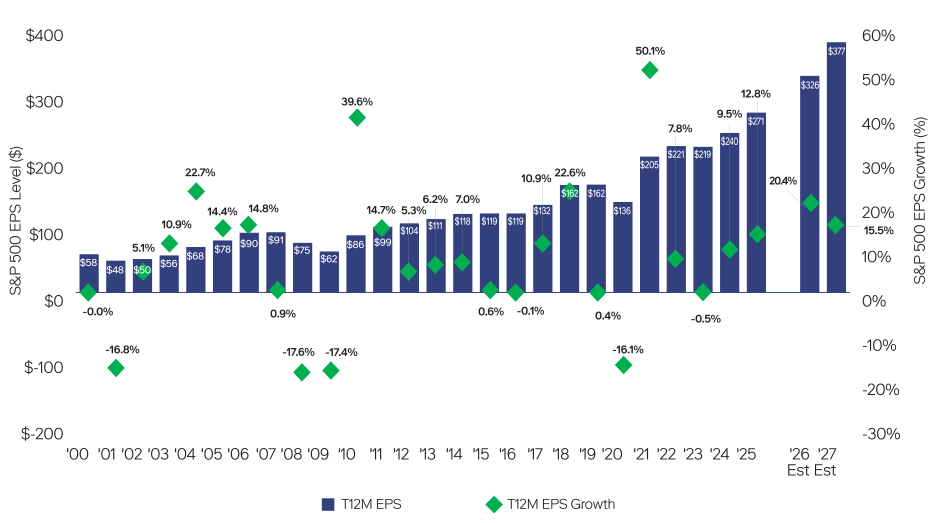
Source: Bloomberg, April 30, 2026.
Equities. We maintain an overweight to global equities, despite the potential for higher energy prices and continued political uncertainty to weigh on investor sentiment. We are overweight U.S. equities and have become more constructive as of late around U.S. large-cap equities, as referenced above. While we still value the Japan story, centered on structural reform and strong growth, Europe's energy vulnerability and deteriorating growth prospects have pushed us to downgrade it to underweight. We maintain overweights in China, India and Brazil, where structural growth themes and attractive valuations continue to outweigh their reliance on energy imports.
Fixed Income. Fears of interest rate hikes in response to higher inflation have created opportunities at the front end of global yield curves, most notably in the U.S. curve, where we think markets have gotten ahead of themselves on tightening. We believe there is also opportunity in investment grade credit and non-U.S. developed market bonds, maintaining overweights in European and Japanese government and corporate debt. In emerging markets (EM), a stronger dollar and energy-driven headwinds have taken some of the shine off, prompting us to trim back to at target on EM sovereign bonds—though our longer-term constructive view on EM currencies remains intact.
Private Markets. Private equity has been moved to an at-target position, given the risk of AI disruption, rising refinancing costs and geopolitical uncertainty. Private credit, too, remains at target as redemptions from retail focused products dominate the narrative, but may translate into opportunities for long-term, institutional investors to allocate higher spreads. We remain constructive on commodities, as energy markets have been repriced, and the asset class offers both return potential and diversification to other risk assets.
| Apr-26 | 3M | YTD | 2025 | |
|---|---|---|---|---|
| Equities | ||||
| Major U.S. Indices | ||||
| S&P 500 Index | 10.49% | 4.19% | 5.70% | 17.88% |
| Nasdaq Composite | 15.31% | 6.26% | 7.29% | 21.14% |
| Dow Jones | 7.24% | 1.97% | 3.81% | 14.92% |
| U.S. Size Indices | ||||
| Large Cap | 10.11% | 4.07% | 5.50% | 17.37% |
| Mid Cap | 7.33% | 5.50% | 8.72% | 10.60% |
| Small Cap | 12.21% | 7.46% | 13.21% | 12.81% |
| All Cap | 10.20% | 4.22% | 5.84% | 17.15% |
| U.S. Style Indices | ||||
| All Cap Growth | 12.22% | 2.82% | 1.51% | 18.15% |
| All Cap Value | 8.22% | 5.70% | 10.63% | 15.71% |
| Global Equity Indices | ||||
| ACWI | 10.17% | 3.58% | 6.65% | 22.34% |
| ACWI ex US | 9.65% | 2.73% | 8.88% | 32.39% |
| DM Non-U.S. Equities | 7.56% | 1.08% | 6.36% | 31.89% |
| EM Equities | 14.73% | 5.28% | 14.61% | 34.36% |
| Portfolios | ||||
| 50/50 Portfolio | 5.82% | 2.11% | 3.33% | 11.06% |
| Apr-2026 | 3M | YTD | 2025 | |
|---|---|---|---|---|
| Fixed Income Currencies & Commodities | ||||
| Major U.S. Indices | ||||
| Cash | 0.29% | 0.86% | 1.14% | 4.18% |
| U.S. Aggregate | 0.11% | -0.04% | 0.07% | 7.30% |
| Munis | 1.15% | 0.03% | 0.97% | 4.25% |
| U.S. Corporates | ||||
| Investment Grade | 0.45% | -0.26% | -0.09% | 7.77% |
| High Yield | 1.58% | 0.64% | 1.15% | 8.78% |
| Short Duration (1.9 Yrs) | 0.24% | 0.33% | 0.56% | 5.39% |
| Long Duration (12.8 Yrs) | -0.14% | -0.68% | -0.90% | 6.65% |
| Global Fixed Income Indices | ||||
| Global Aggregate | 1.25% | -0.77% | 0.16% | 8.17% |
| EMD Corporates | 1.73% | 0.59% | 1.37% | 8.74% |
| Commodities | ||||
| Commodities | 4.21% | 17.47% | 29.65% | 15.77% |
| U.S. Treasury Yields | ||||
| U.S. 10-Year Yield | 0.05% | 0.14% | 0.20% | -0.40% |
| U.S. 2-Year Yield | 0.08% | 0.35% | 0.40% | -0.77% |
| FX | ||||
| U.S. Dollar | -1.91% | 1.10% | -0.27% | -9.37% |
Source: Bloomberg, Total returns as of April 30th, 2026. S&P 500 Index is represented by S&P 500 Total Return Index. Nasdaq Composite NASDAQ-Composite Total Return Index. Dow Jones is represented by Dow Jones Industrial Average TR. Large Cap is represented by Russell 1000 Total Return Index. Mid Cap is represented by Russell Midcap Index Total Return. Small Cap is represented by Russell 2000 Total Return Index. All Cap is represented by Russell 3000 Total Return Index. Large Cap Growth is represented by Russell 1000 Growth Total Return. Large Cap Value is represented by Russell 1000 Value Index Total Return. Small Cap Growth is represented by Russell 2000 Growth Total Return. Small Cap Value is represented by Russell 2000 Value Total Return. ACWI is represented by MSCI ACWI Net Total Return USD Index. ACWI ex US is represented by MSCI ACWI ex USA Net Total Return USD Index. DM Non-U.S. Equities is represented by MSCI Daily TR Gross EAFE USD. EM Equities is represented by MSCI Daily TR Gross EM USD. Cash is represented by ICE BofA US 3-Month Treasury Bill Index. U.S. Aggregate is represented by Bloomberg US Agg Total Return Value Unhedged USD. Munis is represented by Bloomberg Municipal Bond Index Total Return Index Value Unhedged USD. Munis Short Duration is represented by Bloomberg Municipal Bond: Muni Short (1-5) Total Return Unhedged USD. Munis Intermediate Duration is represented by Bloomberg Municipal Bond: Muni Intermediate (5-10) TR Unhedged USD. Investment Grade is represented by Bloomberg US Corporate Total Return Value Unhedged USD. High Yield is represented by Bloomberg US High Yield BB/B 2% Issuer Cap Total Return Index Value Unhedged USD. Short Duration is represented by Bloomberg US Agg 1-3 Year Total Return Value Unhedged USD. Long Duration is represented by Bloomberg US Agg 10+ Year Total Return Value Unhedged USD. Global Aggregate is represented by Bloomberg Global-Aggregate Total Return Index Value Unhedged USD. EMD Corporates is represented by J.P. Morgan Corporate EMBI Diversified Composite Index Level. EMD Sovereigns – USD is represented by J.P. Morgan EMBI Global Diversified Composite. Commodities is represented by Bloomberg Commodity Index Total Return. Commodities ex Energy is represented by Bloomberg Ex-Energy Subindex Total Return. U.S. 10-Year Yield is represented by US Generic Govt 10 Yr.
IMPORTANT INFORMATION:
This material is provided for informational and educational purposes only and nothing herein constitutes investment, legal, accounting or tax advice, or a recommendation to buy, sell or hold a security. This material is general in nature and is not directed to any category of investors and should not be regarded as individualized, a recommendation, investment advice or a suggestion to engage in or refrain from any investment-related course of action. Neither Neuberger nor its employees provide tax or legal advice. All information is current as of the date of this material and is subject to change without notice. The firm, its employees and advisory accounts may hold positions of any companies discussed. Any views or opinions expressed may not reflect those of the firm as a whole. Neuberger products and services may not be available in all jurisdictions or to all client types. Diversification does not guarantee profit or protect against loss in declining markets. Investments in private equity are speculative and involve a higher degree of risk than more traditional investments. Investments in private equity are intended for sophisticated investors only. Unless otherwise indicated, returns shown reflect reinvestment of dividends and distributions. Indexes are unmanaged and are not available for direct investment. Investing entails risks, including possible loss of principal. Past performance is no guarantee of future results.
Portfolio positioning views expressed herein are those of Neuberger Wealth Investment Group which may include those of the Neuberger’s Asset Allocation Committee. Asset allocation and positioning views are based on a hypothetical reference portfolio. The Neuberger Wealth Investment Group analyzes market and economic indicators to develop asset allocation strategies. The Neuberger Wealth Investment Group works in partnership with the Office of the CIO. The Neuberger Wealth Investment Group also consults regularly with portfolio managers and investment officers across the firm. The Asset Allocation Committee is comprised of professionals across multiple disciplines, including equity and fixed income strategists and portfolio managers. The Asset Allocation Committee reviews and sets long-term asset allocation models, establishes preferred near-term tactical asset class allocations and, upon request, reviews asset allocations for large diversified mandates. Asset Allocation Committee members are polled on asset classes and the positional views are representative of an Asset Allocation Committee consensus. The views of the Asset Allocation Committee and the Neuberger Wealth Investment Group may not reflect the views of the firm as a whole and Neuberger advisers and portfolio managers may take contrary positions to the views of the Asset Allocation Committee or the Neuberger Wealth Investment Group. The Asset Allocation Committee and the Neuberger Wealth Investment Group views do not constitute a prediction or projection of future events or future market behavior. Defensive positioning generally means an underweight bias on allocations to risk assets such as equities and alternatives. Positioning views may change over time without notice and actual client positioning may vary significantly. Discussion of yield characteristics or total returns of different asset classes are for illustrative purposes only. Such asset classes, such as equities and fixed income, may have significantly different overall risk-return characteristics which should be consider before investing.
The information in this material may contain projections, market outlooks or other forward-looking statements regarding future events, including economic, asset class and market outlooks or expectations, and is only current as of the date indicated. There is no assurance that such events, outlook and expectations will be achieved, and actual results may be significantly different than that shown here. The duration and characteristics of past market/economic cycles and market behavior, including any bull/bear markets, is no indication of the duration and characteristics of any current or future be market/economic cycles or behavior. Information on historical observations about asset or sub-asset classes is not intended to represent or predict future events. Historical trends do not imply, forecast or guarantee future results. Information is based on current views and market conditions, which will fluctuate and may be superseded by subsequent market events or for other reasons.
Discussions of any specific sectors and companies are for informational purposes only. This material is not intended as a formal research report and should not be relied upon as a basis for making an investment decision. The firm, its employees and advisory accounts may hold positions of any companies discussed. Nothing herein constitutes a recommendation to buy, sell or hold a security. It should not be assumed that any investments in securities, companies, sectors or markets identified and described were or will be profitable. Investment decisions and the appropriateness of this content should be made based on an investor's individual objectives and circumstances and in consultation with his or her advisors.
Neuberger Investment Advisers LLC is a registered investment adviser.
The “Neuberger” name and logo are registered service marks of Neuberger Berman Group LLC.