NEWS AND INSIGHTS | MUNICIPAL BASIS POINTS
Smart Shopping: Focusing on Yield and Selection in a Mixed Environment
July 24, 2026

While volatility could persist, we believe risk/return for municipals generally remains compelling. DOWNLOAD REPORT
We see an environment that should reward security selection.
The municipal bond market showed considerable resilience in the second quarter of 2026 following a sharp selloff in March triggered by war-related inflation concerns. With Treasury yields rangebound and muni valuations more attractive, in our view, investors jumped in with market support, helping to deliver positive index returns in all three months. For the full quarter, the investment-grade municipal market returned 2.34%.1
This was impressive, in our opinion, given the backdrop of continued heavy issuance, which is on pace to set an annual record. Offsetting the supply, municipal mutual funds and ETFs have experienced over $50 billion of inflows so far this year—the second-strongest first half on record.2 Demand for new issues remains strong, with many deals experiencing subscriptions that meaningfully exceed the amount of bonds available for purchase. (Demand is particularly robust in California, where many issues trade at lower yields relative to similarly rated bonds from lower-tax states.) Investors showed some appetite for risk as 20- to 30-year bonds meaningfully outpaced shorter-dated securities for the quarter. In addition, A and BBB rated bonds outperformed high-rated credits.
Looking ahead, all eyes will be on the Federal Reserve and its new chair, Kevin Warsh. At his first meeting as chair in June, his comments were more hawkish than anticipated, which caused the market to price in a greater likelihood of future Fed tightening. Many moving parts remain, however, including an uncertain outcome for the war in Iran, inflation that may soften as tariff effects roll off, likely continuing shelter disinflation, and a fairly resilient job market. While some investors are in the hiking camp and others believe the Fed’s next move may be to ease, we think the central bank could be on hold for longer.
From a positioning standpoint, we moved to neutral on duration (sensitivity to changes in interest rates) in March, and maintain that view. High-grade munis generally outperformed Treasuries in 2Q, so valuations are a bit fuller than at the end of March. That said, heavy supply continues to come with a price concession so that deals can clear the market, while the sheer volume of issuance is increasing the likelihood of mispricing. The supply has also created more action in the secondary market as investors sell bonds to pay for the new issues. When you put it all together, we believe this is a market that will likely reward effective security selection. An added potential benefit, should rates experience volatility, could be new opportunities to execute tax-loss swaps. Proactivity on that front will likely be important when it makes economic sense.
Key takeaways on recent turbulence and opportunities that may await.
A challenging first half. Municipal bonds navigated a challenging first half of 2026 with notable resilience, absorbing elevated rate volatility as oil-price-driven inflation concerns weighed on broader fixed income sentiment.
Municipal yields declined in 2Q. Yields fell across the curve, led by longer-dated maturities. Although we believe valuations remain stretched, summer reinvestment flows and the potential for continued positive fund flows could provide a positive technical tailwind through August.
We believe tax-free yields remain attractive. Relative to Treasury bills and money market funds, municipal bonds across the yield curve continue to offer materially higher after‑tax income.3 Investors are increasingly rotating out of cash, seeking to lock in these yields.
The Fed may remain on extended hold. New Fed Chair Kevin Warsh has struck a hawkish tone, reiterating that price stability remains crucial with inflation still above the 2% target. Still, the Iran ceasefire (while it lasted) helped trim oil prices, providing a modest tailwind that could reduce the urgency of near‑term rate hikes.
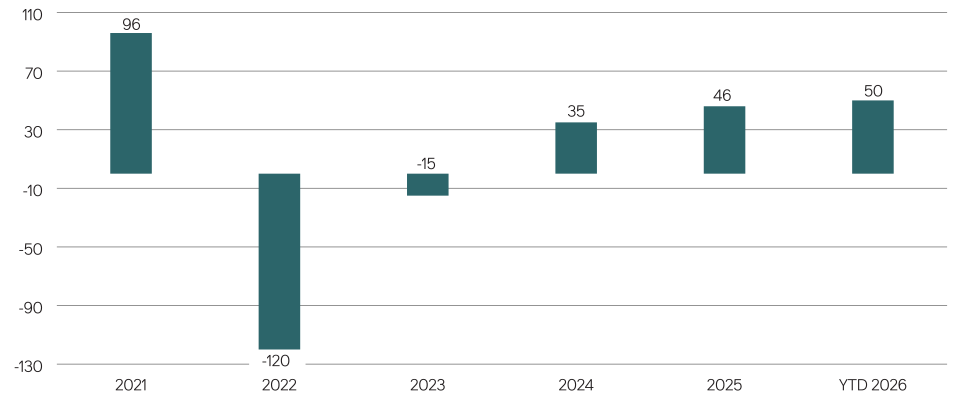
Fund flows into munis remain healthy. Year-to-date inflows are roughly $50 billion, the second-highest on record for the first half of a calendar year, reflecting robust demand for the municipal asset class.
Source: Lipper. Data as of June 30, 2026.
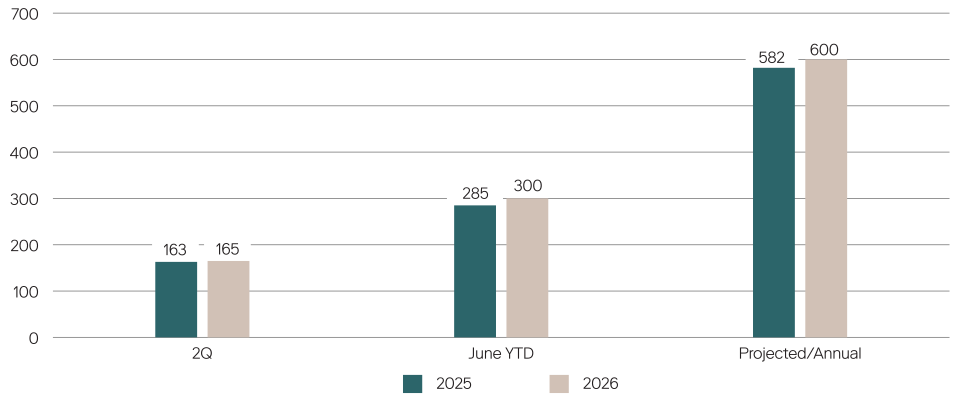
Record pace of Issuance, resilient demand. Year‑to‑date tax‑exempt supply of roughly $300 billion is running at a historic pace—driven by higher project costs, the fading of pandemic‑era aid, and a market that has largely acclimated to a higher‑for‑longer rate environment.
Source: BofA. Data as of June 30, 2026.
Neutral duration positioning. After favoring a shorter duration exposure versus benchmarks in February, we returned to neutral in mid‑April as absolute yields and muni relative valuations in these segments became more attractive.
Attractive risk/return potential. With the Fed holding rates steady through the first four meetings of 2026, we believe munis remain well positioned, offering attractive absolute yields and compelling taxable‑equivalent value versus U.S. Treasuries. In our view, the year-to-date pace of positive fund inflows further reinforces the asset class’s enduring appeal.
Cybersecurity represents a growing credit consideration for municipal bond investors.
Cybersecurity is becoming an important part of municipal credit analysis. Investors have traditionally focused on familiar risks such as economic weakness, revenue pressure, debt levels and reserve strength. Those factors remain central to our work, but we believe cyber risk now deserves a place in the same conversation because local governments, utilities, transit systems and other public entities increasingly rely on technology to deliver essential services and manage financial operations.
Recent incidents show that cyberattacks can create practical and financial consequences for municipal issuers. They can disrupt operations, delay payments, increase recovery costs and, in some cases, affect access to the bond market. This does not change our view that high-quality municipal bonds can play an important role in conservative portfolios, but it does reinforce the value of active credit research and ongoing surveillance.
Municipal issuers have become more frequent targets because they provide essential public services and often operate with limited technology budgets. Water systems, transit agencies, school districts, counties and local governments can be attractive targets because service interruptions can quickly create public pressure to restore systems. For investors, the key issue is not only whether an attack occurs, but whether the issuer has the financial flexibility, management practices and recovery plans needed to limit the impact.
The risk has also become more complex. Attacks are not limited to a city or authority’s own systems. Vendors that process payments, manage data or support daily operations can create exposure across many issuers at once. This means a credit review needs to look beyond the balance sheet and consider how well an issuer manages technology, vendors and operational risk.
FBI data shows ransomware exposure across multiple critical infrastructure sectors, including several categories that are directly relevant to municipal credit. Government facilities, transportation, and water and wastewater systems are core municipal exposure areas, while health care, communications, energy and emergency services also intersect with public finance credit analysis.
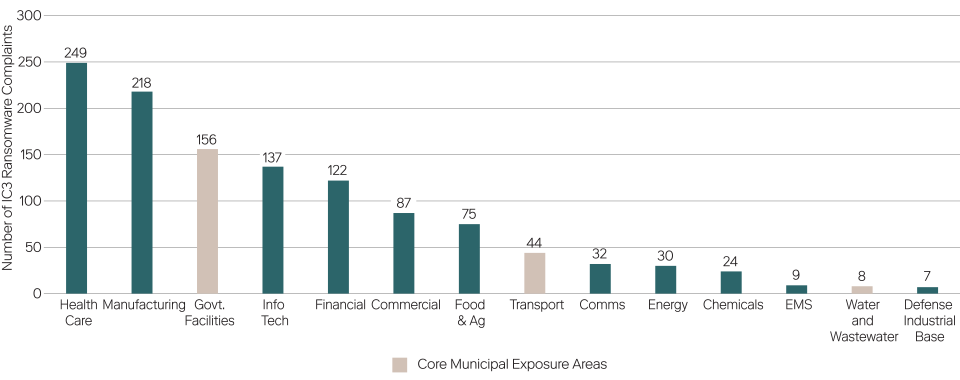
Source: FBI Internet Crime Complaint Center (IC3), 2023 Internet Crime Report. Chart recreated from IC3 sector counts; bars highlight muni-relevant sectors.
Recent federal guidance reinforces that this is not simply a backward-looking risk. In April, the Cybersecurity and Infrastructure Security Agency, the Federal Bureau of Investigation and the National Security Agency issued a joint advisory identifying local governments and municipalities as active targets of nation-state actors. Combined with the continued prevalence of ransomware across public sector and critical infrastructure organizations, this highlights the need to evaluate cyber resilience as an ongoing component of municipal credit analysis.
For investors, cyber risk should be viewed as a recurring credit consideration rather than an isolated headline event. Cyber incidents can impair service delivery, disrupt collections and payment systems, create unexpected recovery costs and, in some cases, affect liquidity management or access to capital markets, particularly for issuers that operate essential services or rely heavily on outside technology vendors.
Our approach is to treat cybersecurity as another measure of an issuer’s ability to manage risk. We do not view every cyber incident as a credit problem. Instead, we focus on the issuer’s preparedness, financial capacity, transparency and ability to maintain essential services.
Important considerations include reserve levels, insurance coverage, contingency planning, the quality of management response and the issuer’s dependence on outside vendors. We also consider whether the issuer has demonstrated a willingness to disclose material operational risks in a clear and timely manner.
Some sectors warrant closer review because they operate essential infrastructure or rely heavily on complex systems. Water and wastewater utilities, transportation systems, hospitals, higher education institutions and large local governments can face different types of cyber exposure. The credit implications depend on the role of technology in operations, the importance of uninterrupted service, and the issuer’s financial ability to respond.
This sector-specific analysis is consistent with our broader credit process. We place the greatest emphasis on issuers that have strong financial metrics, conservative debt profiles, reliable revenue sources, and management teams that show discipline in planning for both expected and unexpected risks.
Cybersecurity reinforces the importance of making selective, conservative investment choices in the municipal market. The strongest issuers are generally those with the financial resources, management discipline and operational planning needed to withstand disruption. In our view, this supports a continued focus on conservative credit selection and ongoing monitoring. As the risk environment changes, our credit work continues to evolve as well, with cyber risk remaining a core part of our analysis alongside the financial and governance factors that have long guided our investment decisions.
1 Source: Bloomberg. ICE BofA U.S. Municipal Securities Index.
2 Source: Lipper. Data as of June 30, 2026.
3 Source: Bloomberg. AA G.O. municipal yields as of June 30, 2026.
This material is provided for informational purposes only and nothing herein constitutes investment legal accounting or tax advice or a recommendation to buy sell or hold a security. This material is general in nature and is not directed to any category of investors and should not be regarded as individualized recommendation investment advice or a suggestion to engage in or refrain from any investment-related course of action. Neuberger is not providing this material in a fiduciary capacity, and has a financial interest in the sale of its products and services. Neuberger as well as its employees does not provide tax or legal advice. You should consult your accountant tax adviser and/or attorney for advice concerning your particular circumstances. Information is obtained from sources deemed reliable, but there is no representation or warranty as to its accuracy completeness or reliability. All information is current as of the date of this material and is subject to change without notice. Any views or opinions expressed may not reflect those of the firm as a whole. Neuberger products and services may not be available in all jurisdictions or to all client types. Investing entails risks including possible loss of principal. Investments in hedge funds and private equity are speculative and involve a higher degree of risk than more traditional investments. Investments in hedge funds and private equity are intended for sophisticated investors only. Indexes are unmanaged and are not available for direct investment. Past performance is no guarantee of future results.
Unless otherwise indicated, portfolio characteristics, including attribution, yield data, relative returns and risk statistics are shown gross of fees. The views expressed herein do not constitute a prediction or projection of future events or future market behavior. This material may include estimates, outlooks, projections and other “forward-looking statements.” Due to a variety of factors, actual events or market behavior may differ significantly from any views expressed.
Neuberger Berman Investment Advisers LLC is a registered investment adviser. The “Neuberger” name and logo are service marks of Neuberger Berman Group LLC.