NEWS AND INSIGHTS | MARKET COMMENTARY
Taking Stock of 2025
January 05, 2026

In our view, year-end is a prudent time to reassess long-term strategic allocations and portfolio diversification with potential risks on the horizon, with an emphasis on utilizing active management for security selection in 2026.
The new year can be a good time to pause and reflect on the past and to perhaps set a new course for the future. 2025 was another very strong year for financial markets despite bouts of volatility, reflecting an economic backdrop that held steady in the face of some challenges. Perhaps the most unexpected source of uncertainty last year was tariffs. In early April, President Donald Trump revealed his list of reciprocal trade tariffs, sending shockwaves through markets globally. This sparked a significant sell-off in global equities, with the S&P 500 falling over 10% in the subsequent two trading sessions and the Cboe Volatility Index (VIX) reaching its highest level since the onset of the COVID-19 pandemic.
Investors then experienced a second bout of volatility later in the year, reflecting a “risk-off” mood related to a lack of U.S. government data, more-hawkish-than-expected Federal Reserve (Fed) sentiment, and cooling of artificial intelligence-related optimism. At one point in November, the S&P 500 was down 5% from its peak, which marked the end of what was an exceptionally resilient equity rally with only a few shallow pullbacks of less than 3% since April’s tariff angst. In both instances of outsized volatility last year, markets experienced a quick recovery, with the S&P 500 index ultimately up nearly 18% in 2025.
In the face of volatility, we reminded clients of the importance of “staying the course” and adhering to long-term strategic asset allocation targets with diversification across asset class, region and style, which can help to buffer market swings. We also encouraged clients to continue to take advantage of market fluctuations to deploy cash in a thoughtful manner. This strategy paid off handsomely in 2025: For example, from the “market bottom” on April 8 to the end of the year, the S&P 500 was up over 38%. The Magnificent 7 stocks, as measured by the Roundhill Magnificent 7 ETF (ticker: MAGS), were up over 65% in the same period.
It has been a strong few years for financial markets, although equities have particularly benefited from the rise of AI-related tailwinds and monetary easing by central banks globally (the Fed cut interest rates three times in 2025 for a total of six cuts since the easing cycle began in September 2024, with the policy rate now at its lowest level in three years). The S&P 500 index finished higher for an eighth straight month in December and a third straight quarter, in part due to solid earnings growth, up 13.6% in the third quarter. The index is now up a cumulative 92% over the past five years (14% annualized), an impressive feat that has pushed investment portfolios higher, though not without some potential drift.
In fact, without rebalancing to long-term targets, a 60% equities/40% fixed income portfolio in 2020 would be closer to 77%/23% at the end of 2025 due to market appreciation. Given the uptick in equity exposure, we think it is prudent for investors to review current allocations and consider whether the level of risk is an appropriate reflection of investment goals.
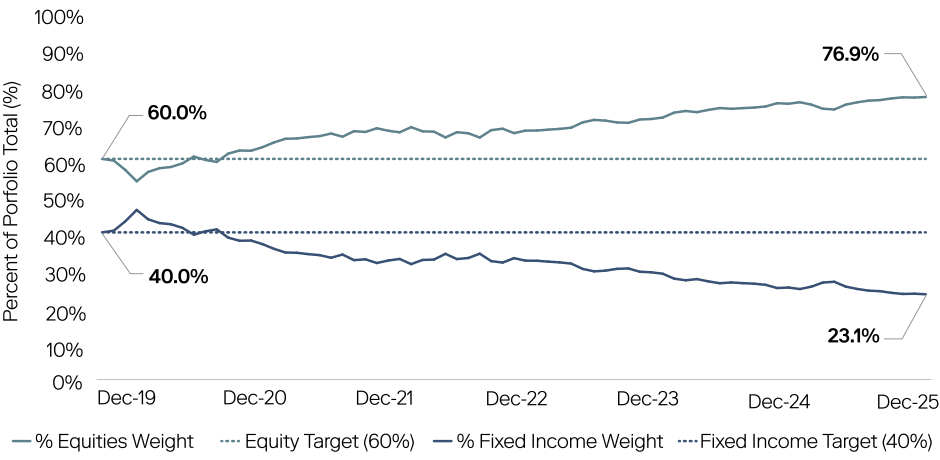
Source: Bloomberg. The latest value for the portfolio weights is as December 23rd, 2025. Equities are represented by the S&P 500 Index. Fixed Income is represented by the Bloomberg U.S. Aggregate Index.
Our Solving for 2026 market outlook lays out important considerations as we enter the new year, with artificial intelligence and the direction of fiscal and monetary policy remaining central themes that highlight the importance of diversification and active portfolio management. First, the Fed’s job will be complicated by an unusual mix: solid growth powered by productivity gains, but relatively weak hiring. Heavy investment in AI may boost output and growth but weigh on employment as automation pushes unemployment higher. For the Fed and other data‑dependent central banks, this could make the timing and scale of rate cuts uncertain, hinging on how labor markets, growth and inflation evolve.
Further, as the race for AI leadership heats up, its impact on inflation, jobs and markets should intensify, widening differences across economies and companies and prompting more policy action. The U.S. and China are leading AI development, backed by supportive rules, heavy private investment and rapid rollouts, but policy variation could create an opportunity set for investing in AI beyond these regions (and non-tech sectors) going forward.
Beyond the macro, we expect AI to affect both global equity and credit markets. Within equities, AI leadership is still concentrated within a few U.S. hyperscalers, but adoption is spreading, lifting productivity and profits across the S&P 500 and into traditional sectors like health care and financials. At the same time, froth is building in deals, capex plans and some valuations, with risks around free-cash-flow strain and power constraints for data centers; as a result, we believe investors should avoid broad AI exposure and instead focus on companies with sustainable, well-executed AI investment strategies.
Within credit markets, today’s tight credit spreads generally line up with the fundamentals, but the economy is shifting just as risk premiums are low. As AI and other forces create new winners and losers across industries, borrowers once seen as safe could come under pressure, highlighting the importance of security selection and quality considering rising idiosyncratic risk.
Finally, 2026 is a midterm election year, which has been historically challenging for stocks. The S&P 500 fell in both 2022 (Biden’s midterm election year) and 2018 (Trump’s first midterm election year). Going back to the 1920s, both average and median returns for the index during midterms have been lower than all other years in the election cycle. With the potential for more muted domestic equity returns, and after the recent strength seen within the U.S. stock market, it may be more important than ever to reassess whether portfolios are over-exposed to this area of the market.
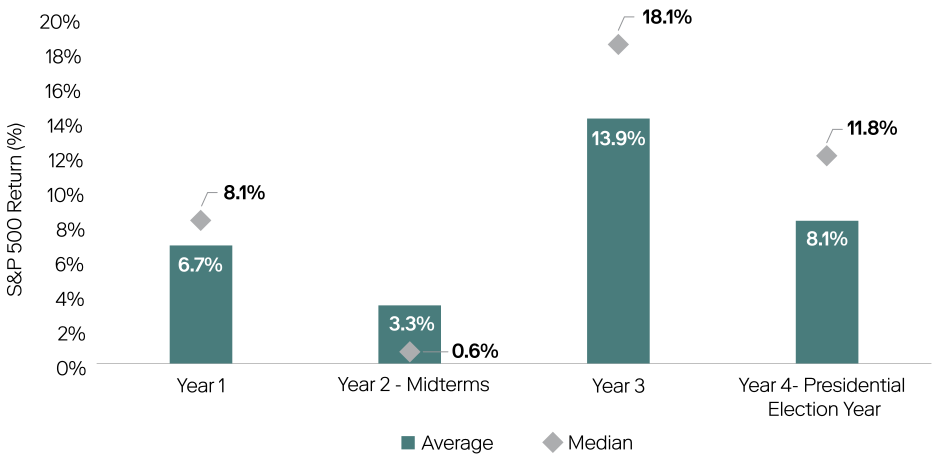
Source: Bloomberg, RBC Capital Markets U.S. Equity Strategy.
With AI accelerating “creative destruction,” pockets of froth in equity and credit markets, and a U.S. midterm election year adding political risk, broad, blanket exposure may look less appealing to investors. Instead, investors may want to focus both on diversification and allocating to active managers who can identify companies with durable, measurable returns on AI spending and balance sheets and free cash flow that can support high capex needs.
While there should be potential for tactical opportunities in the new year, we believe this is also a prudent time to review your long-term asset allocation (the mix of stocks bonds, and alternatives in your portfolio) to see if there are opportunities for rebalancing or as part of a general reassessment of your investment goals and objectives. Some relevant factors to consider include short- to medium-term liquidity needs, shifts in risk tolerance, potential portfolio drift and whether there are new opportunities to make investments that are more in line with your long-term goals.
Equities were flat to slightly higher in December with value outperforming growth. We maintain an overweight to small and midcaps on the expectation that these companies will continue to benefit from rate cuts, deregulation and pro-business policies. Developed non-U.S. equities should continue to benefit from the rotation as well, although there are opportunities to be more tactical on signs of economic divergence. Otherwise, we maintain an “at-target” view across equities. Admittedly, short-term political volatility may create some pressure. However, any larger pullbacks (10% or more) could be an appropriate trigger to add risk, especially for those holding excess cash. In this more challenging environment, we favor employing active management to select companies with high earnings visibility.
Fixed Income saw gains in high yield, emerging market debt and shorter duration securities during the month. While geopolitical and tariff risks persist, we maintain that the worst-case scenarios seem less likely, and that outcomes should not significantly affect credit markets. Further expected cuts of U.S. policy rates by the Fed should continue to boost performance of U.S. fixed income, but the One Big Beautiful Bill Act has added some uncertainty, as investors may continue to demand higher term premiums to compensate for the risk of holding long-term government bonds at a time when large federal deficits are creating uncertainty about future economic stability. Multi-sector bond funds may be an appropriate vehicle to consider, given the levers a manager can opportunistically pull across sector, duration profile and region.
With a fading liquidity drought and a recent pickup in mergers and acquisitions and other deal activity, we believe significant opportunities still exist within Private Markets, as investors should expect new buyout activity and an unlocking of distributions. That said, liquidity and capital solutions providers will likely remain important to work through the substantial backlog of legacy investments. As a result, we continue to see compelling opportunities across secondaries, midlife co-investments and capital solutions. We are cautious on core private real estate, but this is offset by what we see as abundant market-dislocation opportunities in the value-add and opportunistic sectors and, particularly, real estate secondaries. Neuberger’s deep relationships and unique position within the private equity ecosystem have translated into record levels of deal flow across our platform.
| Dec-25 | 3M | YTD | |
|---|---|---|---|
| Equities | |||
| Major U.S. Indices | |||
| S&P 500 Index | 0.1% | 2.7% | 17.9% |
| Nasdaq Composite | -0.5% | 2.7% | 21.1% |
| Dow Jones | 0.9% | 4.0% | 14.9% |
| U.S. Size Indices | |||
| Large Cap | 0.0% | 2.4% | 17.4% |
| Mid Cap | -0.3% | 0.2% | 10.6% |
| Small Cap | -0.6% | 2.2% | 12.8% |
| All Cap | 0.0% | 2.4% | 17.1% |
| U.S. Style Indices | |||
| All Cap Growth | -0.6% | 1.1% | 18.2% |
| All Cap Value | 0.7% | 3.8% | 15.7% |
| Global Equity Indices | |||
| ACWI | 1.0% | 3.3% | 22.3% |
| ACWI ex US | 3.0% | 5.1% | 32.4% |
| DM Non-U.S. Equities | 3.0% | 4.9% | 31.9% |
| EM Equities | 3.0% | 4.8% | 34.4% |
| Portfolios | |||
| 50/50 Portfolio | 0.1% | 2.1% | 11.1% |
| Dec-25 | 3M | YTD | |
|---|---|---|---|
| Fixed Income Currencies & Commodities | |||
| Major U.S. Indices | |||
| Cash | 0.3% | 1.0% | 4.4% |
| U.S. Aggregate | -0.1% | 1.1% | 7.3% |
| Munis | 0.1% | 1.6% | 4.2% |
| U.S. Corporates | |||
| Investment Grade | -0.2% | 0.8% | 7.8% |
| High Yield | 0.6% | 1.5% | 8.8% |
| Short Duration (1.9 Yrs) | 0.4% | 1.2% | 5.4% |
| Long Duration (12.8 Yrs) | -1.4% | 0.0% | 6.6% |
| Global Fixed Income Indices | |||
| Global Aggregate | 0.3% | 0.2% | 8.2% |
| EMD Corporates | 0.5% | 1.2% | 8.7% |
| Commodities | |||
| Commodities | -0.3% | 5.8% | 15.8% |
| U.S. Treasury Yields | |||
| U.S. 10-Year Yield | 0.2% | 0.0% | -0.4% |
| U.S. 2-Year Yield | 0.0% | -0.1% | -0.8% |
| FX | |||
| U.S. Dollar | -1.1% | 0.6% | -9.4% |
Source: Bloomberg, Total returns as of December 31, 2025. S&P 500 Index is represented by S&P 500 Total Return Index. Nasdaq Composite NASDAQ-Composite Total Return Index. Dow Jones is represented by Dow Jones Industrial Average TR. Large Cap is represented by Russell 1000 Total Return Index. Mid Cap is represented by Russell Midcap Index Total Return. Small Cap is represented by Russell 2000 Total Return Index. All Cap is represented by Russell 3000 Total Return Index. Large Cap Growth is represented by Russell 1000 Growth Total Return. Large Cap Value is represented by Russell 1000 Value Index Total Return. Small Cap Growth is represented by Russell 2000 Growth Total Return. Small Cap Value is represented by Russell 2000 Value Total Return. ACWI is represented by MSCI ACWI Net Total Return USD Index. ACWI ex US is represented by MSCI ACWI ex USA Net Total Return USD Index. DM Non-U.S. Equities is represented by MSCI Daily TR Gross EAFE USD. EM Equities is represented by MSCI Daily TR Gross EM USD. Cash is represented by FTSE 3 Month Treasury Bill Local Currency Index. U.S. Aggregate is represented by Bloomberg US Agg Total Return Value Unhedged USD. Munis are represented by Bloomberg Municipal Bond Index Total Return Index Value Unhedged USD. Munis Short Duration is represented by Bloomberg Municipal Bond: Muni Short (1-5) Total Return Unhedged USD. Munis Intermediate Duration is represented by Bloomberg Municipal Bond: Muni Intermediate (5-10) TR Unhedged USD. Investment Grade is represented by Bloomberg US Corporate Total Return Value Unhedged USD. High Yield is represented by Bloomberg US High Yield BB/B 2% Issuer Cap Total Return Index Value Unhedged USD. Short Duration is represented by Bloomberg US Agg 1-3 Year Total Return Value Unhedged USD. Long Duration is represented by Bloomberg US Agg 10+ Year Total Return Value Unhedged USD. Global Aggregate is represented by Bloomberg Global-Aggregate Total Return Index Value Unhedged USD. EMD Corporates is represented by J.P. Morgan Corporate EMBI Diversified Composite Index Level. EMD Sovereigns – USD is represented by J.P. Morgan EMBI Global Diversified Composite. Commodities are represented by Bloomberg Commodity Index Total Return. Commodities ex Energy is represented by Bloomberg Ex-Energy Subindex Total Return. U.S. 10-Year Yield is represented by US Generic Govt 10 Yr.
IMPORTANT INFORMATION:
This material is provided for informational and educational purposes only and nothing herein constitutes investment, legal, accounting or tax advice, or a recommendation to buy, sell or hold a security. This material is general in nature and is not directed to any category of investors and should not be regarded as individualized, a recommendation, investment advice or a suggestion to engage in or refrain from any investment-related course of action. Neither Neuberger Berman nor its employees provide tax or legal advice. All information is current as of the date of this material and is subject to change without notice. The firm, its employees and advisory accounts may hold positions of any companies discussed. Any views or opinions expressed may not reflect those of the firm as a whole. Neuberger Berman products and services may not be available in all jurisdictions or to all client types. Diversification does not guarantee profit or protect against loss in declining markets. Investments in private equity are speculative and involve a higher degree of risk than more traditional investments. Investments in private equity are intended for sophisticated investors only. Unless otherwise indicated, returns shown reflect reinvestment of dividends and distributions. Indexes are unmanaged and are not available for direct investment. Investing entails risks, including possible loss of principal. Past performance is no guarantee of future results.
Portfolio positioning views expressed herein are those of Neuberger Berman’s Private Wealth Investment Group which may include those of the Neuberger Berman’s Asset Allocation Committee. Asset allocation and positioning views are based on a hypothetical reference portfolio. The Private Wealth Investment Group analyzes market and economic indicators to develop asset allocation strategies. The Private Wealth Investment Group works in partnership with the Office of the CIO. The Private Wealth Investment Group also consults regularly with portfolio managers and investment officers across the firm. The Asset Allocation Committee is comprised of professionals across multiple disciplines, including equity and fixed income strategists and portfolio managers. The Asset Allocation Committee reviews and sets long-term asset allocation models, establishes preferred near-term tactical asset class allocations and, upon request, reviews asset allocations for large, diversified mandates. Asset Allocation Committee members are polled on asset classes and the positional views are representative of an Asset Allocation Committee consensus. The views of the Asset Allocation Committee and the Private Wealth Investment Group may not reflect the views of the firm as a whole and Neuberger Berman advisers and portfolio managers may take contrary positions to the views of the Asset Allocation Committee or the Private Wealth Investment Group. The Asset Allocation Committee and the Private Wealth Investment Group views do not constitute a prediction or projection of future events or future market behavior. Defensive positioning generally means an underweight bias on allocations to risk assets such as equities and alternatives. Positioning views may change over time without notice and actual client positioning may vary significantly. Discussion of yield characteristics or total returns of different asset classes are for illustrative purposes only. Such asset classes, such as equities and fixed income, may have significantly different overall risk-return characteristics which should be consider before investing.
The information in this material may contain projections, market outlooks or other forward-looking statements regarding future events, including economic, asset class and market outlooks or expectations, and is only current as of the date indicated. There is no assurance that such events, outlook and expectations will be achieved, and actual results may be significantly different than that shown here. The duration and characteristics of past market/economic cycles and market behavior, including any bull/bear markets, is no indication of the duration and characteristics of any current or future be market/economic cycles or behavior. Information on historical observations about asset or sub-asset classes is not intended to represent or predict future events. Historical trends do not imply, forecast or guarantee future results. Information is based on current views and market conditions, which will fluctuate and may be superseded by subsequent market events or for other reasons.
Discussions of any specific sectors and companies are for informational purposes only. This material is not intended as a formal research report and should not be relied upon as a basis for making an investment decision. The firm, its employees and advisory accounts may hold positions of any companies discussed. Nothing herein constitutes a recommendation to buy, sell or hold a security. It should not be assumed that any investments in securities, companies, sectors or markets identified and described were or will be profitable. Investment decisions and the appropriateness of this content should be made based on an investor's individual objectives and circumstances and in consultation with his or her advisors.
Neuberger Berman Investment Advisers LLC is a registered investment adviser.
The “Neuberger Berman” name and logo are registered service marks of Neuberger Berman Group LLC.